

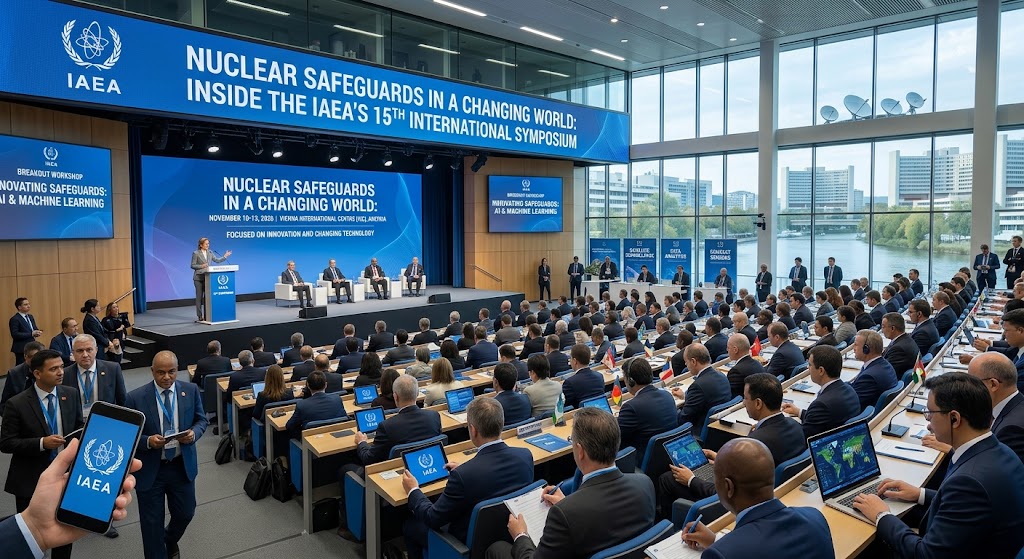
From 9 to 12 November, the International Atomic Energy Agency (IAEA) will host its 15th Symposium on International Safeguards at its headquarters in Vienna, Austria. The four-day meeting brings together specialists and stakeholders to consider how nuclear verification can respond to a world undergoing rapid change. Its theme, “Innovation and Resilience in a Changing World – Safeguards as a Shared Responsibility,” emphasizes both the evolving demands on safeguards and the need for sustained international cooperation.
Safeguards help provide assurance that nuclear material and activities are used for peaceful purposes, and their effectiveness depends on reliable methods, expertise and collaboration. The symposium is designed to support this work through scientific and technical exchange. Participants can present research, discuss practical challenges and explore developments relevant to verification, while drawing on experience from different institutions, disciplines and national contexts. This exchange helps connect technical advances with the operational and policy questions that shape safeguards implementation.
The expected scale reflects the breadth of interest in the subject: around 1,000 participants from more than 100 countries and 20 international organizations are anticipated. The programme is also expected to include approximately 300 scientific papers. Together, these contributions offer a wide-ranging view of current work, from research and technologies to approaches for strengthening resilience and maintaining effective verification. The gathering provides opportunities for experts to compare findings, identify shared concerns and build professional connections across borders.
Held every four years, the symposium is a recurring opportunity for the international community to assess progress and consider future priorities in nuclear safeguards. Its value lies not only in presenting new work, but also in renewing a shared commitment to effective safeguards and the cooperation that makes them possible. By bringing together technical specialists, policymakers and representatives of international organizations, the meeting encourages knowledge to move across disciplines and countries. That exchange can help the safeguards community adapt to changing conditions while preserving the confidence and consistency required for credible nuclear verification.
The symposium is scheduled to open on Monday, 9 November, at 14:00 CET, with an opening statement by Massimo Aparo, IAEA Deputy Director General and Head of the Department of Safeguards. His remarks are intended to set the context for the discussions ahead, placing the work of international nuclear verification within a global environment that continues to evolve. Participants will be invited to consider how changes in nuclear technologies, geopolitical conditions and the wider use of nuclear energy shape the demands placed on safeguards.
Aparo is also expected to review recent milestones in IAEA safeguards, outlining developments that have informed the Agency’s work and its ability to carry out verification responsibilities. Rather than presenting the symposium as a forum for settled answers, the opening is designed to frame questions about how safeguards can remain effective as circumstances change. The discussion will include the practical and institutional considerations involved in maintaining a system that is robust, adaptable and capable of responding to emerging challenges.
The opening statement will further emphasize the shared responsibility of the international community in sustaining a resilient safeguards system. Safeguards depend not only on the Agency’s technical and professional capacity, but also on cooperation, support and engagement among states and other stakeholders. Aparo is expected to provide an update on progress with the “Ideas for Action” introduced at the 2022 symposium, connecting those proposals to the current agenda without presuming that all have been completed. He is also scheduled to address the strategic direction of the Department of Safeguards, including how its priorities may guide future work. Together, these topics are intended to establish a common starting point for participants: assessing where safeguards stand, identifying areas that merit further attention, and considering how collective commitment can help the system remain credible and resilient in a changing world.
The symposium’s three keynote speakers bring complementary perspectives to the changing demands of nuclear safeguards. Their backgrounds span organizational leadership, nuclear policy and innovation, helping connect the technical work of safeguards with the institutions and international relationships that sustain it. Together, their talks are intended to broaden discussion beyond established methods and consider how organizations can respond to new pressures while maintaining trust, effectiveness and accountability. This range of expertise reflects a central premise of the meeting: safeguards depend not only on sound technical approaches, but also on people, resilient institutions and cooperation across borders.
Margaret Heffernan, former CEO and Professor of Practice at the University of Bath’s School of Management, brings experience in leadership and organizational resilience. Her perspective is relevant to questions about how institutions recognize change, learn from uncertainty and adapt without losing sight of their responsibilities. In a safeguards context, resilience can mean more than continuity during disruption. It also involves creating the organizational conditions for people to share information, raise concerns and apply new ideas. Her contribution can therefore help frame discussion of the human and managerial dimensions that support dependable safeguards systems.
Francesca Giovannini, Executive Director of the Project on Managing the Atom at Harvard Kennedy School’s Belfer Center, contributes expertise in nuclear policy and multilateral non-proliferation. Her work connects the safeguards conversation to the broader policy environment, where international commitments and cooperation shape how verification is understood and carried out. Roberto Verganti, Professor and Director of the Center for Art and Innovation at the Stockholm School of Economics and Visiting Lecturer at Harvard Business School, adds a perspective on innovation. His expertise invites consideration of how new ideas can emerge and gain practical value. Taken together, the keynotes link innovation with resilient organizations and international cooperation, encouraging participants to explore how all three can reinforce the future of safeguards.
The symposium’s closing plenary, scheduled for Thursday, 12 November, will bring its discussions to a close by looking both at individual experience and the shared work required to sustain effective nuclear safeguards. A fireside chat will feature Deputy Director General Aparo, who is expected to reflect on a career spanning four decades, including three decades working in the IAEA Department of Safeguards. This conversation will offer an opportunity to consider how the safeguards profession has developed over time and how experience gained across a long career can inform its future.
Rather than treating safeguards as the responsibility of a single institution or group, the closing session will also consider how different participants contribute to the system. A planned panel discussion will invite symposium participants to examine the roles and contributions of key stakeholders under the theme “Safeguards as a Shared Responsibility.” The discussion will provide a forum for considering how responsibilities are distributed, where cooperation is essential, and how distinct forms of expertise can reinforce one another. It will also connect the symposium’s technical and policy discussions to the practical relationships that support safeguards implementation.
The plenary’s focus on collective responsibility reflects the broad range of actors involved in maintaining confidence in safeguards. Governments establish and carry out commitments; international organizations support implementation and verification; technical experts contribute methods, analysis and specialized knowledge; and other participants can help strengthen cooperation and understanding. Their contributions are not interchangeable, but they can be complementary when supported by clear responsibilities and sustained engagement. The symposium aims to examine how these groups can contribute to the credibility and resilience of nuclear safeguards in a changing world. By pairing Aparo’s reflections on professional experience with a discussion of stakeholder roles, the closing plenary will frame safeguards as both a demanding technical undertaking and a continuing cooperative effort.