


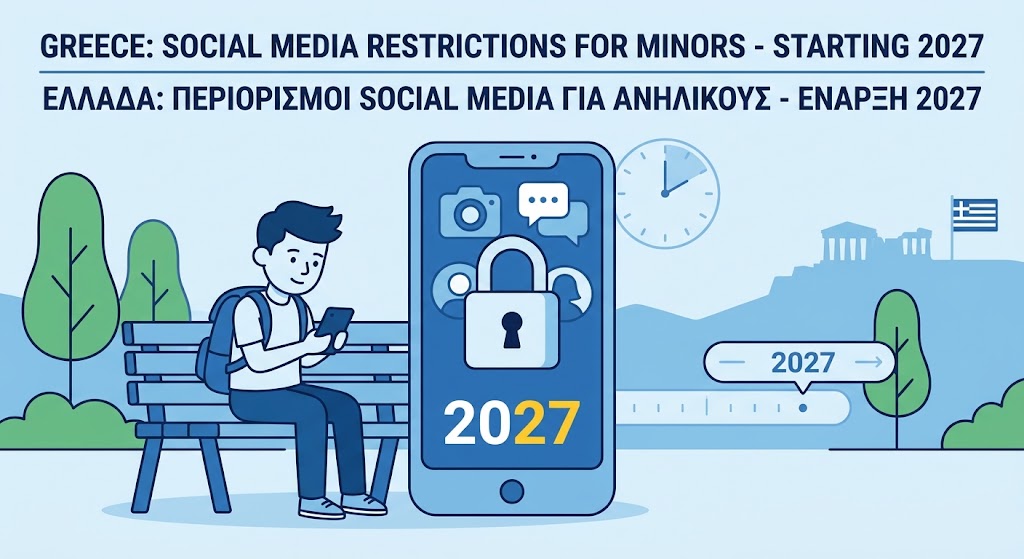
Greece’s parliament approved a bill that will restrict minors’ use of online social networking services from January 1, 2027. The measure passed by a majority vote during a plenary session held late Thursday, October 22. The decision sets the legislative direction and start date for the planned restrictions, while the voting record also showed differing positions among political parties. Approval by a majority means the bill passed the legislature; it does not mean that every party supported it, or that all members took the same position. The outcome and the parties’ stated voting stances are separate aspects of the parliamentary decision.
Ruling New Democracy supported the bill in principle. PASOK voted “present,” a position distinct from a vote in support or opposition. The parties voting against the measure were SYRIZA, Elliniki Lysi, the Communist Party of Greece (KKE), Niki, and Plevsi Eleftherias. These positions describe how the parties aligned during the vote, rather than changing the fact that the bill was approved by a majority in the plenary session. In particular, PASOK’s “present” vote should not be grouped with either affirmative support or the votes cast against the proposal.
The parliamentary result thus combines approval of the legislation with visible disagreement over it. New Democracy’s backing in principle contributed to the measure’s support, while the opposition parties listed above rejected it and PASOK did not register a vote for either side. The vote established the bill’s passage, with the restrictions scheduled to begin on January 1, 2027. Reporting the result accurately requires retaining both parts of the record: parliament approved the bill by majority vote, and parties expressed distinct positions during that process. The vote does not, by itself, establish additional details about implementation beyond the start date stated in the approved measure.
Digital Governance and Artificial Intelligence Minister Dimitris Papastergiou has defended Greece’s planned restrictions on social media access for minors as a necessary response to the risks associated with children’s uncontrolled internet use. He has argued that the measure is designed to protect young people and should not be understood as an excessive intervention. In his view, it is an effective and proportionate step, consistent with the country’s responsibility to safeguard children while digital platforms continue to shape their daily lives.
Papastergiou has also maintained that the legislation is compatible with European Union law. He has rejected the idea that Greece must wait for an ideal, fully developed EU-wide framework before taking action, saying that children are already experiencing the effects of unrestricted online activity. The minister’s position is that national measures can address an immediate concern while broader European rules are still being discussed or developed. Waiting for consensus across member states, he has suggested, could leave families and young users without a response during that process.
To explain why targeted restrictions may be justified, Papastergiou has compared the approach with rules governing the sale of alcohol and tobacco products. He said restrictions in those areas helped curb sales during the first few months after they were introduced, drawing on that experience to argue that regulation can influence access to products considered harmful to minors. His comparison presents the social media measure as a preventive policy rather than a claim that regulation can eliminate every risk. The minister’s comments describe the government’s rationale and expectations; they do not, by themselves, establish how the new restrictions will affect young people or platform use. The policy’s practical effects will depend on its implementation, compliance by services and families, and the way it operates alongside any future EU-level rules. By acting ahead of a comprehensive European framework, the government says it is responding to an immediate issue while remaining within the boundaries of EU law.
From January 1, 2027, the planned measure would require social media platforms to determine whether their accounts and services are intended for adults or for minors. The date is presented as the start of the requirement, rather than as evidence that the change is already in force. It places the responsibility on platforms to make this distinction about the services and accounts they offer, while the available description does not specify how that determination must be made.
The government has framed the bill as a response to concerns about children’s use of social media. In explaining its purpose, the minister pointed to excessive or uncontrolled use and the possibility of addiction, as well as potential harm to children’s mental health. These concerns are the stated rationale for the proposed measure; they do not, on their own, establish that every child experiences such effects or that all social media use is harmful.
The planned start date and the minister’s explanation provide the central points currently described about the measure. The policy is intended to address risks associated with minors’ engagement with social media by requiring platforms to consider whether their accounts and services are designed for adults or children. Further implementation details should not be assumed from that description: it does not set out technical methods, enforcement arrangements, or penalties. Accordingly, January 1, 2027, should be understood as the announced date from which the requirement is planned to apply, and the concerns about use, addiction, and mental health as the government’s stated reasons for introducing the bill.
Digital age checks are a central part of the approach described by Minister of Digital Governance Dimitris Papastergiou. He highlighted the Kids Wallet application as a practical means of indicating whether a user is above or below the age of 15. The system is intended to support the proposed restrictions while limiting the personal information that needs to be shared during verification. Papastergiou said the application follows European codes and technical specifications established the previous summer, presenting it as an approach aligned with technical standards developed at the European level.
According to the minister, Kids Wallet does not disclose personal data about children or other users to establish their age category. In particular, it provides an indication of whether someone is over or under 15 without sharing the person’s date of birth. That distinction is relevant to the design of age-verification tools: a platform or service can receive the limited information needed to apply an age threshold without being given a precise birth date. Papastergiou’s description therefore placed privacy safeguards alongside the objective of enforcing the proposed rules.
In his closing remarks, Papastergiou framed the measure as a response to a concern that society has been waiting to see addressed. He appealed for children to be protected while also being allowed to enjoy their childhood, linking the policy debate to the wider responsibilities of families, institutions and digital services. The emphasis was not only on checking ages, but on ensuring that safeguards serve children’s wellbeing. As Greece prepares to introduce social media restrictions for minors in 2027, the government’s account of Kids Wallet presents age verification as one component of that effort: a way to apply an age boundary while avoiding the disclosure of a child’s exact birth date or other personal details. The minister’s appeal underscored the balance at the heart of the proposal—responding to public concern and offering protection, while keeping children’s privacy and experience of childhood in view.