

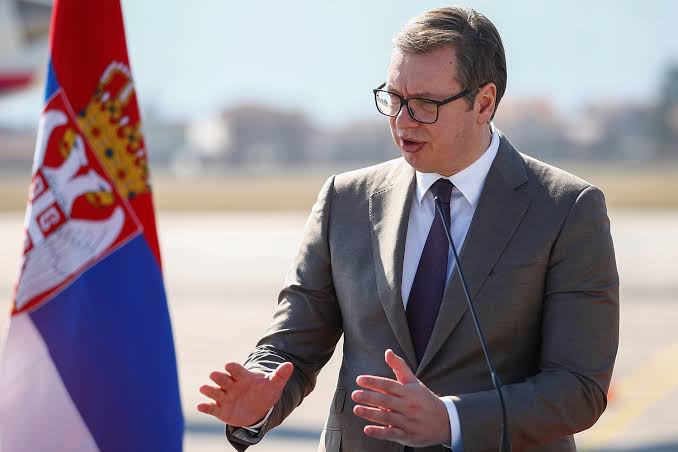
On 27 September 2026, Aleksandar Vučić is due to leave Serbia’s presidency after completing the second term that began on 31 May 2022. The departure marks a formal constitutional boundary: the two-term limit applies to the office of president. It does not, however, require him to withdraw from politics or prevent him from seeking a different elected office. His announcement that he intends to pursue the prime ministership in the parliamentary election scheduled for 25 October therefore places the distinction between constitutional office and political influence at the centre of the transition.
Vučić has been at the centre of Serbian politics for roughly a decade, first serving as prime minister and then as president. Supporters present this period as one of greater stability, economic development and international visibility. They point to extensive infrastructure construction, including new roads and railways, as evidence of a government able to deliver large projects. Belgrade Waterfront and preparations for Expo 2027 are also frequently cited as signs of investment and ambition, intended to reshape the capital and strengthen Serbia’s profile abroad.
Those accomplishments are part of a wider debate, rather than a complete assessment of his record. Questions about how political power has been exercised, the strength of institutions and the relationship between state authority and party leadership remain significant. Supporters’ emphasis on peace, stability and development sits alongside criticism and public concern about institutional independence and political competition. The end of a presidential term may therefore change the formal distribution of office without resolving disputes over the concentration, accountability or practical use of power.
The parliamentary election will test whether Vučić can convert his personal political standing into a new role at the head of government. If he becomes prime minister, the constitutional change of office could coexist with considerable continuity in leadership and influence. If he does not, the outcome may open more room for other figures and institutions to shape policy. In either case, leaving the presidency closes a formal chapter in his career, but it does not by itself settle how much influence he will retain, or how Serbia’s political system will evolve after the transition.
The collapse of the Novi Sad railway station canopy in November 2024, which killed 16 people, quickly became more than a test of engineering oversight. For many citizens, it raised urgent questions about how public projects are approved, inspected, and maintained—and whether officials would face consequences when decisions fail. Demonstrations grew into a broader civic mobilisation, drawing students and other groups into sustained calls for transparency and accountability.
Protesters connected the tragedy to concerns about corruption, opaque procurement, and inadequate supervision of major infrastructure projects. Their demands also encompassed media freedom and stronger, more independent institutions, reflecting a wider perception that oversight mechanisms were too weak to scrutinise those in power. The central issue was not only who bore responsibility for the station disaster, but whether public decisions could be investigated fairly and openly.
President Aleksandar Vučić and government allies, by contrast, have portrayed demonstrations as politically motivated and influenced by foreign actors. Vučić has also linked criticism to Serbia’s refusal to join sanctions against Russia, presenting the dispute within a wider contest over national sovereignty and stability. Such claims have sharpened the divide: supporters of the protests describe them as a demand for responsibility, while critics frame them as a threat to order and the country’s interests.
The confrontation unfolded alongside longstanding concerns raised by the European Commission about Serbia’s rule of law, electoral conditions, media pluralism, judicial independence, and progress in combating corruption. Questions about political pressure on the judiciary have further complicated confidence in investigations and prosecutions. Meanwhile, important OSCE/ODIHR recommendations on elections remain incompletely implemented, reinforcing calls for credible safeguards and fair competition.
These disputes have made institutional accountability a defining test of Serbia’s political future. Even if officeholders change, the credibility of any transition will depend on whether institutions can act independently, explain public decisions, and earn trust across political divides. Sustained polarisation and public distrust therefore shape not only the response to the tragedy, but also how legitimate and durable a post-Vučić transition may appear.
Vučić’s foreign policy has relied on keeping multiple relationships active. Serbia continues to pursue European Union membership while preserving close political and economic ties with Russia and China. Belgrade has declined to join EU sanctions against Moscow, presenting its position as protection of national interests and strategic autonomy. At the same time, it engages the United States, non-aligned partners, Arab states and Israel. Such diplomacy can widen investment options, energy and security contacts, and room for manoeuvre amid competing powers. Yet balancing becomes harder as international expectations sharpen and partners increasingly ask for clearer choices.
Kosovo remains the most immediate pressure point. Vučić has voiced concern over arrests of Serbs in Kosovo and defended the 2013 Brussels Agreement as a framework for protecting their rights and securing arrangements for Serb communities. The European Union, however, insists that Belgrade and Pristina continue dialogue and fully implement the Ohrid Agreement. These positions expose a persistent gap between Serbia’s emphasis on security guarantees and the EU’s focus on normalization through negotiated commitments. Arrests and unilateral measures can heighten mistrust, while stalled talks leave disputes unresolved and vulnerable to escalation.
In June 2026, European Council President António Costa identified good-neighbourly relations, alignment with EU foreign and security policy, and advances on rule of law, media freedom and electoral reform as priorities for Serbia. Accession therefore depends not only on diplomatic flexibility but on credible domestic reforms and consistent cooperation with the bloc. Progress on Kosovo can strengthen regional security and restore confidence in Serbia’s membership prospects; deadlock risks slowing accession and encouraging further instability. Any political transition will need to manage these obligations transparently, sustain dialogue and avoid presenting external alignment as a zero-sum choice. This requires institutions capable of delivering agreements and public debate that acknowledges both domestic concerns and European commitments.
Serbia’s post-Vučić transition will be judged not only by who holds office, but by whether leadership change can loosen the connection between state institutions and party politics. Credible elections are central: voters and political actors need confidence that competition is fair, administration impartial, and results accepted as legitimate. Student mobilisation, opposition activity, and civil society advocacy have made accountability and dialogue prominent issues. Protest alone, however, cannot resolve disputes; political leaders must establish channels for negotiation rather than deepen confrontation.
The European Union’s engagement continues to focus on rule of law, including judicial independence, anti-corruption measures, media freedom, and checks and balances. Progress in these areas matters both for citizens’ trust and for Serbia’s EU accession prospects. Yet negotiations on Chapter 23, which covers judiciary and fundamental rights, have seen no progress for more than four years. Belgrade also faces a strategic balancing challenge: sustaining its European path while maintaining close relations with Russia and China. The transition will test whether Serbia can pursue that course transparently and constructively, while preserving workable ties with the United States and other partners.
Assessments of Vučić’s legacy remain divided. Supporters cite modernisation, stability, and greater international standing; critics point to weak institutions, restricted media pluralism, shortcomings in elections, corruption concerns, and political pressure. Neither account alone constitutes a final verdict, and a fuller historical assessment will take time. The central measure of what comes next is whether Serbia can build trusted, autonomous institutions that function beyond any one leader’s influence. Such institutions should be capable of resolving political disputes peacefully, enabling fair competition, and sustaining constructive relations with the EU, United States, Russia, and China. They must also support regional dialogue, including efforts to reduce tensions with neighbours. If political change produces durable checks on power and confidence in public processes, it may create space for cooperation at home and abroad. If not, a change in leadership could leave the underlying sources of mistrust and confrontation intact.
Frequently Asked Questions
Appreciate it for all your efforts that you have put in this. very interesting info .


Appreciate it for all your efforts that you have put in this. very interesting info .