Gulf security debates often center on deterrence, military capability, and partnerships with external powers. These factors shape strategic calculations and remain important, but they do not capture the full pace of a crisis. After a vessel changes course unexpectedly, a collision occurs, or critical infrastructure is disrupted, the first hours—and sometimes minutes—can influence how governments interpret events. In that narrow window, incomplete information can carry consequences beyond the immediate incident. A movement that is accidental, routine, or poorly understood may appear deliberate when context is missing, particularly amid existing suspicion and heightened alertness. Uncertainty is therefore not merely a communications problem; it can become a driver of escalation.
Dependable communication between governments provides a practical way to narrow that gap. Timely contact can establish what has been observed, which details are confirmed, and what remains unknown. It can also allow officials to clarify intentions, explain operational activity, and correct mistaken accounts before they harden into public or institutional positions. This distinction between verified facts and assumptions matters because decision-makers often act under pressure, with limited time and incomplete visibility. A predictable process for sharing information and requesting clarification gives them a basis for measured choices, rather than forcing them to rely on inference, rumor, or worst-case interpretations during a fast-moving event.
Such procedures need not imply agreement on wider political questions, nor do they substitute for credible deterrence, capable forces, or established partnerships. States may continue to disagree over interests and threat assessments while maintaining channels for immediate incident management. Clear protocols can make deterrence more credible by reducing the risk that routine activity or an accident triggers an unintended confrontation. They also support regional resilience: authorities can coordinate responses, limit disruption, and preserve space for diplomacy when essential services or maritime movement are affected. Communication after detection is a practical security priority, not a concession. It helps ensure decisions follow evidence and that time remains available to choose a proportionate response.
The proposed Muscat Process would establish a gradual, regionally owned forum for dialogue among the Gulf Cooperation Council states, Iran, and Iraq, facilitated by Oman. Its purpose would not be to negotiate a comprehensive settlement at the outset, but to create dependable channels through which governments can discuss shared concerns and build cooperation over time. This approach draws inspiration from the Helsinki Process, where sustained consultations and confidence-building helped participants develop practical measures despite unresolved political differences.
The process could begin with consensus-based consultations, allowing participants to agree on priorities and working methods without requiring unanimity on every regional issue. Technical working groups could then address specific subjects, while annual ministerial meetings would review progress and guide future work. If participants consider it useful, they could establish a small secretariat in Muscat. Its role would be administrative and supportive: preserving continuity, maintaining contacts, arranging meetings, and tracking agreed actions. It would not prescribe a regional security order or impose obligations on participants.
Oman’s experience maintaining diplomatic relationships across regional divides provides a practical basis for its facilitator role. The country could convene discussions while leaving ownership and decisions with the participating states. An example of the value of this incremental approach is the July 2026 Oman–Iran discussions on navigation through the Strait of Hormuz, followed by an August ministerial discussion of a phased framework. The proposed elements included a temporary corridor, mine clearance, information sharing, traffic management, and consideration of longer-term arrangements. These are technical steps aimed at a concrete problem, not a substitute for broader diplomacy. Pursued with attention to international law, they could reduce risks to shipping and create habits of communication. A Muscat forum would offer a place to refine such measures, clarify responsibilities, and assess implementation, while allowing participants to proceed at a pace they accept.
A voluntary, non-binding maritime pilot offers a realistic first operational step for Gulf states to reduce the risk of incidents at sea escalating through confusion or delay. Rather than requiring agreement on disputes or a new institution, it would test practical habits among participating governments. Its limited scope is a strength: states could join without changing alliances, accepting new legal duties, or implying political alignment. The pilot should be a channel for timely communication, not a mechanism for adjudicating responsibility or constraining national decisions. Operational clarity can come before political trust, allowing officials to learn whether coordination works even when relations remain difficult.
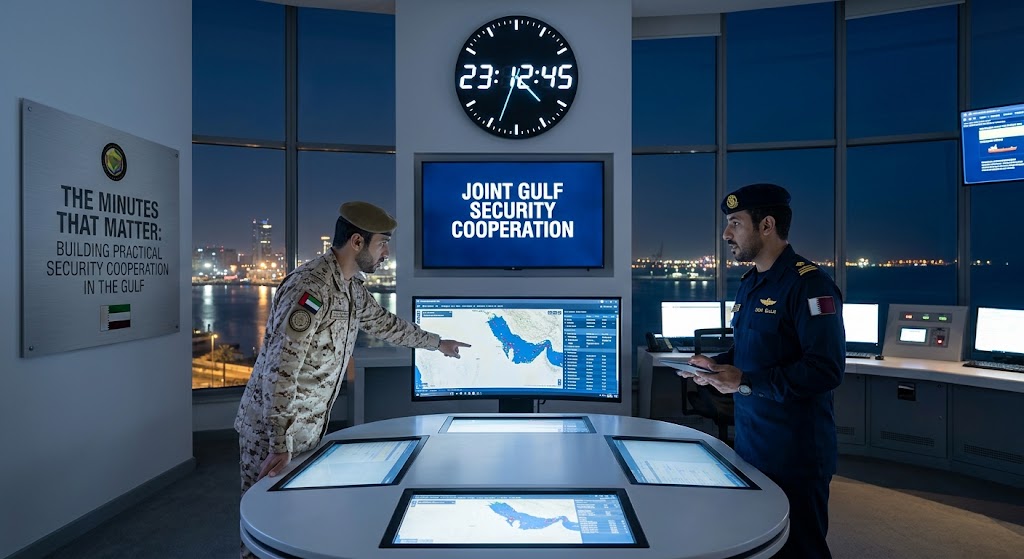
Three commitments could define the pilot. First, each participant would designate permanent points of contact, available around the clock and connected to relevant diplomatic and military authorities, so an urgent report reaches officials able to assess it. Second, participants would adopt simple procedures for notifying others of maritime incidents and acknowledging receipt, including agreed message formats and expected response times. Third, they would hold regular exercises to test contact channels, authenticate messages, rehearse escalation procedures, and practise responses when a primary channel fails. These arrangements need not disclose sensitive operational information; they establish dependable routes for communication and clear expectations after a message is sent. Oman could facilitate the pilot or relay communications when direct contacts are unavailable, offering an intermediary without making it the sole gateway.
The mechanism would preserve national sovereignty and remain consistent with each state’s obligations under international law. Participation would be voluntary, and the protocol would neither predetermine findings about an incident nor require action beyond existing commitments. Credibility should be measured through observable performance: whether messages are delivered, receipt is acknowledged promptly, and officials seek or provide clarification when details are incomplete. After exercises or real-world use, participants could review delays, failed contacts, authentication problems, and escalation decisions, then revise procedures to address weaknesses. Routine assessment turns a modest pilot into a usable confidence-building tool without making political agreement a precondition for cooperation.
A practical framework must remain useful when political relations deteriorate. Consensus can establish shared principles, communication protocols, and areas of common concern, without requiring governments to settle every regional dispute. Within that framework, voluntary technical projects allow willing participants to move ahead at a pace they can sustain. This approach preserves a basis for cooperation while recognizing that broader political disagreements may persist.
Ministers would set strategic direction and approve priorities, while national coordinators and technical groups translate decisions into procedures, exercises, and information-sharing arrangements. A small secretariat could organize activities, maintain contact lists, record commitments, and track follow-up. Confidential post-incident reviews would help participants identify gaps and improve practices without turning each event into a public confrontation. Annual ministerial assessments could then evaluate progress, adjust priorities, and keep the framework accountable.
The Black Sea Mine Countermeasures Task Group offers a bounded example of what defined tasks can achieve. Romania, Bulgaria, and Türkiye have developed practical cooperation around mine countermeasures; accounts of a July 2026 mandate expansion to include undersea infrastructure protection point to the potential for procedures, coordination, and regional capacity to grow from a focused mission. The Gulf’s political and security conditions differ, so this is not a template to import. Progress there would require its own patient diplomacy and carefully agreed scope.
Regional ownership is essential to legitimacy. The United States and European states may offer expertise, training, or technical support, but only in line with priorities set by Gulf participants. Europe has a direct interest in stability because energy security, maritime trade, and supply chains depend on dependable routes. The central strategic objective is to establish usable communication channels before a crisis. When decisions must be made quickly, accurate information and direct clarification can help contain confusion, correct mistaken assumptions, and reduce the risk that miscalculation escalates into confrontation.