


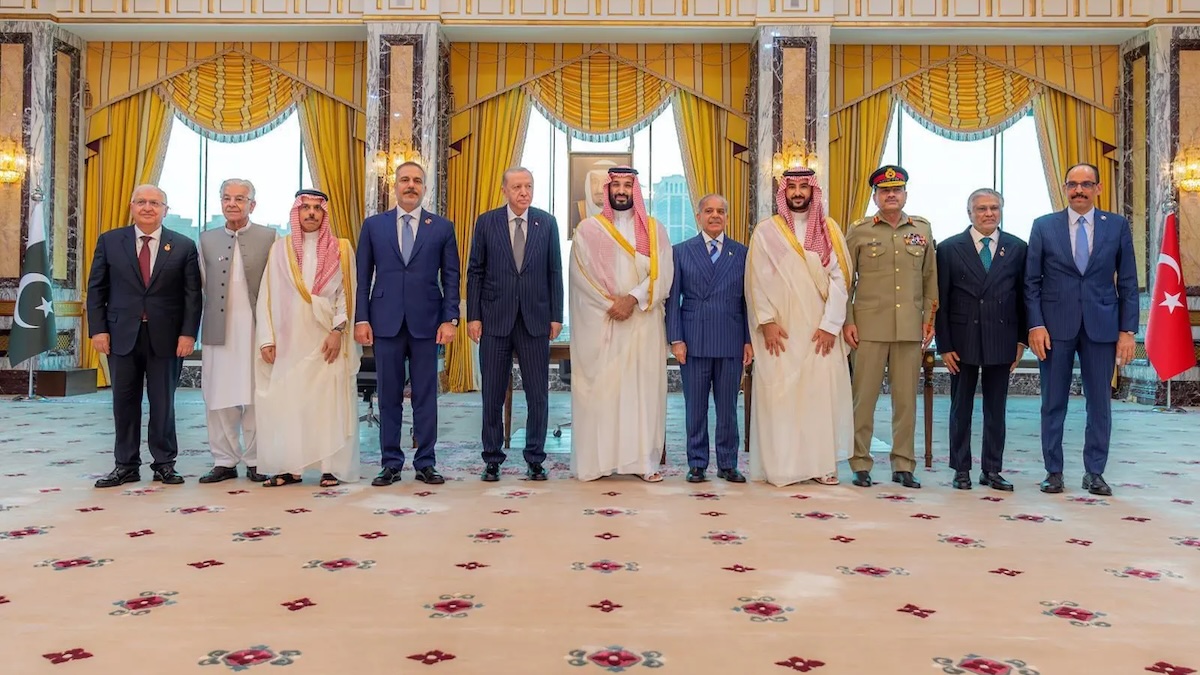
Introduction to the Makkah Agreement
The Makkah Agreement, officially signed on August 7, 2026, marks a significant development in the geopolitical landscape of the Middle East. This agreement was reached between three key Muslim countries: Saudi Arabia, Türkiye, and Pakistan. The location chosen for this crucial event—the holy city of Makkah—was not incidental; it holds deep significance within the Muslim world as a place of unity and spirituality. By convening in Makkah, these nations symbolically emphasized their commitment to collective security and mutual support, reinforcing their shared religious connections.
The Makkah Agreement comprises a collective defense pact, aimed at addressing the growing regional insecurities that have plagued the Middle East. The persistent threats posed by terrorism, sectarian conflicts, and geopolitical rivalries underscore the necessity for cooperation among Muslim nations. The alliance allows these countries to present a united front against common challenges, fostering stability in an increasingly volatile environment.
This strategic partnership emerges amid a backdrop of instability characterized by recent conflicts and the rising influence of extremist groups, which have exploited divisions within the region. Factors such as historical grievances, power struggles, and foreign interventions have further complicated the security dynamics. As such, the Makkah Agreement is viewed not merely as a diplomatic arrangement but as a proactive measure to enhance multilateral relationships among participating states and to promote peace across the region.
In light of the current landscape, the agreement serves as a critical foundation for both specific and broader security initiatives, potentially shaping the future interactions among Middle Eastern countries. Its implications resonate beyond the three signatories, potentially influencing policies and alliances on a wider scale. As the participating nations work together under this collective framework, they seek to navigate the complexities of regional security while adhering to shared values and objectives.
The Nature and Misconceptions of the Agreement
The Makkah Agreement, signed in 2017, represents a significant yet often misunderstood initiative aimed at fostering cooperation among Gulf Cooperation Council (GCC) states and their allies in response to rising security challenges in the Middle East. One prevalent misconception is the characterization of this agreement as an “Islamic NATO,” a term suggesting an organized military alliance akin to NATO’s collective defense structure.
However, upon examining the details of the Makkah Agreement, it becomes evident that such a comparison is inaccurate. Unlike NATO, the Makkah Agreement does not involve an integrated military command structure or predefined protocols for automatic intervention in defense of member states. Rather, it is a framework for cooperation that emphasizes coordination and dialogue among member states, which include several influential Arab nations. This distinction is crucial as it underscores the nature of the agreement, which is more about diplomatic engagement than military alignment.
Furthermore, the agreement does not seek to replace existing alliances. Instead, it aims to complement each country’s sovereignty while offering a platform for addressing common threats. The Makkah Agreement addresses issues like terrorism, regional instability, and other security challenges, but its approach relies heavily on collaboration rather than overt military action. In this regard, the pact serves to enhance collective security without creating a rigid military alliance.
In essence, the Makkah Agreement’s role in regional security dynamics is one of cohesion rather than conflict. By reframing how cooperation is perceived, it can be seen as a necessary step for many Middle Eastern nations to safeguard their interests while maintaining their independence and existing partnerships. Building a common front is essential for long-term stability, yet such cooperative frameworks must be understood within the context of the unique geopolitical landscape of the region.
Strategic Relationships Among the Signatory States
Before the establishment of the Makkah Agreement, the strategic relationships among Saudi Arabia, Türkiye, and Pakistan have been rooted in a shared history of cooperation in various domains, notably in defense and military training. Over the years, these nations have cultivated a multifaceted partnership that underscores their commitment to security and stability in the Middle East. Each of these countries possesses distinct strengths that contribute to a potentially robust collective defensive posture.
Saudi Arabia, as a leading regional power, has invested heavily in its military capabilities. Its advanced defense systems, coupled with substantial financial resources, allow it to play a pivotal role in regional security initiatives. With a focus on modernizing its armed forces, the Kingdom has sought to enhance its military readiness, fostering a role that often puts it at the forefront of multilateral coalitions aimed at addressing security threats.
On the other hand, Türkiye brings a unique geopolitical position and military prowess to the table. Its strategic location straddling Europe and Asia has granted Türkiye significant influence and the ability to act as a bridge in regional security matters. Furthermore, Türkiye has developed a diverse defense industry, producing various military resources that can be shared among the signatories, thereby strengthening cooperative defense strategies.
Pakistan, with its rich history of military engagement and partnerships, adds another layer of depth to this trilateral collaboration. Known for its strategic military training programs and robust defense technology sector, Pakistan has partnered with both Saudi Arabia and Türkiye in various defense initiatives over the years. The historical context of these relationships has often highlighted shared interests, particularly in counter-terrorism and military exercises.
Despite the strength of these relationships, challenges exist in realizing a cohesive defense framework. Variances in national priorities and strategic interests may pose obstacles to seamless collaboration. However, the potential for a unified approach towards maintaining regional stability and security continues to drive diplomatic efforts among these nations.
Implications of the Makkah Agreement on Regional and Global Security
The Makkah Agreement represents a significant development in the security landscape of the Middle East, with far-reaching implications not only for the region but also for major global powers like the United States, NATO, India, and China. This pact, which seeks to enhance cooperation among participating countries, highlights an evolving approach to security guarantees in response to changing geopolitical dynamics.
For the United States, the Makkah Agreement may signal a shift in reliance on traditional security arrangements, encouraging a reassessment of its military presence and involvement in the region. The U.S. has often been viewed as the primary guarantor of security in the Middle East, but the emergence of this agreement suggests a growing emphasis on regional self-sufficiency and a push towards strategic redundancy. This could lead to a more complex relationship between the U.S. and its allies in the region as they navigate their newfound autonomy.
NATO’s role in Middle Eastern security may also evolve as a result of the Makkah Agreement. The alliance has long been involved in various security initiatives across the region; however, this agreement may lead to increased pressure on NATO to adapt and contribute to new security frameworks that respect the agency of local powers. The implications could be profound, affecting NATO’s strategic priorities and operational focus in the Middle East.
Countries such as India and China are observing these developments closely. India’s historical ties and increasing engagement in the Middle East may prompt it to enhance its role in regional security dialogues, potentially leading to deeper partnerships. Conversely, China’s expanding interests in the region, particularly through its Belt and Road Initiative, could encourage it to position itself as a pivotal player in the evolving security architecture, thereby complicating traditional Western influence.
The potential for expanding membership in the Makkah Agreement raises questions regarding the future stability of the region. As more nations consider aligning themselves with the accord, the collaborative security framework could act as both a deterrent against aggression and a catalyst for addressing regional crises. The development signifies a gradual move away from unilateral security dynamics and towards multilateral cooperation, thereby reshaping the future of security in the Middle East.


