

Introduction to Li-Fi Technology
Li-Fi, short for Light Fidelity, represents an innovative leap in wireless communication technology by utilizing visible light for data transmission. Unlike traditional methods such as Wi-Fi, which depend on radio frequency signals, Li-Fi employs light waves emitted from LED lights, enabling a faster and more efficient means of transferring information. This shift not only enhances data transmission speeds but also addresses issues of spectrum congestion commonly faced in wireless communication systems.
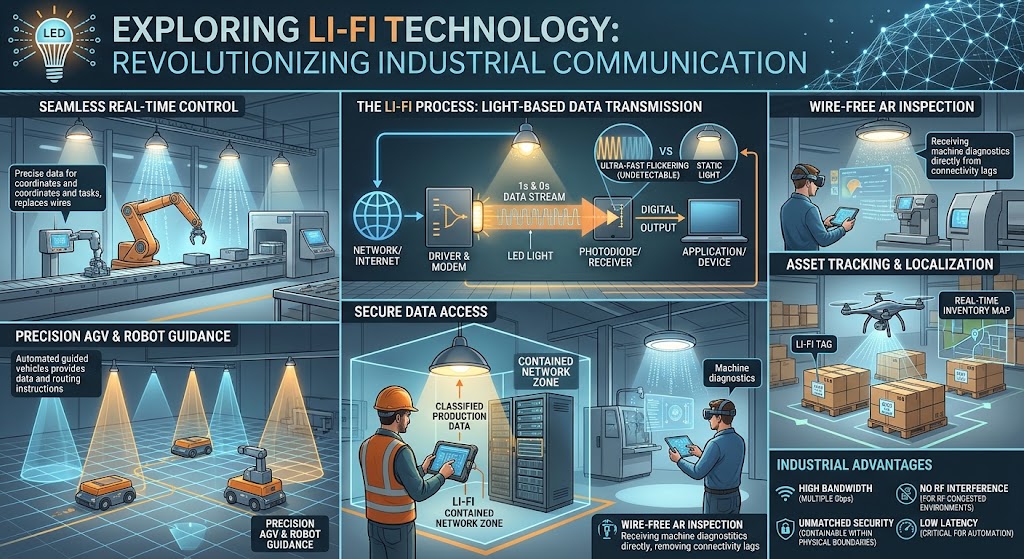
The fundamental principle behind Li-Fi revolves around the modulation of light intensity to encode data, allowing it to convey information at high speeds. When a light source, such as an LED lamp, is turned on and off at a speed faster than the human eye can perceive, it creates a data stream that can be received by photodetectors. This method of optical wireless communication can deliver data rates that far exceed those provided by current Wi-Fi standards.
One of the most significant advantages of Li-Fi technology within industrial environments is its potential to operate in environments where radio frequencies may interfere with equipment or pose safety concerns. The use of light as the transmission medium allows for operation in sensitive areas, such as hospitals and chemical plants, without the risk of electromagnetic interference. Additionally, Li-Fi can provide enhanced security as it is confined to line-of-sight communication, preventing unauthorized access from outside the illumination zone.
Furthermore, Li-Fi’s efficiency contributes to energy savings and improved operational capabilities in manufacturing and logistics sectors. Given these benefits, Li-Fi technology is emerging as a transformative solution for industries looking to enhance their communication systems and overall productivity.
Fraunhofer IPMS and the Development of Li-Fi Grathus
The Fraunhofer Institute for Photonic Microsystems (IPMS) plays a pivotal role in the evolution of Li-Fi technology, particularly through the innovative product known as Li-Fi Grathus. This system is a direct response to the growing need for high-speed wireless communication in industrial environments, where traditional radio frequency (RF) communication methods often encounter limitations such as interference and bandwidth constraints.
Li-Fi Grathus leverages light as a medium for data transmission, utilizing visible, ultraviolet, and infrared light to achieve unprecedented data rates. The design of Li-Fi Grathus focuses on modularity and versatility, enabling seamless integration into various industrial settings, from manufacturing floors to logistics hubs. Its unique features include highly efficient modulation techniques that allow multiple data streams to be transmitted simultaneously, ensuring robustness and reliability even in complex environments.
One of the primary objectives of Li-Fi Grathus is to enhance communication capabilities in areas where RF communication is impractical or undesirable. For instance, in environments sensitive to electromagnetic interference, such as hospitals or aircraft, Li-Fi technology offers a solution that eliminates the risks associated with RF signals. Furthermore, the system is designed to work in conjunction with existing infrastructures, facilitating a smooth transition for industries looking to adopt cutting-edge communication technologies.
The potential applications of Li-Fi Grathus extend beyond traditional communication. In smart factories, for example, Li-Fi can be employed to connect automated systems and devices in real-time, significantly improving operational efficiency and data integrity. Additionally, its ability to provide secure communication channels in restricted environments makes it an ideal candidate for mission-critical industrial scenarios.
Through the development of Li-Fi Grathus, Fraunhofer IPMS is setting a new standard for industrial communication, illustrating the transformative potential of Li-Fi technology in modern industry.
Advantages of Li-Fi Over Traditional Communication Systems
In recent years, industries have increasingly relied on traditional communication systems such as radio frequency (RF) methods for data transmission. However, these conventional technologies expose several limitations, particularly within industrial settings. One major challenge is the susceptibility to interference, where RF signals can be disrupted by physical obstacles or electromagnetic interference. This poses significant challenges in environments filled with machinery and equipment, where reliable communication is essential.
In contrast, Li-Fi technology utilizes visible light spectrum for communication, offering a superior alternative to RF methods. By leveraging existing lighting infrastructure, Li-Fi can transmit data at unprecedented speeds, achieving gigabit-speed communication in real-time. This development enables the transmission of large amounts of data rapidly, which is crucial in industrial applications that demand instant feedback and control.
Moreover, the inherent wireless nature of Li-Fi facilitates greater flexibility. Unlike RF systems that require extensive cabling and can be hampered by physical obstructions, Li-Fi’s use of light can easily penetrate and adapt to various industrial layouts. The ability to create dynamic communication setups without the need for rewiring or extensive infrastructure modifications is a notable advantage for industries seeking agility in their operations.
An additional benefit of Li-Fi lies in its enhanced security features. RF signals can be intercepted from considerable distances, posing risks to sensitive information. In contrast, Li-Fi operates within a confined space, as light signals cannot penetrate opaque barriers. This characteristic makes Li-Fi highly suitable for secure data transmission in settings where confidentiality is paramount.
Overall, the advantages of Li-Fi technology in comparison to traditional RF communication systems underscore its potential to revolutionize data exchange within industrial environments, offering speed, flexibility, and security.
Future Implications of Li-Fi in Industrial Communication
The future implications of Li-Fi technology in industrial communication are both promising and multifaceted. As organizations increasingly seek to enhance communication speed and security, Li-Fi stands out as a transformative solution. Utilizing light waves for data transmission, this technology offers several advantages over traditional wireless systems, particularly in environments where radio frequency interference is problematic.
One of the primary considerations for the future of Li-Fi in industrial settings is its scalability. As industries expand and diversify, so too must the communication systems that support them. Li-Fi networks can be easily scaled by adding more light sources, thereby enabling more devices to connect seamlessly. This flexibility allows manufacturers to adapt their communication needs without the extensive infrastructure overhaul often required by conventional wireless technology.
Integration with existing infrastructure is another crucial factor that will determine the success of Li-Fi. Many industries already have extensive lighting systems in place; upgrading these to support Li-Fi could be a cost-effective solution that minimizes disruption. By utilizing existing LED fixtures, businesses can achieve efficient data transmission without significant infrastructural changes.
Anticipated advancements in Li-Fi technology will further enhance its viability in industrial communication. Ongoing research is exploring new modulation techniques and signal processing methods that could exponentially increase data rates and improve reliability. Additionally, as the Internet of Things (IoT) expands, the role of Li-Fi will likely grow, providing real-time communication for interconnected devices.
In conclusion, as Li-Fi technology evolves, its impact on the industrial sector could be profound. Enhanced efficiency, improved communication reliability, and innovative applications are all potential outcomes of integrating Li-Fi into industrial communication systems, paving the way for a new era of industrial connectivity.