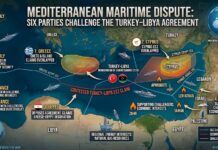

Greek Foreign Minister George Gerapetritis delivered a joint statement at the United Nations on behalf of Greece, Egypt, Cyprus, Bahrain, the United Arab Emirates and the European Union. The statement followed the Libyan House of Representatives’ decision to ratify the 2019 memorandum of understanding between Turkey and Libya on the delimitation of maritime areas in the Mediterranean. The six parties said the move raised serious concerns about regional security and stability, and reiterated their objections to the agreement.
The signatories challenged the memorandum’s legal basis and its consequences for other states. They argued that it could not create obligations for countries that were not party to it, nor could it prejudice their rights under international law. In their view, the agreement’s proposed maritime boundaries disregarded the geography of the eastern Mediterranean and the rights of states with relevant coastlines. They also maintained that maritime delimitation should be reached through agreement among the states concerned, in accordance with applicable international law.
The statement further objected that the memorandum was inconsistent with the principles and rules of the United Nations Convention on the Law of the Sea, which the parties regarded as the framework governing maritime entitlements and boundary delimitation. The signatories emphasized that an agreement between Turkey and Libya could not, by itself, settle claims involving third countries or override their lawful maritime rights. They called for disputes to be addressed peacefully and through dialogue, rather than through unilateral measures that could heighten tensions.
By presenting these objections collectively at the UN, the six parties signaled that they viewed the ratification as a matter extending beyond bilateral relations between Ankara and Tripoli. Their statement linked the legal status of the memorandum to broader questions of stability, cooperation and respect for international law in the Mediterranean. It also restated their position that any maritime arrangement must account for the rights and interests of affected states and be pursued through an inclusive, rules-based process. The joint intervention underscored continuing opposition to the 2019 accord and concern that its implementation could complicate efforts to manage regional disputes peacefully.
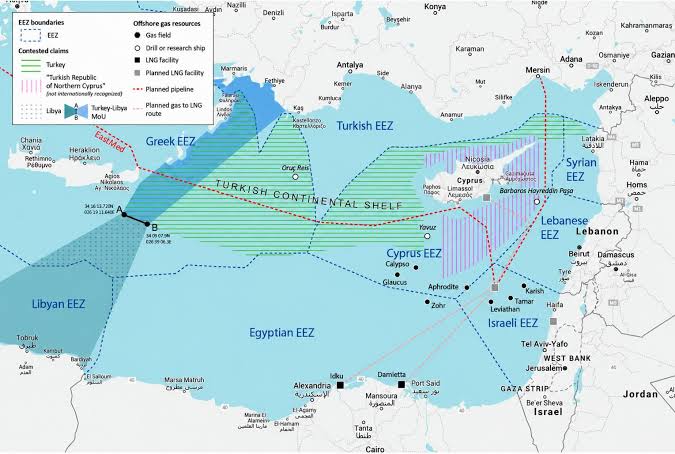
The six signatories reject the 2019 Turkey–Libya maritime memorandum as null and void, arguing that it is contrary to international law and cannot establish a lawful boundary between the two countries. In their view, the agreement does not satisfy the legal requirements for delimiting maritime zones where the rights of other coastal states are affected. They therefore deny that it can serve as a valid basis for claims over areas of the Mediterranean Sea or alter the maritime entitlements recognized under applicable international rules.
A central concern is that the memorandum draws a proposed maritime line without adequately accounting for the region’s geography. The signatories maintain that the arrangement disregards the presence and position of other coastal states, as well as their rights to maritime zones. They emphasize that islands cannot simply be excluded from consideration when maritime boundaries are assessed. Under the United Nations Convention on the Law of the Sea (UNCLOS), islands may generate maritime entitlements, subject to the convention’s provisions and the circumstances of a particular delimitation. In the signatories’ assessment, a bilateral agreement cannot lawfully settle questions involving third parties or extinguish rights those parties hold under international law.
The statement also distinguishes between an agreement’s domestic approval and its international legal effect. Libya’s parliament ratified the memorandum, but the signatories say that this step does not change their position on its status. Ratification may reflect a process within Libya, yet it cannot, in their view, make the memorandum binding on states that did not consent to it, nor cure the objections they raise about its consistency with international law. Accordingly, they continue to regard the document as incapable of producing legal effects for third states or providing a lawful foundation for maritime delimitation. Their objection is not presented as a rejection of every bilateral arrangement; rather, it rests on the claim that any delimitation must respect geography, the rights of all relevant coastal states, and the framework established by UNCLOS.
The six signatories framed their objections to the Turkey–Libya maritime agreement within the broader rules governing the delimitation of maritime boundaries. They emphasized the United Nations Convention on the Law of the Sea (UNCLOS), alongside customary international law, as the applicable framework for assessing how states’ maritime entitlements should be reconciled. In their statement, these rules were not presented as optional guidance, but as a shared basis for dealing with overlapping claims and reaching arrangements consistent with international law.
The signatories argued that adherence to established legal principles helps make maritime delimitation more predictable. When states use common rules and recognized methods, they said, governments and other affected parties can better understand the basis of boundary claims and assess their potential consequences. That predictability, in turn, supports legal certainty: states can plan and conduct activities with a clearer understanding of the rights and obligations at stake. The statement linked those benefits to stable relations between neighboring countries, particularly where competing maritime claims might otherwise become sources of tension.
Greek Foreign Minister George Gerapetritis warned that accepting bilateral agreements that disregard applicable legal principles could have consequences beyond the parties to any single arrangement. As the signatories presented it, such acceptance might encourage other states to rely on similar agreements, even where the relevant rules or the interests of third parties had not been properly considered. They voiced concern that this could weaken the authority and consistency of the international legal order, rather than resolve disputes through shared standards.
Gerapetritis also connected that risk to peaceful dispute resolution. The signatories’ stated position was that a rules-based approach gives states a common reference point for negotiation and other peaceful processes. If agreements made outside that framework were treated as acceptable precedents, they argued, confidence in established procedures could diminish and disputes could become harder to manage. These remarks describe the signatories’ concerns about the agreement’s broader implications; they are not, by themselves, an independent legal ruling on its validity. Their central point was that consistent respect for UNCLOS and customary international law helps preserve legal certainty and supports peaceful relations among states.
The joint statement places Libya’s future at the center of its appeal, expressing support for the reunification of the country’s institutions and for the emergence of a united, prosperous, and stable state. It presents institutional unity not only as a domestic objective but also as a condition for Libya to participate constructively in regional cooperation. In this framing, a stable Libya can contribute to shared interests across the Mediterranean, while fragmentation risks complicating both internal governance and relations with neighboring countries.
The signatories also link Libya’s political transition to respect for international law and the principles of good-neighborly relations. Their position is that decisions affecting Libya’s political path, as well as its interactions with surrounding states, should be conducted consistently with those standards. The statement therefore connects the country’s long-term stability with a rules-based approach to regional affairs. It calls for engagement that recognizes international legal obligations and supports cooperative relations, rather than arrangements that could increase tension among Mediterranean partners.
Against this broader context, the statement addresses Greece–Libya discussions on maritime delimitation. It says Greece has pursued these discussions in good faith and in accordance with international law, and remains willing to continue them. The reference underscores that the parties have an available diplomatic channel for addressing maritime questions through dialogue and legal principles. It also situates the bilateral talks within the wider concern for regional stability, rather than treating them as an isolated disagreement. In his closing argument, Foreign Minister George Gerapetritis emphasized that respect for international law is essential to stability in the Mediterranean. Taken together, the statement’s support for Libyan unity, its emphasis on good-neighborly relations, and its endorsement of continued Greece–Libya dialogue point to a common principle: durable regional cooperation depends on legal norms being respected and disputes being addressed peacefully.