
Some events are first described as too complex to explain, or too politically charged to name plainly. Yet what is difficult to interpret does not remain beyond scrutiny. Over time, evidence accumulates, testimony travels, and consequences become visible in ways that make avoidance harder. The inexplicable can become impossible to ignore, not because uncertainty has vanished, but because the cost of looking away grows. Language matters at this threshold: the words used to describe events can clarify responsibility and harm, or blur them behind abstraction. To examine those words is not to settle every dispute; it is to ask what public speech makes visible and what it leaves out.
For three years, Israeli military operations in Gaza have unfolded amid extensive destruction, displacement, restrictions, and profound loss of life. Homes and essential infrastructure have been damaged or destroyed, while repeated upheaval has reshaped daily life for civilians. The scale of harm, alongside realities of occupation, makes this more than a distant political argument. It is a human emergency whose effects are measured not only in casualty figures, but in lost homes, interrupted care and education, separation of families, and uncertainty about what comes next. These conditions prompt a closer examination of what has happened on the ground and how observers beyond Gaza have interpreted, described, or contested it.
This examination considers both the material realities of the war and the frameworks through which the wider world has understood them. Its subject is language: labels, descriptions, and silences that influence how suffering and responsibility are recognized. Language is only one part of a broader inquiry. That inquiry also asks what value is assigned to human lives, whose losses receive attention, and what conditions enable violence to continue. Looking closely at words cannot replace evidence or restore what has been lost. It can, however, reveal assumptions that shape public understanding and the possibilities for response.
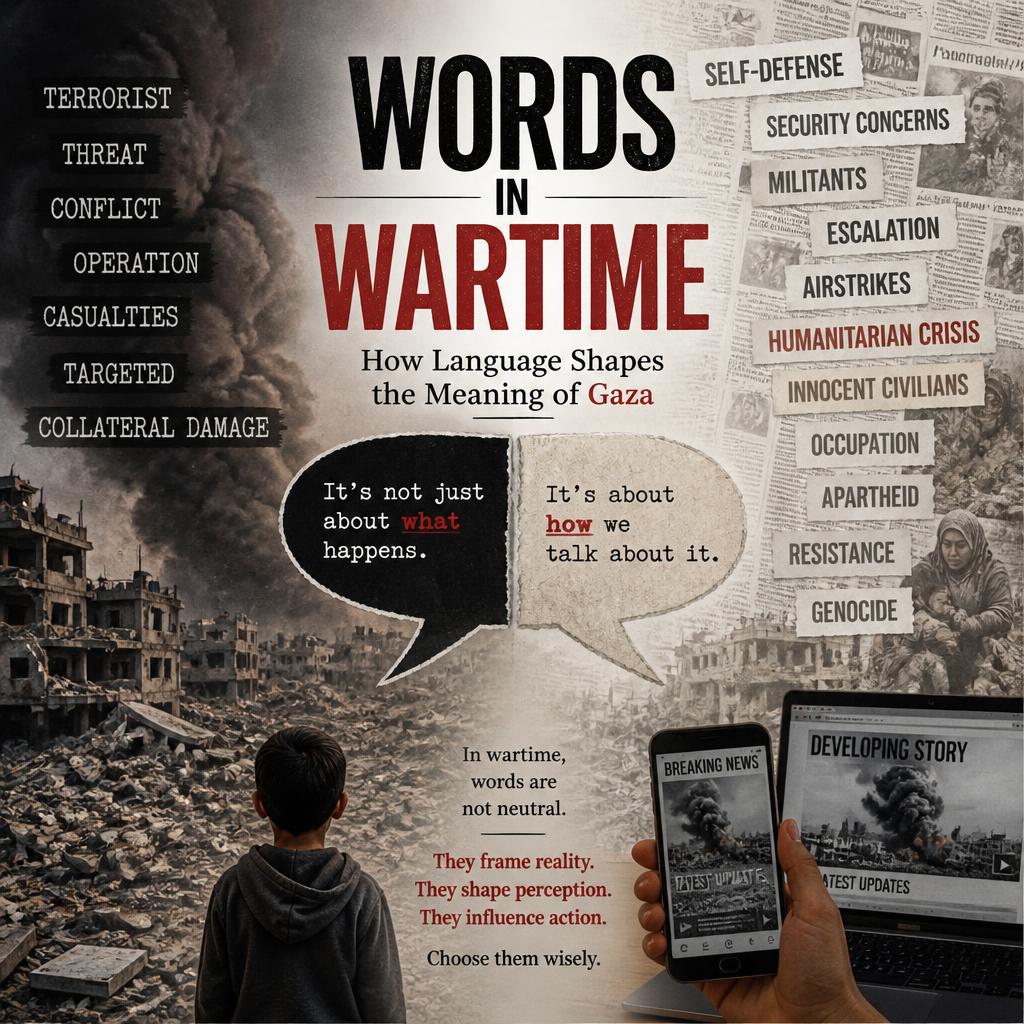
Names do more than identify events; they organize how those events are understood. Calling an episode a military campaign can foreground strategy and stated objectives, while describing it as an invasion may emphasize the crossing of borders and the use of force. The word occupation directs attention to control over territory and the lives of people subject to that control. Massacre signals the killing of civilians on a large scale, whereas security operation presents action through the framework of threat and protection. These terms are not interchangeable, and choosing among them can shape which questions readers ask first.
Such choices appear across official statements, news reports, and political speech. Governments may favor descriptions that explain or justify their actions; armed groups and their supporters may use language that stresses resistance, defense, or victimhood. Journalists must decide whether to adopt those formulations, place them in quotation marks, or provide context and independent evidence. Repeated phrases can become familiar enough to seem neutral, even when they carry assumptions about responsibility, legitimacy, or whose experiences deserve attention. Consistency in terminology can aid comprehension, but it does not remove the need to examine what a term includes and what it leaves unspecified.
Careful reporting therefore distinguishes description from attribution. A report can state who used a label, what evidence supports it, and whether relevant institutions or observers dispute its application. It can also identify the people and conditions made less visible by abstract language: civilian deaths, displacement, restrictions on movement, or the stated security concerns of those involved. Precision does not require false equivalence, nor does it mean treating every claim as equally credible. It requires clarity about evidence and uncertainty. Language cannot substitute for events on the ground, but it helps audiences recognize, judge, and remember them. The words chosen in wartime thus influence public understanding without determining it entirely.
An account of Gaza begins with a record of ascertainable events: dates, locations, military actions, civilian casualties, damage to infrastructure, and displacement. This documentation is indispensable. It establishes what happened, where, and when, giving investigators and readers a basis for comparing claims. Records may draw on testimony, official statements, photographs, medical data, and independent reporting. Each source has limits, so corroboration and careful attribution matter. Yet a detailed chronology is not the whole of history. A list of events cannot explain how they were understood, which relationships were emphasized, or why some actions were treated as decisive while others receded from view.
This is the difference between a superficial history, concerned with verifiable particulars, and a deep history, which examines the interpretations through which those particulars acquire meaning. The distinction does not make facts secondary or optional. Rather, it recognizes that facts are selected, arranged, named, and connected within accounts. A report may describe an attack, for example, while its choice of context, terminology, and sources shapes how readers understand responsibility and consequence. Different accounts can use some of the same evidence yet draw contrasting conclusions. Assessing them requires attention both to what can be established and to the reasoning that links evidence to interpretation.
Public knowledge is also shaped by what accounts leave out or make difficult to see. Euphemisms can soften descriptions of violence; repetition can make particular claims seem familiar or authoritative; censorship, restricted access, and the omission of testimony can narrow the available record. These effects do not prove that any single competing account holds the truth outright. They do, however, raise questions about who can publish claims, which sources receive credibility, and what evidence is challenged or excluded. Examining language in wartime therefore means asking not only whether statements are accurate, but also how power influences the terms of debate. The stakes lie in how records and interpretations together shape what audiences can know and remember.
The struggle over language in Gaza reaches beyond the immediate conflict. Descriptions of an event do not merely record it; they organize attention, assign agency, and establish which harms appear urgent or ordinary. A term can foreground a victim, soften responsibility, or place an action within a familiar category that seems to require little further question. In this sense, public language becomes part of how a society encounters reality, rather than a neutral covering for it.
These events and the words attached to them may therefore be read as a moment of truth for the world. The test is not simply whether governments or institutions state principles of human rights, civilian protection, and accountability, but whether they apply them consistently when political alliances or public sympathies complicate judgment. It is also a test of whose grief receives sustained attention, whose deaths are counted as individual losses, and whose lives become abstractions.
Terminology matters because familiar phrasing can make some forms of violence seem unavoidable, defensive, or beyond scrutiny, while other harms are presented as exceptional and unmistakable. This does not mean that every description is equally accurate, or that careful distinctions should be abandoned. Precision remains essential: claims require evidence, context, and correction when they are wrong. Yet factual accuracy alone cannot settle the question of what a statement does. Its chosen emphasis, omissions, and repetitions can shape the limits of public concern, and influence what audiences are prepared to dismiss, tolerate, or defend.
That scrutiny connects the contest over words with larger questions about language, life, and labor: how people describe human worth, whose work and vulnerability remain visible, and which lives receive protection. Readers must ask not only whether a statement is factually sound, but what its framing permits them to see, dismiss, or defend in public debate today.