


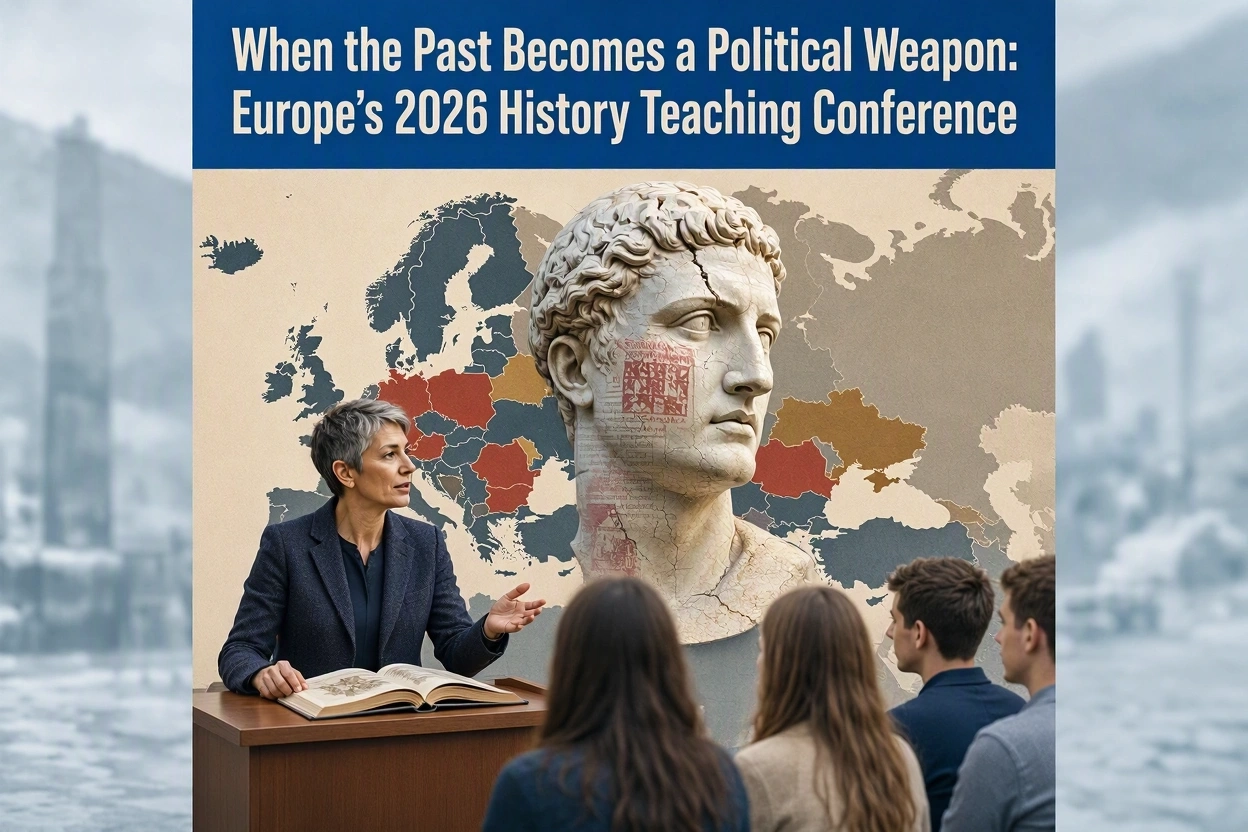
On 8–9 October 2026, the Observatory on History Teaching in Europe will hold its sixth annual conference in Strasbourg and online. Bringing together participants in person and remotely, the event will examine a question with urgent relevance across Europe: what happens when accounts of the past are manipulated for political purposes, and how can history education help societies respond? Its theme, “Manipulating History, Undermining Democracy,” places the relationship between historical narratives and democratic life at the centre of discussion.
The conference will consider how selective, distorted, or politically motivated uses of history can weaken public trust and democratic principles. Historical interpretation is not confined to academic debate or classroom curricula; it shapes how communities understand their identities, institutions, and shared experiences. When the past is presented to justify exclusion, authoritarian rule, or hostility toward democratic norms, citizens may find it harder to assess political claims critically. Exploring these risks is therefore part of a wider effort to understand how democratic backsliding can take hold and how it may be challenged.
Policymakers, educators, researchers, and young people are expected to contribute perspectives from their different fields and experiences. Their participation reflects the conference’s broader purpose: to consider how teaching about the past can equip people to recognize the misuse of history, question simplistic narratives, and resist efforts to erode democratic values. By creating space for exchange among those who shape education and public debate, the gathering treats history teaching not as a narrow specialist concern, but as a matter of public importance. Its focus is on the role historical understanding can play in sustaining informed participation and resilience in democratic societies.
Historical distortion rarely depends on inventing an entire past. More often, it works by selecting evidence that supports a preferred claim, omitting facts that complicate it, or presenting events as a simple contest between heroes and villains. Emotionally charged language can make these accounts persuasive before audiences have a chance to examine their sources. At the 2026 history teaching conference, attention to such methods highlights why historical literacy matters beyond the classroom: the way societies discuss the past can shape how people interpret current events and public choices.
When political debate relies on incomplete or misleading accounts, citizens may struggle to distinguish evidence from assertion. Competing groups can invoke incompatible versions of the same event, each claiming exclusive authority, while shared standards for assessing sources recede. This can deepen mistrust in journalists, educators, public institutions, and one another. It may also redirect discussion away from present policy questions toward disputes framed to provoke resentment or fear. Over time, confusion about what is known, what remains contested, and how conclusions were reached can weaken the informed participation on which democratic institutions depend.
Careful interpretation of history is not the same as claiming that the past has one final, uncontested meaning. It involves weighing sources, considering context, acknowledging uncertainty, and making room for evidence that challenges an initial view. Using history as a political instrument, by contrast, begins with a desired present-day outcome and arranges the past to justify it. Renewed attention is needed because political messaging travels quickly across digital platforms, where short, striking claims can outpace careful correction. Teaching people to question how historical claims are constructed does not require them to abandon conviction; it helps ensure that debate rests on more than selective memory. The conference’s focus therefore speaks to a practical democratic task: enabling the public to recognize manipulation while remaining open to rigorous, good-faith disagreement about the past and its relevance today.
High-quality history education does more than introduce learners to important events and dates. It develops the habits needed to examine how accounts of the past are created, circulated, and used. Students learn to identify who produced a source, when and why it was made, whose experiences it records, and what evidence supports its claims. These questions help distinguish documented findings from opinion, omission, or assertion.
Context is essential to that process. A quotation or image removed from its original setting can appear to support a conclusion it never intended to make. By studying events alongside their social, political, and cultural conditions, learners can assess what sources reveal and what they leave uncertain. Comparing perspectives also helps them recognise that historical accounts may differ—not simply because one must be false, but because people experienced events differently and records preserve some voices more fully than others.
The conference’s two keynote addresses will consider the value of these skills in a changing information environment. One will examine how artificial intelligence can distort history, including the risks of fabricated or misleading material being presented as authentic. As generative tools make it easier to create plausible text, images, and other media, the ability to check provenance, seek corroboration, and judge evidence becomes increasingly important. Technology can support research, but it does not remove the need for informed human scrutiny.
These methods matter beyond the classroom. Public arguments often invoke history to explain current challenges, assign responsibility, or justify political choices. Historical literacy enables people to test such claims against reliable evidence, notice when context has been stripped away, and consider competing interpretations without treating every assertion as equally credible. It also encourages careful communication: acknowledging uncertainty where evidence is incomplete while remaining clear about what the record supports. In this way, teaching history equips learners not with a single prescribed judgment, but with tools to make better-grounded judgments about the past and its relevance to the present.
An intergenerational Oxford-style debate on the motion, “Gen Z are better equipped to identify manipulations of history than baby boomers,” offers a useful way to examine how people assess claims about the past. Its value lies less in declaring a winning generation than in testing assumptions about knowledge, credibility, and media literacy. Participants can ask what makes a historical account persuasive, how omissions and distortions become visible, and whether familiarity with new technologies necessarily brings stronger critical judgement.
Generational experience can shape these responses, but it does not determine them. Younger people may encounter historical narratives through social platforms, where rapid circulation and competing interpretations can make source-checking essential. Older people may draw on long experience of political change, institutions, and earlier forms of mass communication. At the same time, access to education, the quality of teaching, personal interests, and opportunities to engage with diverse sources vary within every age group. Neither digital fluency nor lived memory alone guarantees a reliable reading of historical claims.
The debate also highlights how education can equip people of any age to distinguish evidence from assertion, recognise selective use of facts, and consider whose perspectives are absent. These skills matter when history is invoked to legitimise political choices, define national identity, or challenge the rights of others. A pluralistic discussion should take differing experiences seriously while remaining attentive to the standards by which claims are tested. The conference’s wider message is that democratic life depends on citizens’ capacity to interpret the past critically. That capacity can help public understanding remain grounded in accuracy, pluralism, and respect for human dignity, rather than allowing historical memory to become a weapon that narrows debate or diminishes people’s rights.