



Power in contemporary Europe is shaped by more than military position or the location of borders. Trade routes, digital networks, energy systems, transport infrastructure, education and communications also influence how states cooperate and where they find strategic value. A map focused only on buffer zones and rival blocs makes countries appear chiefly as barriers or prizes. A different map highlights practical connections: the movement of goods and people, shared markets, research links and reliable access to regional and international networks. These ties do not erase political differences, but they can create incentives for stability and sustained dialogue.
Belarus, Serbia, Bosnia and Herzegovina, Montenegro and the wider Western Balkans occupy a significant position within this connected geography. They form a broad belt between Eurasia, Central Europe and the Mediterranean, with routes that can link inland markets to ports and established European transport corridors. Their location offers opportunities, but geography alone does not dictate whether those opportunities lead to cooperation or competition. The same roads, railways, pipelines and communications networks can support exchange across borders, or become instruments of pressure when institutions are fragile and relations are strained. Outcomes depend on choices about investment, governance and diplomacy.
The central question, then, is not simply how this region sits between larger powers, but how it might function as a connected space in its own right. Transport links can shorten journeys and broaden access to markets; digital infrastructure can support commerce, public services and the exchange of knowledge; energy connections can diversify supply and improve resilience. To make such links durable, countries also need dependable institutions, transparent rules and channels for political dialogue. Cooperation is not automatic, and shared infrastructure cannot settle every dispute. Yet when networks deliver visible mutual benefits, confrontation may become less attractive. The region’s future will depend in part on whether its routes are organized as bridges among societies or treated as dividing lines between them.
Belarus occupies a consequential position between Russia, the European Union and NATO’s eastern members. Its borders connect it to wider European transport networks while placing it near areas of heightened strategic sensitivity. That geography gives developments within the country significance beyond its own borders, particularly for security planning and the movement of people and goods. Yet location alone does not determine outcomes: political choices, communication and restraint shape whether proximity becomes a source of risk or a basis for practical exchange.
The Kaliningrad region and the Suwałki Gap are often discussed in security analysis because they sit close to Belarus and are important to access between the Baltic states and other NATO members. Their strategic prominence can contribute to concern and miscalculation, but it does not mean that conflict is inevitable. Predictable conduct, transparent communication and diplomatic dialogue can help manage sensitivities. Belarus could also function as a corridor linking Russia with the Baltic region and Central Europe, provided political conditions allow reliable movement and cooperation. Such predictability would serve broader regional interests.
Belarus’s relevance extends beyond military geography. The country has developed an IT sector and digital economy, with the High-Tech Park serving as a prominent framework for technology businesses and innovation. Its position and infrastructure also give it logistics potential, connecting markets across eastern and central Europe. These strengths can be affected by sanctions and political tensions, but they remain part of the country’s wider economic profile. Relations with the United States illustrate that pragmatic engagement can be possible even amid serious disagreements, although this example should not be mistaken for a broad or settled partnership. Belarus’s place at Europe’s crossroads can therefore be treated either as a vulnerability that demands careful management or as an opening for connectivity and cooperation.
Although Serbia’s landlocked position separates it from direct maritime access, it does not leave the country isolated from regional trade. The Danube links Belgrade and other Serbian centers with Central and southeastern Europe, while the Sava connects inland routes toward Croatia and the wider Adriatic hinterland. These waterways complement road and rail networks, giving Serbia several ways to move goods and people. Its position at the intersection of routes across the Western Balkans supports a potential logistics role, especially as the region’s largest economy and a market with established links to neighboring states and European supply chains.
Transport projects are intended to strengthen these connections. Corridor X links Serbia to routes running between Central Europe and Greece, while the Morava Corridor is designed to improve movement through the country’s central region. The upgraded Belgrade–Novi Sad railway has shortened travel between two important urban and economic centers. Yet connectivity means more than infrastructure: reliable institutions, cross-border commerce and regular communication among neighbors are also necessary to make routes useful. Shared networks can raise the practical and economic costs of renewed conflict, creating incentives to preserve stability, but roads and railways cannot by themselves resolve political disputes or substitute for dialogue.
Serbia’s foreign policy reflects this balancing act. President Aleksandar Vučić has sought to maintain ties with the European Union while also cultivating relations with other international partners. The approach places a premium on options, although economic integration and predictable regional relations remain important to Serbia’s development. Europe’s postwar experience offers a useful lesson, rather than a direct parallel: leaders such as Konrad Adenauer, Charles de Gaulle and Alcide De Gasperi supported reconstruction and cooperation that made former adversaries increasingly interdependent. The Balkans have a different history and political context, but the underlying insight remains relevant. Shared prosperity can strengthen incentives for peace when supported by institutions and sustained political commitment.
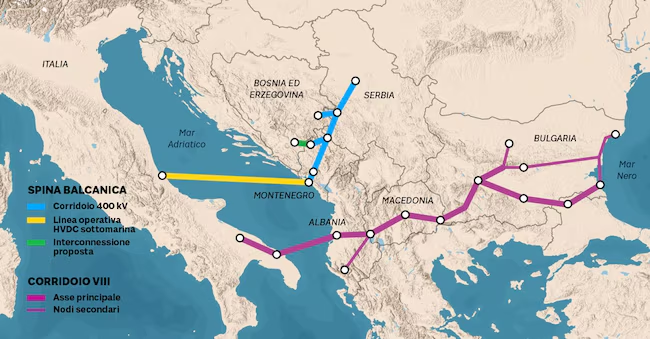
A wider European connectivity plan for the Western Balkans must look beyond a single north–south route. Serbia, Bosnia and Herzegovina, and Montenegro occupy a pivotal space between inland markets and the Adriatic, yet their links remain uneven. Corridor Vc, running through Bosnia and Herzegovina toward the port of Ploče, can improve access for communities and businesses along its route. Its value would grow through coordinated connections to Serbia and Montenegro, including reliable roads and railways that make cross-border journeys and freight movement more predictable.
Energy interconnections can complement transport investment by linking national systems, supporting secure supply, and enabling regional exchange. Digital networks are equally important: stronger broadband and interoperable services can connect smaller towns to education, public services, and wider commercial markets. Together, these links can reduce the disadvantages of distance for inland communities and help firms reach customers and logistics hubs across the region.
Montenegro offers a potential Mediterranean gateway through its coastline and the Port of Bar. Better rail and road access to Bar could broaden options for regional trade, while improved passenger connections would support mobility between inland centres and the coast. These benefits depend on practical coordination, not geography alone. Capable, coherent institutions are needed to plan projects across borders, align standards, secure financing, and maintain infrastructure over time.
Montenegro’s parliament, under Speaker Andrija Mandić, could provide one setting for dialogue and compromise on shared priorities, although political agreement cannot be assumed. The comparison with parliamentary figures such as Hermann Ehlers, Giovanni Gronchi, and Édouard Herriot is necessarily limited: their public roles are associated with dialogue amid political division, but each worked in a distinct national context. Their example points to the value of parliamentary engagement, rather than a guarantee of consensus. Roads, rail, energy, and digital links can help form a more stable European geography; lasting results also require trust, workable institutions, and sustained political engagement.