


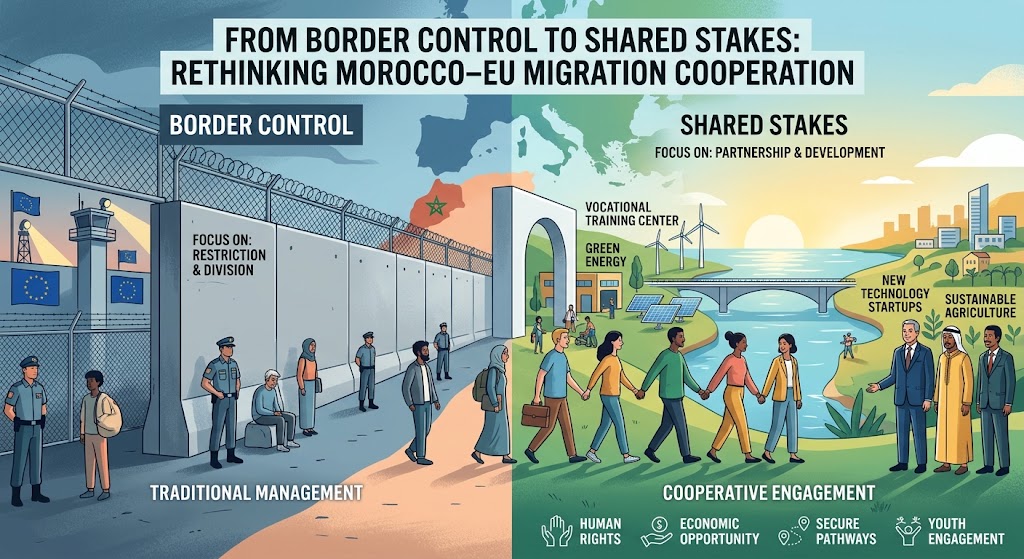
For years, EU–Morocco migration cooperation has placed border enforcement at its centre. More than €1 billion has been earmarked for border control through 2027, yet this approach has done little to address the pressures that drive movement. Morocco has also resisted being cast as Europe’s “outsourced border guard,” arguing in practice that cooperation cannot mean carrying responsibility for European border security without addressing shared interests. Development programmes have not consistently reached the regions experiencing the strongest emigration pressures, and local governance has too often been insufficiently incorporated into programme design and delivery.
The gap between migration’s economic contribution and its local investment impact points to another shortcoming. Remittances to Morocco total about $11.7 billion, equivalent to roughly 8% of GDP, but diaspora investment represents only around 10% of private investment. These flows support households and the wider economy, but they do not automatically create jobs or opportunities in the communities most affected by emigration. Without locally grounded investment and stronger participation by municipalities and residents, development funding can remain disconnected from the conditions shaping migration decisions.
The Ceuta crises of 2021 and July 2026 further demonstrate that migration is shaped by shared responsibility and geopolitical tensions, not border management alone. Reports put crossings during the July crisis at 60,000–80,000 and deaths at more than 111. Contributing factors included a Spanish court ruling, a regularisation drive, disinformation, criminal networks, lapses in Moroccan border controls and deeper socio-economic pressures. Treating the episode solely as an enforcement failure obscures how political decisions and vulnerabilities interacted across borders. Ursula von der Leyen’s pledge of further funding did not resolve divisions among EU member states over the response, exposing the limits of coordinated European action. Security measures may form part of cooperation, but their effectiveness depends on sustained investment, local accountability and a shared approach to the economic and political forces behind migration.
Morocco’s youth migration should be understood in the context of limited opportunity, not as flight from war or state collapse. The country is relatively stable, yet many young people see migration as a way to pursue work, security and prospects they cannot readily find at home. In 2025, unemployment stood at 13% overall, rising to 38.4% among young people and 25.7% among graduates. These figures point to a mismatch between people’s skills and the jobs available, as well as a shortage of pathways into secure employment. Migration decisions therefore reflect both economic pressure and the understandable desire to build a better future.
Retention efforts need to address conditions where people live, rather than relying on broad national measures alone. Investment should reach regions with significant emigration, including the Rif, Al Hoceima, Nador and the southeast, where limited access to jobs can reinforce the decision to leave. Industrial and technology hubs can help, but only when they respond to genuine regional economic needs and create durable employment. Projects that attract attention or spending without sustaining productive enterprises and long-term jobs are unlikely to change young people’s calculations. Local development plans should identify viable sectors, connect businesses to infrastructure and markets, and make skilled work accessible beyond major urban centres.
Two further levers concern skills and opportunity. Temporary-return programmes can make it easier for diaspora members to share expertise, mentor young people and support local enterprises without requiring permanent relocation. This matters because only a small share of diaspora funds reaches private investment; practical channels, trusted partnerships and clear incentives could help direct more capital and knowledge towards productive activity. At the same time, education and training need stronger links to available work, so that graduates acquire skills employers actually seek and can see credible routes into employment. Progress should be assessed through visible local outcomes: factories and productive enterprises that endure, more skilled jobs, and more young people choosing to remain. Spending totals alone cannot show whether cooperation has widened prospects or reduced the pressures behind migration.
Effective migration cooperation between Morocco and European states must begin by recognising that Rabat is not simply a geographic buffer or operational extension of EU border controls. Its position connects Europe with the Maghreb and Africa, while its diplomatic choices shape regional relationships and domestic debate. Policies designed without meaningful Moroccan participation are unlikely to remain durable when political pressures rise. Treating migration as a technical task of interception and returns misses the conditions that determine whether cooperation is trusted and effective. A partnership should recognise shared interests alongside unequal capacities, and give Morocco influence over decisions that affect its society.
First, establish permanent strategic dialogue among Rabat, Madrid, and Brussels. Regular forums should address operational priorities and long-term policy, with channels for consultation during disputes and crises. Difficult political questions, including Western Sahara, cannot simply be excluded in the hope that migration cooperation will remain insulated. Unresolved disagreements can instead erode trust, shape public opinion, and destabilise practical arrangements. Addressing sensitive issues openly does not require agreement on every position; it requires candid discussion, predictable procedures, and a commitment to prevent bilateral tensions from producing avoidable disruption at borders or in shared programmes. Such dialogue should continue between elections too.
Second, develop shared governance that treats Morocco as a partner with agency, defined responsibilities, and mutual obligations. European funding or technical support should be negotiated around jointly established aims, not attached to expectations that Morocco enforce Europe’s preferences as a contractor. Third, European diplomacy must be more coherent: unilateral decisions by member states or EU institutions can contradict cooperation, weaken confidence, and trigger avoidable crises. Consultation across European capitals is therefore essential before consequential policy shifts. These principles acknowledge that migration is inseparable from diplomatic relations, regional stability, domestic politics, and the distribution of responsibility across origin, transit, and destination states alike.
European support for Morocco should extend beyond grants, equipment and cooperation at the border. Financial assistance can help institutions respond to immediate pressures, but it cannot substitute for durable commitments that create shared interests. A practical starting point is reciprocal legal mobility, including well-designed seasonal work pathways. Such routes give people lawful options to travel for defined periods and allow employers to address genuine labour needs in sectors with recurring shortages. When transparent and accessible, they can reduce dependence on irregular intermediaries without suggesting that migration pressures will disappear.
Reciprocity must shape both the design and delivery of these arrangements. Recruitment should be fair, with clear information about pay, contracts, fees, working conditions and available remedies before departure. Rules should be enforced on both sides, and workers need access to support if agreements are breached. Employers and public institutions in Europe benefit from predictable recruitment; workers gain safer choices and recognized protections, while Moroccan institutions can build expertise and retain meaningful links with citizens abroad. Mobility partnerships should include monitoring and accessible complaint channels, so that benefits and risks are not simply transferred to individuals. These safeguards make legal pathways credible, but they remain one element of a broader response. They cannot by themselves resolve the economic, social and political factors that influence decisions to move.
European commitments should connect mobility to sustained political dialogue and consistent diplomacy, rather than shifting with each crisis. They can support regional economic development, strengthen links between vocational training and actual employment, and create opportunities for diaspora participation in investment, mentoring and knowledge exchange. These measures should be jointly designed, with responsibilities, timelines and public indicators agreed by Moroccan and European partners. Progress might be assessed through access to decent jobs, protection of recruited workers, participation in training and the distribution of benefits across communities. Regular review can help institutions adjust policies when evidence shows gaps, instead of relying on short-term announcements. The central test is whether Europe’s contribution generates measurable gains for people and institutions on both sides. Without reciprocity, cooperation risks returning to emergency funding and crisis response; with it, border coordination can sit within a durable partnership that respects shared responsibilities and expands practical choices.

