


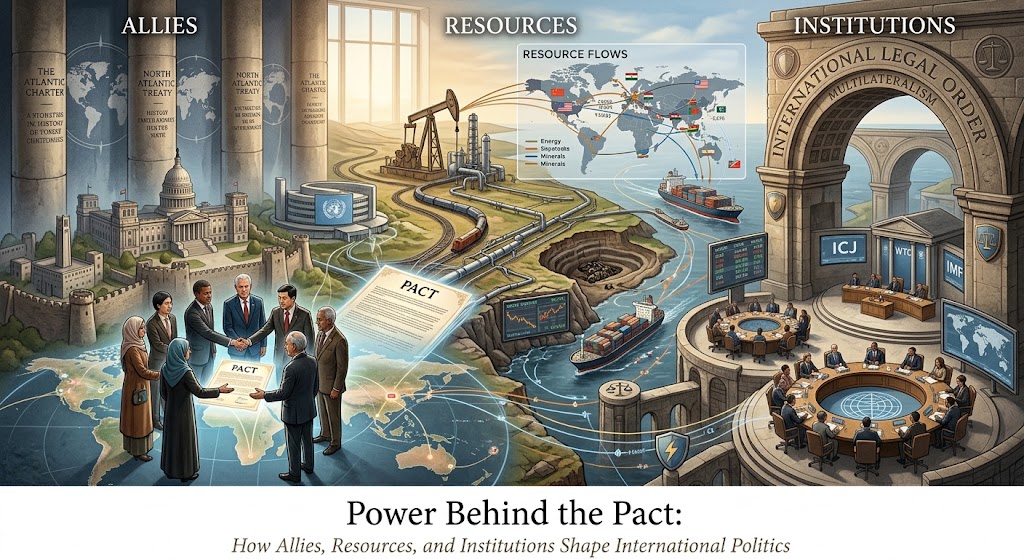
States rarely pursue a single objective in international affairs. Governments seek security against external threats, but they also want influence over regional decisions and global rules. Prosperity matters through trade, investment, and access to markets, while dependable supplies of energy, food, and critical materials can shape foreign policy. Prestige and recognition may reinforce a government’s legitimacy or signal its standing. At the same time, leaders value room to make independent choices, avoiding commitments that could restrict future options. These aims can complement one another, yet they may compete for resources and attention. A policy that strengthens security, for example, may impose economic costs or constrain diplomatic flexibility.
Nor is a state a single-minded actor with one settled set of preferences. Political leaders may prioritize security or electoral support, while ministries and legislatures differ over how to achieve national goals. Businesses may favor open markets and predictable rules, whereas workers or industries exposed to competition may call for protection. Public opinion can support cooperation in principle while resisting its costs, risks, or perceived effects on sovereignty. These differences matter because governments must assemble domestic backing for international decisions. The priorities expressed abroad are therefore often the result of negotiation at home, not a simple reflection of a unified national interest. Leadership changes, economic shifts, or public pressure can alter that balance.
This complexity makes cooperation useful but conditional. States may coordinate when they share an interest in deterring a threat, expanding commerce, or managing a common problem. Yet each government also assesses who gains influence, which actors receive the benefits, and who bears financial or political costs. Partners can disagree about how responsibilities should be divided, which rules should apply, or whether cooperation limits their freedom to act. Governments may support common arrangements while seeking exceptions, safeguards, or greater control over their implementation. International relationships thus combine shared objectives with bargaining and strategic competition. Understanding them requires attention not only to what states agree to do, but also to the domestic pressures and calculations that shape the terms of agreement.
Alliances are not necessarily cynical transactions. Countries may cooperate because they share security concerns, political principles, or practical interests, and because joint action can offer protection and benefits that neither could secure as effectively alone. Trust can make coordination possible: partners share information, plan together, and support one another during crises. Such commitments may be sincere even when each government also weighs its own national interests.
Yet cooperation can create dependence. A state that relies heavily on another for military protection, energy supplies, advanced technology, weapons, or access to important markets may face risks if that relationship changes. Where one partner controls an essential resource or service, it can acquire bargaining power. In a dispute or emergency, the stronger or less dependent party may threaten to withhold support, delay delivery, or impose conditions. The possibility of pressure does not mean it will occur, but it can shape the dependent country’s choices before any explicit threat is made.
A Romanian saying captures this uneasy dimension of closeness: “God protect me from my friends; from my enemies I can protect myself.” It expresses a folk observation that familiarity and trust may expose vulnerabilities, because a partner knows where a country depends on it. Another saying, “Brother is brother, but cheese still costs money,” points to the price that may attach even to goods exchanged among close partners, especially when they are scarce or essential. Together, these expressions suggest that goodwill does not automatically remove bargaining or material interests from international relationships.
They should be understood as illustrations of political experience, not evidence that allies are inherently hostile or that cooperation is futile. Their value is as a reminder to distinguish trust from assumption. Governments can preserve close partnerships while reducing avoidable exposure: diversifying suppliers, developing alternatives, setting clear agreements, and maintaining the capacity to respond if assistance is delayed. Such measures need not signal distrust. They can make cooperation more resilient by ensuring that shared commitments remain based on choice rather than one partner’s ability to dictate terms.
The International Criminal Court (ICC) and International Court of Justice (ICJ) are often mentioned together, but they perform distinct functions. The ICC prosecutes individuals accused of genocide, crimes against humanity, war crimes and, under specified conditions, aggression. It does not resolve legal claims between governments. The ICJ, by contrast, settles disputes submitted by states and gives advisory opinions to authorized United Nations bodies. It does not try people or impose criminal sentences. This distinction matters when assessing what a court can decide, whom its ruling concerns, and what jurisdiction has been accepted.
Neither institution has a domestic-style police force capable of independently arresting suspects, executing judgments or compelling governments to comply. The ICC depends heavily on national authorities to arrest people subject to its warrants and transfer them to The Hague. The ICJ likewise has no enforcement officers: states are expected to carry out judgments in cases to which they are parties. If a party fails to comply, the other may turn to the UN Security Council, whose response is shaped by political considerations and can be limited. Cooperation is therefore not a procedural detail but a condition of practical effectiveness.
The reach of each court also depends on the legal basis for its jurisdiction. The ICC may act where relevant jurisdictional conditions are met, including a state’s acceptance of its authority, territorial or national links, or a Security Council referral; these routes do not make every state subject to the same obligations. The ICJ generally hears contentious cases only when states have consented to its jurisdiction through an applicable treaty, declaration or special agreement. A powerful government that rejects jurisdiction, withholds cooperation or resists enforcement can expose the gap between formal rules and practical authority. Such resistance does not erase the law, but it can weaken compliance, delay accountability and test the credibility of institutions whose decisions depend on states.
In the stated August 2026 example, the Trump administration expanded sanctions targeting leaders of the International Criminal Court (ICC), while disputing the court’s authority over nationals of countries outside the Rome Statute, including the United States and Israel. The administration’s position reflects a familiar sovereignty argument: states that have not accepted the treaty contend that the court should not exercise jurisdiction over their nationals. That disagreement is fundamentally legal and political, and governments may challenge an institution’s reach through public argument, diplomacy, or established legal procedures. Sanctions, however, change the setting in which that dispute unfolds.
When judges or prosecutors are subjected to sanctions, the consequences can extend beyond formal restrictions on travel or assets. Financial institutions and other organizations may avoid dealings with designated officials to limit their own exposure, while governments may face pressure to reconsider cooperation, information-sharing, or assistance to the court. The measures can therefore raise the personal and operational costs of judicial work, potentially chilling engagement even among actors not directly targeted. They also risk making an argument about jurisdiction appear inseparable from coercion, weakening confidence that international rules are applied through impartial procedures rather than through the leverage of powerful states.
Henry Farrell’s concept of weaponized interdependence helps explain this broader mechanism. States occupying central positions in global networks—finance, technology, supply chains, or access to essential systems—can use those connections to gather information, deny access, or impose costs. Sanctions draw on such network centrality: banks, service providers, and partners may enforce restrictions across borders, multiplying their effect. This capacity is not inherently illegitimate; governments use economic measures to pursue policy goals. Yet when pressure is directed at judicial officials for carrying out institutional duties, it can undermine the court’s credibility and the perceived fairness of the rules-based order. The distinction between contesting a ruling and constraining those who issue it matters to institutional legitimacy and future cross-border cooperation. Sovereignty and jurisdiction remain contested, but coercion can make rules seem conditional on the preferences of those with the greatest leverage.
Frequently Asked Questions
I like this internet site because so much utile material on here :D.


I like this internet site because so much utile material on here :D.