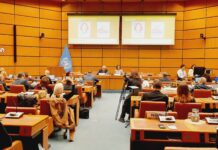



Just a few weeks ago, I was in New York presenting the IAEA’s annual report – your annual report – to the United Nations General Assembly.
There is a deep and widespread appreciation of our work, of the Secretariat’s work, of the Board’s work and of the General Conference’s work.
One hundred and eleven States co-sponsored the resolution which introduced the report to the Assembly – the highest number in the IAEA’s nearly 70-year history. To give you an idea of how far we have come: in 2017 the resolution had only 59 co-sponsors.
The world knows that it needs the IAEA and it wants us to succeed. We have a noble and unique mission. Its delivery is up to all of us.
Let me begin today with the IAEA’s Technical Cooperation programme – a programme of central importance to “Atoms for Peace and Development”.
I thank the Technical Assistance and Cooperation Committee, which met this week, and all the Member States who contribute their strong support, making these activities so relevant and effective.
In this, our second year of the 2026 – 2027 programme, Health and Nutrition is the main area of focus, at 27%. Food and Agriculture is second, at 23.5%, followed by Safety at almost 17%. These focus areas underscore the national priorities of Member States while taking into consideration the safety infrastructure required to support the growing use of nuclear science and technology around the world.
The flexibility of the TC programme also allows us to respond to emergencies. This year, the IAEA has provided support to Colombia, Panama and Venezuela in the aftermath of earthquakes, and is preparing to support Indonesia and Nepal.
So far, we have received 69.3 million Euros in payments to the TC Fund, a rate of attainment of 70.7%. I encourage all Member States to pay their contributions to the TCF in full and on time. I also remind Member States of the importance of the timely payment of National Participation Costs. I invite those in a position to do so, to support the programme through extrabudgetary contributions.
I have been adamant about using our resources to make the biggest positive impact possible. Our flagship initiatives are making that happen, by strengthening partnerships, mobilizing additional resources and delivering tangible benefits where they are needed most. Let me update you on them now.
Our Rays of Hope initiative supporting Member States in the fight against cancer now has 21 Anchor Centres, with the recent additionof SingHealth in Singapore. Expanding our partnerships with the private sector, we signed practical arrangements with several companies to scale access to diagnostic imaging, nuclear medicine and radiotherapy in low and middle-income countries.
Since the last time we met, our training continued with regional courses in Africa, Asia and Latin America covering everything from mammography to AI systems for imaging and therapy.
The International Symposium on Standards, Applications and Quality Assurance in Medical Radiation Dosimetry (IDOS) marked 50 years of the IAEA/WHO network of Secondary Standards Dosimetry Laboratories, whose 87 members in 75 countries keep radiation measurements traceable to international standards.
Atoms4Food continues to provide countries with tailored, science-based solutions to strengthen food security, improve nutrition and build more resilient agrifood systems through the application of nuclear and related technologies, supporting priorities across crop production, soil and water management, animal production and health, food safety and nutrition.
The initiative now comprises 49 participating Member States and country assessment missions have been completed in six countries, including the most recent one in Türkiye just last month.
The Zoonotic Disease Integrated Action (ZODIAC) initiative is advancing technologies, strengthening field surveillance and reinforcing national capacities to detect, characterize and report zoonotic pathogens, with practical progress being made in tackling Rift Valley fever in livestock and haemorrhagic fever virus in ticks, to give just two examples.
Under NUTEC Plastics, and in support of the Administrators of Latin American Antarctic Programmes (RAPAL), in São Paulo eight countries approved a harmonized regional strategy for monitoring microplastics during the 2026–2027 Antarctic campaign. The IAEA Marine Environment Laboratories provided technical guidance on sampling shorelines, waters, snow and sediment cores, so that the data are comparable.
The Global Water Analysis Laboratory (GloWAL) Network has grown to 78 laboratories in 63 Member States. It is working to keep our most precious resource safe and available. Nuclear science and applications, including, for example, isotopes that trace pollution, hydrological change and climate impacts, are key to generating data that underpin fact-based policy decisions. Keeping up with the latest available technologies, the IAEA is developing an AI course and a research project on AI and digital twins for water resources.
Standardizing and validating radioanalytical methods, proficiency testing, and enhancing readiness for radiological or nuclear emergencies were front and centre at the 23rd coordination meeting of the IAEA’s Network of Analytical Laboratories for the Measurement of Environmental Radioactivity (ALMERA), which was held at the Marine Environment Laboratories in Monaco. The network includes more than 200 laboratories in more than 90 countries.
Advancing nuclear science and producing radioisotopes used in medicine are just two benefits of research reactors, and so it is little surprise that interest in this powerful technology is growing. The IAEA’s Research Reactor Database shows 226 research reactors are currently in operation in 54 countries and 23 are either under construction or planned in 18 countries. This year integrated Nuclear Infrastructure Review missions for Research Reactors were conducted in Kenya, Rwanda and Nigeria.
Mr Chairperson,
Today 419 nuclear power reactors are in operation in 31 countries, comprising more than 381 gigawatts of installed capacity and providing about 9 per cent of the world’s total electricity generation. Seventy-six reactors totaling almost 80 gigawatts of installed capacity are under construction in 16 countries, three of which are newcomers. Further details are available in our newly revamped Power Reactor Information System.
Our latest projections for new nuclear power capacity, published during the General Conference, have been revised up for a sixth consecutive year.
In the high case scenario, capacity reaches 1045 GW(e) by 2050 before increasing further to 1284 GW(e) by 2060. That is approximately 3.4 times the 2025 level. The low case projects growth to 696 GW(e), nearly doubling the 2025 level.
To turn these forecasts into reality, many countries turn to the IAEA. The IAEA’s Sixth International Ministerial Conference on Nuclear Power, hosted by the Government of the Republic of Korea in Incheon last month, brought together Ministers and high-level delegates to discuss the many elements that go into the expansion of nuclear power, including, effective regulation, advanced technologies, workforce and industrial development, emerging applications, financing, stakeholder engagement and the relationship between nuclear energy and the digital economy. In my opening statement, I urged those in attendance to make full use of IAEA services, including our peer reviews.
Another important area where we are making progress is our cooperation with international financial institutions. Over the past years, I have worked to strengthen the dialogue between the nuclear energy and development finance communities. Our growing engagement with the World Bank Group, the Asian Development Bank, the European Bank for Reconstruction and Development, the Development Bank of Latin America and the Caribbean, the OPEC Fund and other institutions has opened new avenues for cooperation. Most recently, we signed an agreement with the Inter-American Development Bank, further expanding this cooperation in Latin America and the Caribbean. Through these partnerships, we are helping Member States strengthen the technical and institutional foundations necessary for informed investment decisions and the successful development of nuclear power programmes.
On that note, an Integrated Nuclear Infrastructure Review (INIR) Phase 1 mission to Zambia took place earlier this month and next month an INIR Phase 3 mission will head to Bangladesh, showing how newcomer countries are turning to the IAEA and international cooperation to ensure their programmes succeed.
The International Conference on Fuel Supply Chain for Sustainable Nuclear Power Development was held in Vienna last month, highlighting the importance of developing robust international supply chains.
The future will require us to make the most of the capacity we have now. Four out of every 10 operating reactors today are more than 40 years old. Long-term operation of the existing fleet remains the most effective and economic path to reliable, secure, low-carbon energy. That includes, in a growing number of cases, the restart of plants previously shut down. To strengthen the international exchange on policies, regulatory approaches and the enabling foundations of plant life management, the Agency will convene the Sixth International Conference on Nuclear Power Plant Life Management, PLIM-6, in Tokyo from 7 to 11 December 2026.
In the coming weeks we will also hold an International Symposium on Nuclear Energy Research and Development and the fifth plenary meeting of the Nuclear Harmonization and Standardization Initiative. NHSI’s teams have made significant progress, including in developing NEXSHARE, a global platform for collaboration on experimental testing and code validation for SMRs, which will be presented at the meeting.
Following its launch in August, work under Atomic Technologies Licensed for Applications at Sea (ATLAS) has started in earnest. We have received more than 500 nominations from over 30 Member States for the six Project Groups. Participants include Member State representatives, reactor and maritime industry, classification societies, international organizations, NGOs, and academia.
This year, the Agency is once again present at the United Nations Climate Change Conference. COP31 is taking place in Antalya as we speak and the IAEA is ensuring that nuclear energy and nuclear science are on display, including through our Atoms4Climate pavilion.
As engineers and scientists make progress on the road from fusion energy being at an experimental stage to its commercial deployment, the IAEA is bringing together stakeholders crucial to the journey, most recently at the third high-level meeting of the World Fusion Energy Group just a few days ago.
At the meeting, we released the 4th World Fusion Outlook covering recent achievements, plant concepts at various stages of development, and the ecosystem behind commercialization, from investment to supply chains and international cooperation. A special focus of this Outlook are the data foundations needed to accelerate fusion development with AI.
Mr Chairperson,
Over past weeks, several incidents have underlined military-related risks to the safe and secure operation of nuclear facilities in Ukraine. Military activity, including drone attacks that have killed personnel, and disruptions to off-site power supplies, raise serious concerns.
At the Zaporizhzhya Nuclear Power Plant, all six reactor units remain in cold shutdown as the plant continues to face significant challenges related to both the reliability of off-site power and the security situation in the surrounding area.
Military activities continue to affect plant personnel and supporting safety infrastructure, with several ZNPP workers, contractors and personnel reportedly injured or killed. These incidents are stark reminders of the human costs of the conflict and of the risks faced by those responsible for maintaining nuclear safety and security.
On 8 November the site experienced its 27th complete loss of off-site power since the start of the conflict. Repeated and prolonged losses of off-site power have reduced available diesel fuel reserves at the plant, prompting the implementation of fuel-conservation measures and a revised operating strategy for the emergency diesel generators.
In this context, the Agency is working with both the Russian Federation and Ukraine to facilitate arrangements for the replenishment of diesel fuel inventory at the ZNPP. It is essential to support key nuclear safety and security functions, particularly in the event of a loss of off-site power and during the winter period.
Before the military conflict, the ZNPP – Europe’s largest NPP – had ten off-site power lines. Today, it relies on a single 330 kV line, Ferosplavna-1, to maintain essential nuclear safety functions. Last month, I arranged an eighth ceasefire to strengthen the connection between the ZNPP and that off-site power line. Last week, the repaired infrastructure was destroyed by military activity.
A new ceasefire, the ninth, is being discussed for the repair of the Dnisprovska substation and of the 750 kV power line, which has once again been severely damaged after its repair in June. Air strikes have thwarted the efforts made over the past several months to secure the second off-site power line before winter.
Beyond the Zaporizhzhya Nuclear Power Plant, military activities continue to affect critical energy infrastructure throughout Ukraine. In October, the Agency assessed 19 electrical substations nationwide that are essential for maintaining nuclear safety and security. This unique effort underscored the scale of the challenges facing Ukraine’s power system and confirmed continuing damage to substations and transmission infrastructure that support the operation of Ukraine’s nuclear facilities. As Ukraine enters the winter period, these challenges are becoming even more acute, with the electrical grid in its worst condition since the start of the conflict.
These findings reinforce our concern regarding the reliability of the national electricity grid. Since we last met, off-site power supply to all five nuclear sites was affected by the armed conflict.
At the Khmelnytskyy, Rivne and South Ukraine nuclear power plants, safety and security systems remained operational, and the plants continued generating electricity, except for reactors undergoing planned maintenance or refueling outages. Yet the operating environment remains extremely challenging. Persistent air raid alarms, causing the IAEA on-site teams to shelter, at times even daily, increasing reports of drones nearby, and continuing damage to the electrical grid all place additional pressure on plant operations. Plant staff are also under considerable pressure, as military activity continues to affect nearby cities, where they and their families live. At the Khmelnytskyy Nuclear Power Plant drone attacks affected residential areas of the city of Netishyn, where most plant staff live, including areas close to the local electrical substation.
On several occasions, reactor units had to reduce power output because of grid-related constraints.
The Agency’s presence on the ground remains indispensable. 185 Agency staff members have participated in 295 missions in Ukraine and continue to provide impartial assessments of nuclear safety and security conditions and independent radiation monitoring.
The Agency also continues to provide large-scale technical assistance. Since September’s Board meeting, 19 deliveries of equipment, medical supplies and other support were delivered to Ukrainian counterparts. This brings the total number of deliveries since the start of the conflict to 274, with equipment valued at approximately €28.6 million provided to 48 entities across Ukraine.
These efforts have been made possible through the generous support of 30 Member States and the European Union. To sustain the current level of programme delivery through June 2027, approximately €17 million in additional funding is required. I encourage Member States in a position to do so to continue supporting this important work.
The Agency continues to implement safeguards throughout Ukraine in accordance with Ukraine’s Comprehensive Safeguards Agreement and Additional Protocol. Based on the evaluation of all safeguards-relevant information available to the Agency, we have found no indication that would give rise to proliferation concerns.
I reiterate that strict observance of the Seven Indispensable Pillars for ensuring safety and security during an armed conflict and the Five Concrete Principles for protecting ZNPP remain essential to preventing a nuclear accident. The continued vulnerability of nuclear facilities and of the electrical infrastructure upon which they depend demonstrates once again the urgent need for maximum military restraint around all nuclear facilities and infrastructure vital to nuclear safety and security.
The Seven Indispensable Pillars need to be respected everywhere, not just in Ukraine.
As agreed with the Government of the United Arab Emirates during my visit in June, an IAEA advisory mission completed an assessment of the loss of off-site power at the Barakah Nuclear Power Plant following a drone strike on 17 May.
The mission concluded that the national authorities and the plant operator had managed the event appropriately and taken effective action to maintain safety and prevent further escalation. It also found that the Federal Authority for Nuclear Regulation had provided appropriate regulatory oversight. The mission once again underscored that nuclear facilities must never be targeted.
Mr Chairperson,
The IAEA continues to verify the safety of ALPS-treated water discharged from the Fukushima Daiichi Nuclear Power Station. In parallel, we are coordinating and implementing the Additional Measures that I instituted for further transparency of the monitoring process. These measures provide opportunities for independent experts from third-party laboratories, which are part of the ALMERA network, to participate directly in sampling activities, conduct direct measurements and verify radionuclide concentrations in ALPS-treated water and environmental samples. The final two missions of 2026 were conducted in September and October, with experts from participating laboratories conducting sampling activities during both missions. The September mission, which included experts from China, the Republic of Korea, and Switzerland, focused on sampling ALPS-treated water from storage tanks prior to dilution with seawater. The October mission, focused on sampling ALPS-treated water after dilution with seawater, with experts from China, the Republic of Korea, the Russian Federation and Switzerland taking part. During both missions, staff from the IAEA Fukushima Laboratory worked alongside the international experts.
In October, the IAEA also conducted its Interlaboratory Comparison for Marine Environmental Monitoring, involving IAEA experts and experts from third-party laboratories in China, the Republic of Korea, and Switzerland, as well as Japanese analytical institutions. This exercise further supports the comparability and reliability of analytical results and contributes to confidence in the monitoring of the marine environment.
So far, Japan has completed the discharge of 25 batches of ALPS-treated water, representing a total volume of approximately 196,000 cubic metres. The results of the measurements conducted to date have consistently shown that tritium concentrations remain below Japan’s operational limit and consistent with relevant international safety standards.
In Japan, the Agency continues its cooperation with the Ministry of the Environment on the managed recycling and final disposal of approximately 14 million cubic metres of removed soil and waste arising from decontamination activities following the accident at the Fukushima Daiichi Nuclear Power Station. The IAEA review mission in October concluded that Japan had made significant progress in advancing these activities and addressing the recommendations from the previous IAEA review.
Mr Chairperson,
In October, the Governments of the United States and the Kingdom of Saudi Arabia requested the Agency take the necessary steps to implement safeguards and verification measures in relation to the Bilateral Safeguards Agreement between the two Governments, consistent with the Agency’s authority pursuant to Article III.A.5 of its Statute.
According to this Agreement, the Agency will be provided with information about, and access to any sites for conversion, enrichment, fuel fabrication and reprocessing, including activities associated with research and development and manufacturing of nuclear-related equipment, developed, supplied, built or operated in Saudi Arabia pursuant to the United States-Saudi Arabia Agreement for Cooperation Concerning Peaceful Uses of Nuclear Energy. The Agreement stipulates that it will not affect the rights and obligations of the Agency and Saudi Arabia under the Comprehensive Safeguards Agreement. Based on our assessment, there will be no costs incurred in the current biennium for the application of safeguards and verification measures provided for in this Agreement.
Consistent with our practice related to nuclear verification, the request is now before the Board in document GOV/2026/66, which also contains in its attachments the text of the Bilateral Safeguards Agreement, with the recommendation that the Board authorize the Director General to apply safeguards and verification measures in relation to this Agreement consistent with the Agency’s standard safeguards practices. I welcome the open, transparent approach and engagement of both Governments with Member States and the Secretariat on this matter, in particular as this Bilateral Safeguards Agreement will facilitate the provision of broader safeguards relevant information and access to facilities and activities which are subject to the Agreement and enables the Agency to implement additional safeguards and verification measures in Saudi Arabia.
As I reported to the Board in September, I welcome Syria’s transparency and cooperation with the Agency which facilitated the resolution of the outstanding safeguards issues related to Syria’s past nuclear activities. As you see from my report on the Implementation of the NPT Safeguards Agreement in the Syrian Arab Republic, excavation work at the Dair Alzour site has continued throughout the reporting period with Syria regularly providing related reports, photographs and videos to the Agency.
Last week, the Symposium on International Safeguards took place here in Vienna. This provided an opportunity for State and regional authorities responsible for the implementation of safeguards, the research and development community, industry, and civil society to identify challenges and opportunities for IAEA safeguards, to showcase research, to share ideas and to build partnerships.
You will see from my report on the Implementation of the NPT Safeguards Agreement and relevant provisions of the United Nations Security Council resolutions in the Islamic Republic of Iran that – with the exception of Bushehr NPP – the Agency has neither received information from Iran regarding the status of its declared nuclear material and facilities nor had access to any of those facilities to conduct in-field verification activities. Therefore, the Agency was unable to discharge its safeguards responsibilities under the NPT Safeguards Agreement.
I am unable to report in relation to the implementation by Iran of relevant provisions of the UN Security Council resolutions or the Board’s resolutions of November last year and June this year.
It has been nearly 18 months since the Agency lost continuity of knowledge in relation to the previously declared inventories of LEU and HEU enriched up to 60% U-235 at the declared nuclear facilities affected by the military attacks of June 2025.
Unless Iran provides us with information regarding the status of its declared nuclear material and facilities and access to those facilities to conduct in-field verification activities, the Agency will not be able to conclude that there has been no diversion of declared nuclear material from peaceful nuclear activities in Iran.
A return to diplomacy and negotiations aimed at finding a solution to issues related to Iran’s nuclear programme is imperative.
As I said in my briefing last month to the United Nation’s Security Council, I encourage Iran to consider technical and gradual measures by which conditions are achieved that allow for the return of our inspectors to Iran.
Such gradual, technical, incremental steps could pave the way to normal safeguards implementation in Iran while contributing to a confidence-building atmosphere conducive to a wider agreement.
Since the last Board meeting in September, Malaysia and Tonga have brought into force an additional protocol. I applaud these important developments for the legal framework on which the continued peaceful uses of nuclear science and technology rest. The number of States with safeguards agreements in force remains 193, and 148 of these States have additional protocols in force. I urge Equatorial Guinea, the only remaining Non-nuclear-weapon State Party to the NPT without a comprehensive safeguards agreement in force, to bring this agreement into force without delay. I also reiterate my repeated calls for the remaining eleven States with small quantities protocols based on the original standard text to amend or rescind them as soon as possible. I encourage States that have not yet concluded additional protocols to do so as soon as possible.
The IAEA continues to monitor the nuclear programme of the Democratic People’s Republic of Korea (DPRK).
Previously, I have reported to you about the ongoing operation of enrichment facilities at Kangson and Yongbyon, the construction of an additional enrichment facility at Yongbyon, and the reported further expansion of the DPRK’s production of weapons-grade nuclear material. Since mid-September 2026, a further extension to the original Yongbyon enrichment facility has been under construction with the new extension externally complete by late-October 2026. The ongoing expansion of the DPRK’s uranium enrichment programme remains a cause for serious concern.
The Agency has observed indications that the 5MW(e) reactor at Yongbyon likely continues to operate in its seventh irradiation cycle, and that, after a period of shutdown, the light water reactor (LWR) at Yongbyon has been operating since the end of April 2026.
The continuation and further development of the DPRK’s nuclear programme are clear violations of relevant UN Security Council resolutions and are deeply regrettable. The Agency continues to maintain its enhanced readiness to play its essential role in verifying the DPRK’s nuclear programme.
Regarding the safeguards-relevant aspects of naval nuclear propulsion, consultations between the Agency and the Republic of Korea have begun and, separately, the Secretariat has continued to engage Australia and Brazil. I have provided three reports with updates on the consultations and will continue to keep the Board and Member States informed on relevant developments.
Mr Chairperson,
Since its inception, the Marie Sklodowska-Curie Fellowship Programme has made a real contribution in widening access to the nuclear field and bolstering the workforce of tomorrow. Across six application cycles, it has selected 860 students from 135 Member States. Of the 581 graduates, 245 have secured IAEA-facilitated internships, while others have pursued doctoral studies or employment in the field. Selections for the seventh application cycle are ongoing and will be completed by the end of the year. Continued extrabudgetary contributions are essential to sustaining the programme.
Since 2023, the Lise Meitner Programme has organized ten visits hosted by nine Member States, reaching 127 mid-career professionals from 54 countries. Its latest round, hosted by the China Atomic Energy Authority and Harbin Engineering University in October, covered key aspects of the nuclear fuel cycle, advanced nuclear technologies and infrastructure. France will host the programme’s final visit of 2026. I encourage new hosts to come forward so that we can expand the programme from next year onwards.
Mr Chairperson,
In accordance with the Regulations and Rules, I informed Member States through the Quarterly Note of the Financial Situation of the Agency, issued on 30 October, that the Agency faced a serious liquidity situation due to delays in payment of 2026 assessed contributions. The current total outstanding balance of assessed contributions amounts to €127 million. I would like to thank all Member States that have paid their 2026 contributions, as well as those that have already made advance payments towards their 2027 contributions. With these contributions, and provided that recently promised payments of 2026 assessed contributions are received shortly, the Agency will have sufficient funding for operations through the end of the year and into 2027.
Mindful of the current challenges, and in line with established practice, the Secretariat continues to urge Member States to settle their outstanding 2026 assessed contributions to help alleviate the Agency’s liquidity constraints.
In closing, let me thank you for your continued support of the IAEA and its unique mission central to international security and development, and so strongly valued by countries across the world.