



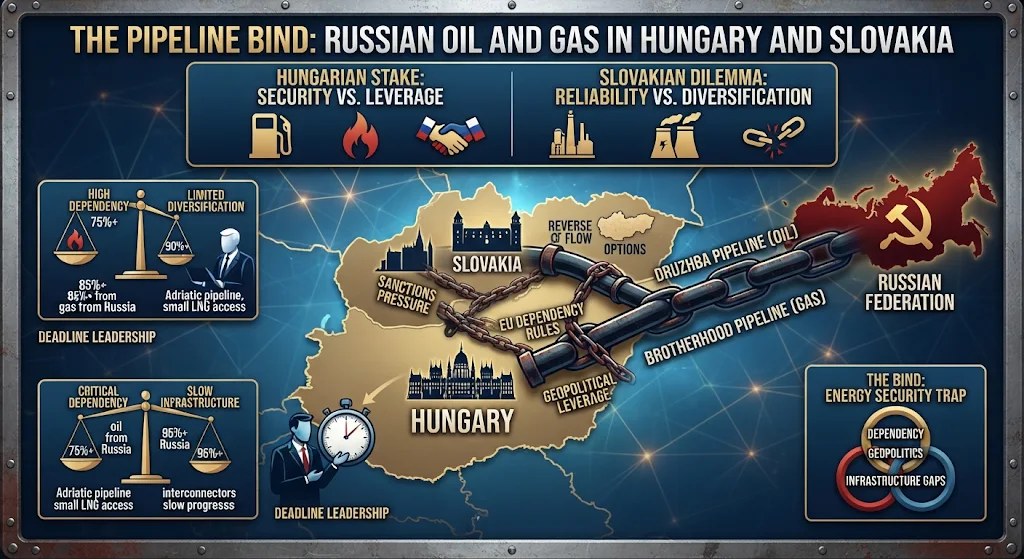
Hungary’s and Slovakia’s energy relationship with Russia has been shaped by two Soviet-era pipeline systems: Druzhba for oil and Bratstvo for gas. Druzhba began carrying Russian crude to Central Europe in the 1960s, linking supply directly to refineries built around its steady flows. Russian oil often arrived at discounted prices, while transit fees and the refining and resale of petroleum products created economic benefits beyond the purchase of crude. These commercial advantages became closely connected to infrastructure that was difficult to replace quickly.
By 2026, Druzhba’s southern branch remained the final route delivering Russian oil into the European Union. It supplied MOL Group’s Duna refinery in Hungary and Slovnaft’s refinery in Slovakia, maintaining a direct link between Russian production and both countries’ fuel markets. Their exposure, however, is not identical. Hungary has access to other supply options and greater scope to manage disruptions, whereas Slovakia relies heavily on its single major refinery and has comparatively limited storage. A prolonged interruption can therefore create sharper practical constraints for Slovakian fuel supply, even when alternative crude can be sourced.
Gas followed a different trajectory. Bratstvo, also known as the Brotherhood pipeline, historically carried Russian gas through Ukraine toward Central Europe and helped anchor long-term supply relationships. Its role changed when Ukraine allowed its Gazprom transit agreement to expire on 31 December 2024, ending Russian gas flows through that route. Supplies to the region could then be redirected through other infrastructure, including the TurkStream and Balkan Stream system, rather than continuing through Ukraine. This distinction matters: Russian oil continued to reach Hungary and Slovakia through Druzhba under a specific exemption from EU restrictions, while gas transit through Ukraine stopped and remaining flows depended on alternative routes and arrangements. The two pipelines thus created related but separate forms of dependence, with different routes, policy conditions, and vulnerabilities.
The European Union’s sixth sanctions package, adopted in June 2022, targeted Russian oil imports as part of its response to the invasion of Ukraine. It prohibited seaborne deliveries of Russian crude, while granting a temporary exemption for oil transported by pipeline. The carve-out recognized that Hungary, Slovakia, and Czechia were landlocked and heavily dependent on the Druzhba pipeline, and that replacing those supplies would require time, infrastructure investment, and adjustments to refinery operations. The exemption was therefore framed as a transition measure, rather than a permanent guarantee of access to Russian crude.
The three countries made different choices. Czechia pursued an alternative route, investing about €65 million to expand the capacity of the Transalpine Pipeline (TAL), which can carry oil from ports in Italy to Central Europe. The upgrade helped it reduce reliance on Druzhba, and Czechia ended imports of Russian oil by April 2025. Hungary and Slovakia, by contrast, continued receiving Russian crude through the pipeline. Their refineries and established logistics remained closely aligned with those supplies, and the available alternatives did not offer an equally straightforward replacement. In February 2025, the two countries also received an additional exemption allowing them to trade with each other in products refined from Russian pipeline oil.
These arrangements preserved continuity for refineries, fuel markets, and cross-border supply chains in Hungary and Slovakia. They also limited the immediate costs and operational disruption that a rapid switch could have caused. Yet continued dependence carries strategic and political risks. Both countries remain more exposed to interruptions or disputes affecting the Druzhba route, including disagreements involving transit states. Their reliance also distinguishes them from Czechia and other EU members that have moved away from Russian crude, prompting criticism that a measure designed to provide adjustment time has enabled prolonged dependence. The result is a persistent tension between the practical value of stable supplies and the EU’s broader effort to reduce revenues and leverage associated with Russian energy exports.
The end of Ukrainian gas transit changed the routes supplying Slovakia and increased Hungary’s importance in the regional market. Shortly before the transit contract expired, Slovak Prime Minister Robert Fico visited Moscow. Gazprom subsequently redirected flows through the TurkStream pipeline and Hungary, shifting deliveries toward southern Slovakia. This rerouting made Hungary a more influential transit and supply corridor for its northern neighbour. The Hungary–Slovakia interconnector can carry roughly 3.5 billion cubic metres of gas annually, equivalent to around 75% of Slovak demand. Its capacity offers an alternative route, but it also ties Slovak supply more closely to infrastructure and arrangements involving Hungary.
Slovakia’s exposure is reinforced by the long-term contract between importer Slovenský plynárenský priemysel (SPP) and Gazprom, which runs until 2034. Bratislava argues that restrictions on Russian gas could leave SPP obliged to pay for contracted volumes that it is no longer permitted or able to receive. The dispute therefore concerns not only the availability of replacement supplies, but also the financial consequences of existing purchase commitments. Hungary’s role as both a transit country and a potential source of supply gives it additional leverage as the two governments weigh energy security, contractual obligations and the European Union’s phaseout timetable.
Regulation 2026/261, adopted on 26 January 2026, sets that timetable: Russian LNG supplied under long-term contracts is to be banned from 1 January 2027, followed by a ban on Russian pipeline gas from 30 September 2027. Listed penalties are €2.5 million for individuals and, for companies, €40 million or 3.5% of worldwide turnover. Slovakia challenged the measure in case C-398/26, filed on 24 April 2026, arguing that it required unanimous approval rather than the procedure used. Hungary also brought a legal challenge. As of October 2026, no interim ruling had been issued; proceedings could take several years, leaving governments and importers to plan amid continued legal uncertainty.
The European Union had not yet completed a permanent ban on Russian oil, despite the European Commission’s pledge to propose one by the end of 2027. The delay has reflected a difficult mix of market and political pressures. Disruptions linked to conflict in the Gulf have heightened concern about global supply and prices, while the dispute over the Druzhba pipeline has sharpened questions about the reliability of existing deliveries. For Hungary and Slovakia, those conditions have strengthened the argument that continued access to Russian crude is necessary to protect domestic supply and limit costs. Higher oil prices make that case more politically compelling, particularly where governments warn that a sudden change could expose consumers and industry to additional expense.
The EU’s position is that alternative routes can supply the two landlocked countries, meaning Russian oil is not the only practical option. Croatia’s Adria pipeline offers a concrete example: it has carried non-Russian crude to the region during disruptions to Russian deliveries. Its use demonstrates that replacement supplies can reach refineries through another route, and European officials have pointed to such infrastructure in arguing that dependence can be reduced. However, the existence of a route does not by itself settle whether it can meet the countries’ needs consistently, or on terms that governments and refiners consider acceptable. Capacity, access, timing and the mix of available crude all influence how straightforward a transition would be.
Transport costs have become a central point of disagreement. One analysis put Adria pipeline tariffs at about €12 per tonne, while Slovak Prime Minister Robert Fico claimed that the charges were roughly five times the transit costs associated with Druzhba. The competing figures frame the alternative not only as a logistical question but also as a dispute over who bears the financial burden of diversification. The unresolved issue is therefore broader than whether another route exists. It concerns the cost of using it, the security and continuity of supply amid regional disruption, and the speed at which Hungary and Slovakia can replace Russian crude without creating new vulnerabilities or imposing substantial costs on their economies.