

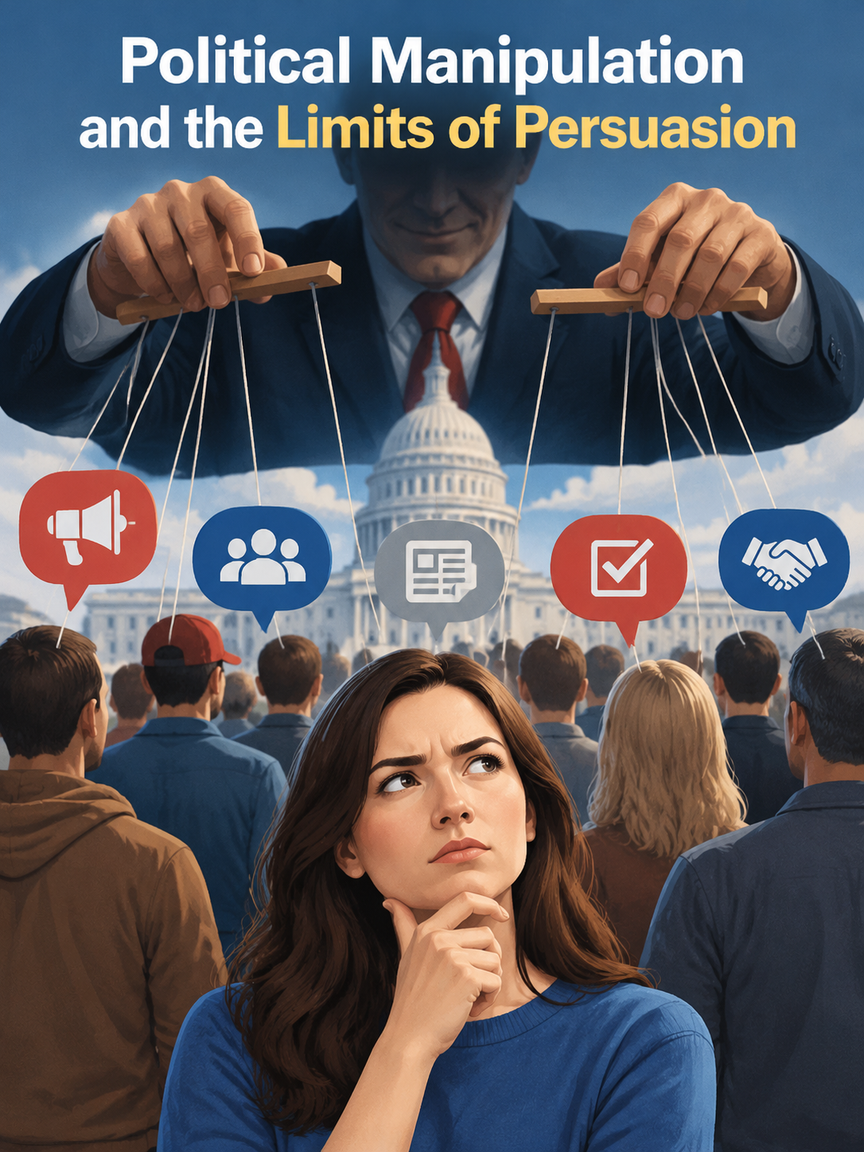
Political influence takes many forms, and not every effort to shape public opinion is manipulative. Campaigns make arguments, governments frame policy choices, and public figures seek support for particular priorities. Even indirect influence, such as arranging options or emphasizing selected consequences, may be legitimate. The central question is not simply whether someone is trying to influence citizens, or whether every statement is true. It is how that influence works and what it permits people to understand and decide.
Persuasion generally addresses people as reasoning agents. It presents claims, evidence, and considerations that audiences can examine, challenge, or reject. Persuasive communication can be selective or emotionally powerful without necessarily denying people a meaningful chance to judge it. Manipulation, by contrast, steers choices through methods that weaken or evade such judgment. It may conceal relevant information, exploit fear or insecurity, target a person’s particular vulnerabilities, or create conditions that discourage reflection. A message can therefore be factually accurate yet manipulative, while an attempt to persuade can include an error without automatically becoming manipulation.
Intent matters, but it does not settle every case. A speaker’s deliberate effort to mislead is significant; so are the methods used and the likely effects on the audience. Concealment may make influence difficult to recognize, while pressure can narrow the practical ability to consider alternatives. Subtle nudges occupy a contested middle ground: they may help people navigate choices, or they may covertly channel behavior toward an outcome that serves those designing the choice. Their legitimacy depends partly on transparency, the importance of the decision, and whether people retain a fair opportunity to assess and resist the influence.
These distinctions are not always clear-cut, because persuasion, deception, and nudging can overlap. The broader concern is political power: manipulation is not merely a technique for circulating false information. It is a way of governing or directing citizens by shaping the conditions under which they form judgments. Assessing it requires asking whether political actors respect people’s capacity to evaluate reasons, or instead seek advantage by obscuring, exploiting, or bypassing that capacity.
Political manipulation matters because influence can undermine freedom without relying on force or an outright falsehood. A message may use technically accurate claims yet omit relevant context, provoke fear, or present alternatives in a misleading order. In such cases, the concern is not simply whether a person said yes or no. It is whether the decision was formed through a process that allowed genuine judgment, rather than one engineered to bypass it. The absence of coercion does not, by itself, establish that a choice was autonomous.
Autonomy involves more than selecting from available options. It includes a meaningful opportunity to access relevant information, weigh reasons, and reflect on one’s priorities. Emotional appeals are not inherently manipulative: concern, hope, and solidarity can be legitimate parts of political life. But an influencer may exploit these responses, conceal a self-serving agenda, or use timing and repetition to narrow attention. A person can then feel that a decision was freely made while the conditions for making it have been carefully shaped. The power at issue lies partly in controlling what people notice and how they interpret their options.
This distinction helps separate a transparent nudge from covert steering. A public reminder about voter registration, for example, may make it easier for people to act on an interest they already hold. Its purpose and operation are visible, and it need not obstruct other choices. By contrast, a campaign that secretly targets people’s anxieties to advance an undisclosed objective may benefit the persuader at the audience’s expense. Both approaches influence behavior, but transparency and alignment with the audience’s interests affect whether that influence supports or diminishes agency. Political freedom therefore depends not only on the choices formally available, but also on the informational and social conditions surrounding them. When those conditions are manipulated, people may retain the appearance of choice while losing some capacity to judge independently. Recognizing this form of power makes it possible to assess persuasion by asking not only what outcome it produces, but how it shapes the decision-maker’s ability to understand, deliberate, and choose.
Political manipulation did not begin with social media, targeted advertising, or fabricated online stories. Across history, rulers and political movements have tried to shape how people interpret events and judge possible courses of action. Ancient authorities used public ceremonies, monuments, official records, and speeches to present power as legitimate and opponents as dangerous. Later governments circulated pamphlets, staged displays, or controlled newspapers to promote particular accounts of conflict. Such efforts were not always wholly deceptive: they often combined accurate information with selective emphasis, omission, and emotionally charged framing.
Recurring methods include propaganda, selective disclosure, scapegoating, and appeals to fear or loyalty. During wartime, leaders have highlighted victories while withholding setbacks, described criticism as disloyalty, and attributed complex social problems to a single group. These approaches can narrow public attention and make alternatives seem impractical or threatening. Manufactured consent may also emerge through repeated claims from trusted institutions, especially when opposing voices have limited access to public platforms. Yet political persuasion is not inherently manipulative. Arguments that present evidence, acknowledge uncertainty, and allow scrutiny differ from tactics designed to conceal relevant facts or undermine independent judgment.
The continuity lies in the effort to influence which events matter, whose testimony deserves belief, and what choices appear available. In different eras, control over courts, schools, religious institutions, or print media has helped establish dominant interpretations. Contemporary communication technologies have not invented these dynamics, but they can accelerate and extend them. Broadcast networks once delivered messages to large audiences; digital platforms can circulate them instantly, tailor content to narrow groups, and reinforce attention through recommendation systems. The result is a familiar political contest conducted at greater speed and scale. Understanding its history helps distinguish ordinary advocacy from manipulation and highlights why access to diverse information, credible sources, and open debate remains important.
Contemporary political manipulation rarely depends on a single fabricated claim. It can combine misleading statements, emotionally targeted messages, deliberate ambiguity, and carefully selected evidence to steer attention toward a preferred interpretation. A campaign may emphasize a genuine statistic while omitting its context, present a complex choice as an urgent threat, or use language broad enough to reassure different audiences for incompatible reasons. These techniques shape not only what people believe, but also which questions seem worth asking.
Misinformation is one instrument in this broader process, not its defining feature. Accurate facts can be arranged selectively, repeated without relevant qualifications, or delivered at a moment designed to provoke fear or anger. A message may therefore be factually defensible yet still conceal a sponsor’s motives or narrow the choices citizens perceive as available. Assessing manipulation requires attention to framing, omissions, timing, and purpose, as well as checking whether individual claims are true.
The costs extend beyond mistaken beliefs. When people are treated primarily as emotional targets, they have less opportunity to weigh competing reasons and make independent judgments. Public debate can become polarized around simplified narratives, while meaningful questions about policy and consequences receive less attention. Repeated exposure to strategic distortion may also weaken trust in institutions, journalism, and fellow citizens. If officials can avoid scrutiny by controlling what information is visible, democratic accountability becomes harder to exercise.
Practical questions can help identify when persuasion crosses this line: Who benefits from the message? What relevant information is missing? Can the methods and evidence withstand open public scrutiny? Most importantly, does the communication treat citizens as reasoning participants, or as targets to be managed? Political persuasion is a legitimate part of democratic life, but its methods matter. Protecting people’s capacity to decide for themselves requires transparency, access to context, and respect for disagreement. These standards do not eliminate influence; they help ensure that influence leaves room for informed judgment and meaningful choice.