


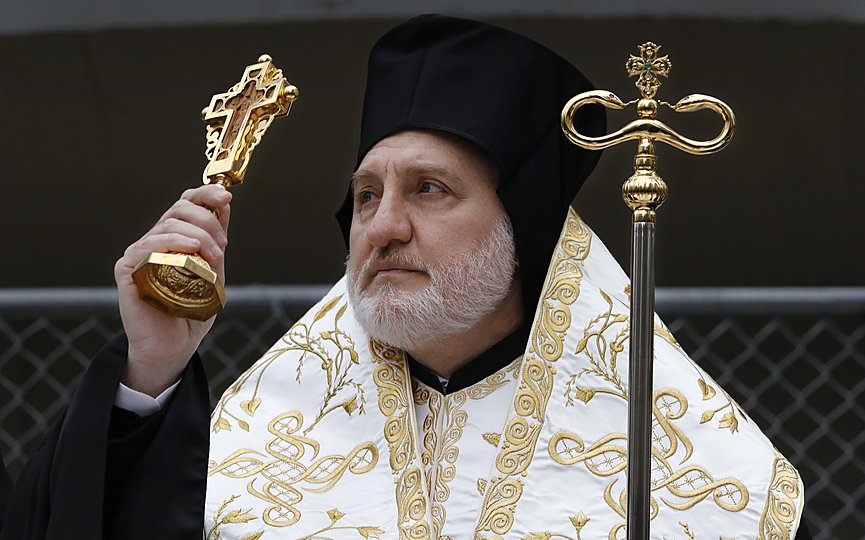
In an opinion piece published by the Turkish news site Haberler, journalist Ahmet Almaz advances a succession-focused interpretation of tensions surrounding the Greek Orthodox leadership. The article is titled “Trump’s Plan for the Patriarchate and Elpidophoros’ Shadow over Bartholomew.” Its central premise is that Archbishop Elpidophoros of America is being discussed as a possible successor to Ecumenical Patriarch Bartholomew, and that he supposedly has backing in Washington. These are claims and framing presented by Almaz; the article’s assertions do not, by themselves, establish that a succession plan exists or that U.S. officials support one.
Almaz places the reported speculation within a wider account of church politics and international influence. In the article’s portrayal, Balat and the Phanar—the Istanbul neighborhood and headquarters associated with the Ecumenical Patriarchate—are not merely local religious settings. They become a point of intersection between ecclesiastical authority, relations with Turkey, the position of Orthodox communities, and the interests of foreign governments. This geopolitical framing encourages readers to view internal church leadership questions as potentially connected to diplomacy, although the piece’s interpretation should be distinguished from independently verified developments.
The title’s reference to a “shadow” over Bartholomew signals the article’s suggestion that Elpidophoros’s profile could affect perceptions of the incumbent patriarch and the future of the office. Almaz presents Washington’s alleged interest as part of that scenario, while positioning the patriarchate as a site where political calculations and theological responsibilities may overlap. The piece therefore offers a particular reading of possible succession dynamics, rather than a confirmed account of decisions or endorsements. Readers should treat its assertions about candidates, U.S. support, and strategic intent as attributed commentary unless corroborated by reliable evidence. That distinction matters because discussion of a potential successor is not equivalent to an official nomination, and speculation about foreign backing does not demonstrate government involvement. The article’s emphasis is consequently less a report of a settled transition than an argument about how Elpidophoros’s visibility might be interpreted amid broader church and diplomatic relationships.
The Haberler article connects Ecumenical Patriarch Bartholomew’s approaching 86th birthday with questions about his capacity to continue carrying out the responsibilities of his office. It suggests that his age and alleged difficulty performing certain duties have become part of a wider discussion about the patriarchate’s future. These points are presented as claims in the article, not as established medical or institutional facts. The account provides no independent documentation confirming that Bartholomew is unable to fulfill his role, nor does it establish that his birthday has prompted an official succession process. Its description is therefore best understood as the article’s interpretation of a possible leadership question.
Within this framing, the article portrays alleged concerns about Bartholomew’s performance as a catalyst for a contest over who might eventually succeed him. It describes a struggle taking shape around leadership of the Orthodox Church, while offering a narrative rather than independently substantiated evidence of organized campaigning or a formal race. Discussion of possible succession does not, by itself, show that a contest is underway, and the supplied account does not confirm that Bartholomew has announced plans to step aside. Its assertions about his age and duties remain attributed claims, not verified conclusions about his health, authority, or timetable for departure.
Haberler identifies Archbishop Elpidophoros as the leading figure in this supposed succession contest. It further associates him with political circles in Washington, including people around Donald Trump and Paula White. Those associations are part of the article’s account and should not be treated as proof of political coordination, influence, or a connection to any succession effort. The supplied material offers no independent verification of either Elpidophoros’s alleged position in a contest or the extent and significance of the relationships it describes. Taken together, the article’s portrayal links leadership speculation with political context, but the claims remain unconfirmed. Readers should distinguish its reported allegations from verified developments involving Bartholomew, Elpidophoros, or U.S. political figures.
Unnamed hierarchs of the Ecumenical Patriarchate, speaking to The National Herald (TNH), disputed both the circumstances and the purpose of the Turkish article at the center of the succession controversy. They characterized its publication not as neutral reporting, but as a directed effort to present Metropolitan Elpidophoros as a prospective successor to Ecumenical Patriarch Bartholomew. In their account, the article’s effect was also to expose and undermine Bartholomew publicly, at a moment when questions about the Patriarchate’s future leadership were attracting attention. These interpretations were attributed to the hierarchs; the account does not independently establish the article’s intent or the motives behind its publication.
The speakers further alleged that influential lay figures associated with the Greek community of Constantinople had a role in promoting Elpidophoros’s prospects. TNH’s report presents these assertions as the views of its unnamed sources, rather than as verified findings, and does not provide independent evidence establishing the involvement or actions of the individuals alluded to. The distinction matters because claims about a coordinated campaign, particularly when they concern identifiable community members, remain allegations unless supported by corroboration. The reported comments therefore describe how some hierarchs interpreted the episode, not a confirmed account of a succession plan or a settled position across the Patriarchate.
TNH also reported that members of the patriarchal court had discussed claims that substantial financial resources were being assembled or used in anticipation of a succession. One allegation relayed to the newspaper was that Elpidophoros possessed and deployed large sums in connection with such efforts. The report, as described, offers no substantiation for that claim, including documentary evidence or independently confirmed details about the alleged funds or their use. It also provides no response from Elpidophoros addressing the accusations. Accordingly, the statements should be treated as attributed claims made by unnamed sources, not as established facts. The available account records serious allegations about influence, money, and succession politics while leaving key questions unresolved and without a public answer from the person they concern.
The available material supports a limited set of conclusions. Haberler published an opinion article that raised questions about succession at the Ecumenical Patriarchate. It included claims concerning Patriarch Bartholomew’s capacity to continue carrying out his responsibilities, Archbishop Elpidophoros’s possible ambitions, and alleged political backing. The National Herald, in turn, quoted unnamed sources who disputed the article’s motives and offered further allegations. These accounts show that a succession narrative has entered public discussion, but they do not independently establish the claims made by either side.
In particular, the information presented does not demonstrate that a formal contest to succeed Bartholomew is underway. It does not verify assertions that Elpidophoros has support in Washington, substantiate claims about financial arrangements, or confirm that Bartholomew is unable to perform his duties. The competing statements are attributed to an opinion article and anonymous sources; without corroborating evidence or on-the-record confirmation, they should be treated as claims rather than settled facts. Nor does the existence of public speculation alone establish that church authorities have begun a succession process.
Readers should therefore distinguish what each publication reported from what remains unconfirmed, and avoid treating allegations about personal motives or political influence as established findings. Succession-related reporting requires careful attribution, corroboration from reliable and appropriately placed sources, and attention to the institutional and religious context of the Ecumenical Patriarchate. That context matters because leadership questions may involve established procedures, church relationships, and considerations not visible in public commentary. On the material available here, the prudent conclusion is not that a succession struggle has been proven, but that questions have been raised and remain unresolved. Further evidence, including clear confirmation from relevant participants or documented institutional action, would be needed before drawing stronger conclusions.