


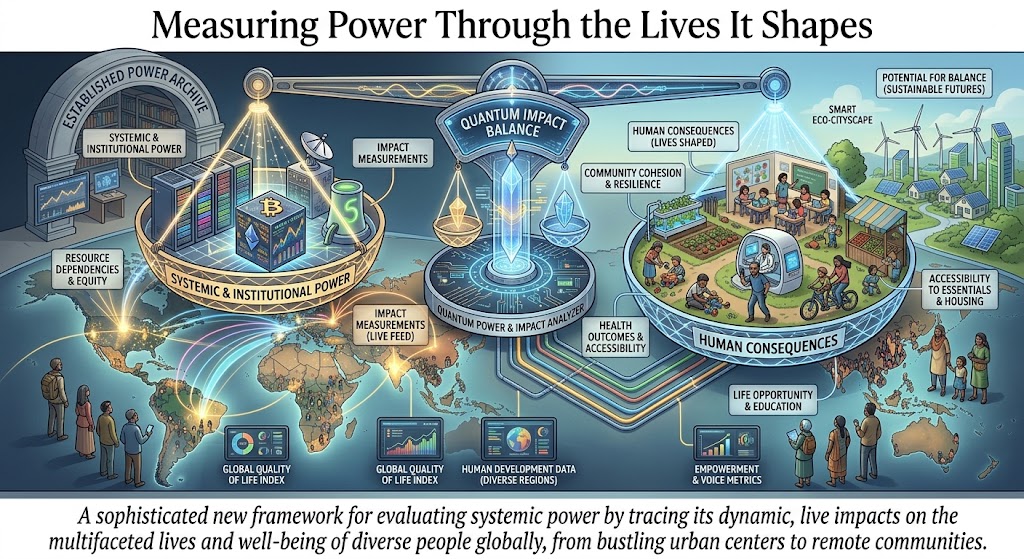
A government’s strength is often described through economic output, productivity, military capacity, or control of territory. These measures can matter, but they do not show whether people are safer, freer, healthier, or better able to shape their lives. The ordinary-person test asks what public decisions actually do to those who live with their consequences. “Ordinary person” is deliberately broad: it includes majorities and vulnerable groups, dissidents and minorities, refugees, displaced and stateless people, and people affected beyond a country’s borders. No group should disappear from the assessment simply because it has little political influence or falls outside official statistics.
The test examines four connected dimensions. Protection concerns whether people are kept from physical danger. Capability asks whether they have real opportunities to exercise freedom, obtain health care and education, earn an income, and pursue meaningful goals. Equity considers how benefits, burdens, and risks are distributed. Correctability measures whether people can challenge harmful decisions, stop them, and secure remedy or repair. This framework echoes Amartya Sen’s account of development as the expansion of real freedoms: progress is not merely more production, but greater ability to live and act with choice. Performance in one dimension cannot erase failure in another. A secured border may coexist with curtailed freedom; rising output may leave households less secure.
Rights and non-discrimination should therefore operate as minimum thresholds, not as costs that aggregate gains can simply outweigh. Averages and headline figures can conceal who has lost safety, income, opportunity, or a voice, so assessments must examine outcomes across different groups. The order of concern in security should be the human being, then security, then the state. States and borders matter: violent upheaval can destroy rights, while state failure can expose people to anarchy or domination. Yet the state is an instrument for protecting life and dignity, not an end in itself. Preserving it has limited value if its people are dead, impoverished, or denied any credible future.
Before presenting a policy as a success, leaders should ask how many people will be safer, how many will live better, who gains, who pays, and who was excluded from consultation. They should identify effects on children, older people, disabled people, low-income households, and other vulnerable groups, rather than treating the public as a single beneficiary. They should also examine consequences for people beyond national borders, including displaced communities, trading partners, and populations exposed to environmental or security risks. A credible assessment describes not only intended gains but also who bears the immediate costs and whether those costs are fairly shared.
The same test applies in conflict and economic policy. Resistance may preserve freedom, while compromise may avert destruction; neither choice should be defended through territory or national prestige alone. Leaders need to explain what a sacrifice protects in people’s lives, what alternatives were considered, and how likely benefits compare with foreseeable losses. They must weigh present safety and comfort against future welfare, and distinguish sacrifices imposed now from benefits promised later. If families are asked to endure hardship for a distant outcome, the terms, evidence, and time frame should be stated clearly. Uncertainty should be acknowledged, not obscured by confident slogans.
Economic growth can coincide with insecurity, household debt, and anxiety, so GDP alone cannot show that lives have improved. Reforms, economic transitions, and defence policies may meet official targets while severely harming families and communities. Leaders should examine lived outcomes, not just national averages, and account for the political pattern in which costs are borne privately but justified collectively. The phrase “we must” can conceal who is paying. They should say who is responsible if a policy fails, whether it can be reversed, and what remedies are available to those harmed. Success is credible only when its distribution, consequences, and prospects for repair are openly addressed.
Good intentions and confident forecasts are not evidence that a decision will work. Every government makes choices with incomplete information, and policies can produce harms that were not anticipated. The relevant test is whether institutions can detect those harms, limit their spread, stop a failing course, and repair damage before a crisis makes correction unavoidable. A resilient state treats error detection as part of governing, not as an admission of weakness. It builds routine ways to gather evidence from affected people, review outcomes, and revise policy while meaningful options remain.
Democratic feedback mechanisms help make that process possible. Elections allow citizens to replace leaders peacefully, while a free press can investigate consequences and convey information beyond official accounts. Independent courts, opposition parties, civil society organizations, universities, audits, and oversight bodies can test claims, expose failures, and press for remedies. Protest can also make overlooked costs visible. These channels do not guarantee sound decisions, but they give the public ways to challenge authority and give decision-makers access to criticism they may otherwise miss. Their value depends on being able to operate without retaliation or political control.
When scrutiny is treated as aggression, oversight is captured, or dissent is branded treason, leaders lose information and people lose practical means to demand change. Political systems carry different risks, not a simple ranking. Authoritarian governments may act quickly from the top, but narrow feedback can conceal systemic failures until they are severe. Democracies may sustain open criticism, yet polarization and the weaponization of information can make facts harder to establish and turn elections into contests of identity. Across systems, the central standard is whether reliable information about mistakes reaches decision-makers while there is still time to act. The capacity to correct is therefore a practical measure of whether power remains answerable to the people affected by its choices.
The ordinary-person test can make political crises legible by asking what decisions mean in daily life rather than treating a headline or poll as a final judgment. A reported 33% approval rating for Donald Trump in August 2026, for example, might suggest a substantial gap between promises and many people’s experience. Yet the figure cannot stand alone: readers need its polling source, sample, question wording, fieldwork dates, and comparison with earlier measures. Polling records opinion at a moment; elections, courts, and other institutions translate public judgment through different rules and constraints. In polarized settings, citizens may dispute not only conclusions but also which evidence to trust, making shared assessment harder.
Romania illustrates a different difficulty: responsibility can be dispersed across successive governments, politicized institutions, and reforms announced but later abandoned. When costs build gradually—through weaker services, lost trust, or delayed opportunities—people may struggle to trace them to specific decisions. Officials can point to predecessors, coalition partners, agencies, or legal constraints, while each institution presents itself as unable to act alone. The result is not merely uncertainty about who deserves blame; it is uncertainty about who has the authority and obligation to repair the damage. Political accountability becomes harder when the chain from decision to consequence is long, and when those asked to explain outcomes also shape the institutions that evaluate them.
This pattern differs from a system centered on one dominant leader, where authority may be more visible and responsibility easier to identify in some cases. But visibility alone does not guarantee a remedy. Conversely, diffuse responsibility can be especially difficult to address when many institutions participate and each can deflect blame. The ordinary-person test therefore asks more than whether leaders deliver on stated goals. Are people safer, freer, and more able to live with dignity? Are rights respected and burdens fairly shared? Can citizens identify who made consequential choices, stop decisions that are causing harm, and repair them through effective institutions? These questions make the test a demanding standard for judging power: it measures not only what a government claims to achieve, but whose lives its choices shape and whether those people can hold it to account.