

Access to cancer care remains uneven around the world. In many low- and middle-income countries, health systems do not have enough equipment, trained professionals or supporting services to provide timely diagnosis and treatment. Gaps can affect the full pathway of care, from diagnostic imaging and nuclear medicine to radiotherapy. When these services are limited or unavailable, patients may face delays in identifying disease and fewer opportunities to receive appropriate treatment close to home.
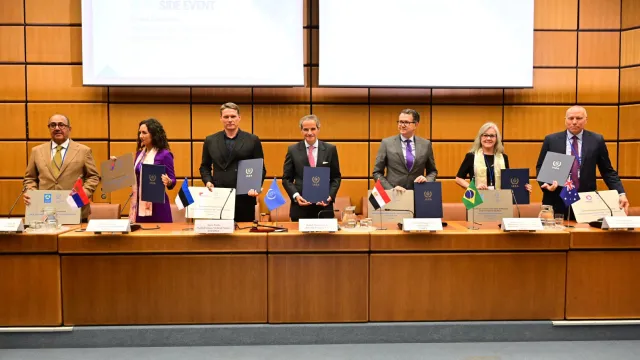
Against this backdrop, the International Atomic Energy Agency (IAEA) signed practical arrangements with six companies on 16 September 2026: Siemens Healthineers, Elekta, GE HealthCare, RaySearch, VERTUAL and AMEX Healthcare. The signings took place during the 70th IAEA General Conference as part of the IAEA’s Rays of Hope initiative, which aims to help expand access to cancer diagnosis and treatment. They were held alongside a side event examining lessons from Rays of Hope anchor centres, where participating countries are working to strengthen cancer services.
The arrangements reflect an approach that brings together complementary capabilities. Industry partners can contribute technology, technical expertise and training, while the IAEA brings experience in radiation medicine, safety standards and international cooperation. Combining these resources is intended to help countries plan and develop services that are appropriate to local needs, rather than focusing only on the installation of equipment. Effective cancer care also depends on skilled teams, safe practices and the systems required to maintain and use technology over time.
Building lasting services is central to narrowing disparities in access. Collaboration can support countries as they strengthen diagnostic and treatment capacity, develop professional skills and reinforce the foundations needed for safe, reliable care. The partnerships announced at the conference therefore form part of a broader effort to translate international cooperation into practical support for national health systems. Through Rays of Hope, the IAEA and its partners aim to help more people access essential cancer services, while supporting countries in establishing capabilities that can be sustained and expanded over the long term.
The six industry agreements are intended to turn the Rays of Hope initiative into practical support for cancer services, particularly in settings where access to radiotherapy remains limited. Partners are expected to contribute equipment and specialized software, as well as access to learning platforms, applications training and technical support. These inputs can help health facilities introduce or improve radiotherapy services and enable clinical teams to use available technologies effectively. The collaboration also creates opportunities to strengthen research and quality assurance, supporting the development of services that are not only more widely available but also dependable and appropriate to local needs.
These contributions work best as a connected package. Installing advanced equipment alone cannot ensure reliable care: professionals need appropriate training to plan and deliver treatment, and facilities need safe operating procedures, ongoing maintenance and robust quality-control processes. Software and technical assistance can support clinical workflows, while education and applications training help staff build the skills to use systems safely. Continued quality assurance can identify issues and reinforce consistent practice. Together, these elements help health services make effective use of investments and sustain their value over time, rather than treating equipment delivery as a standalone solution.
IAEA Director General Rafael Mariano Grossi has emphasized the importance of partnership and the private sector’s role in delivering essential health solutions. The agreements reflect that approach by bringing industry capabilities together with the IAEA’s work to expand access to cancer care. RaySearch, VERTUAL and AMEX Healthcare are joining the initiative as new partners. Siemens Healthineers, Elekta and GE HealthCare, which have already cooperated with the IAEA, are building on that existing collaboration. Their involvement is expected to combine technology, expertise and support in ways that can help countries strengthen both the reach and the quality of radiotherapy services.
Recent contributions under the International Atomic Energy Agency’s Rays of Hope initiative illustrate how industry partnerships can address practical gaps in cancer care. In 2025, Varian, a Siemens Healthineers company, donated a linear accelerator intended for installation at Black Lion Hospital in Addis Ababa, Ethiopia. Once installed and operational, the equipment is expected to increase the hospital’s radiotherapy capacity, helping expand access to a treatment that remains limited in many settings. The donation also highlights the importance of matching equipment provision with the infrastructure, technical expertise and workforce needed to use it safely and sustainably.
Elekta has contributed resources at both clinical and technical levels. The company provided treatment-planning workstations to a Rays of Hope anchor centre in Morocco, supporting the preparation of radiotherapy plans for patients. It also supplied devices to the IAEA Dosimetry Laboratory in Seibersdorf, Austria. The laboratory plays a role in training and research related to dosimetry, the measurement of radiation dose, which is essential to delivering radiotherapy that is both safe and effective. Together, these contributions connect tools used in patient care with the training and technical work that help strengthen practice.
Support for people and professional learning is another part of this effort. GE HealthCare’s fellowship programme has supported medical professionals from 11 countries, helping participants develop skills relevant to cancer diagnosis and treatment. The company has also enabled clinicians from Rays of Hope anchor centres to access learning platforms covering mammography and nuclear medicine. These opportunities can help practitioners build knowledge alongside their daily clinical responsibilities and share it within their institutions. Across equipment donations, laboratory resources and education, the broader purpose is to convert external support into stronger local services. When countries can develop trained teams, maintain appropriate technologies and build reliable care pathways, partnerships can contribute to more sustainable cancer services and improved access for patients over time.
Rays of Hope anchor centres are intended to serve as regional hubs of expertise, helping other developing countries establish, maintain and expand radiation medicine services. Rather than operating as isolated facilities, these centres can share practical experience with health institutions and professionals across borders. Their role includes supporting the planning and delivery of services, strengthening technical capabilities and helping local teams address the operational demands of cancer diagnosis and treatment. This approach recognizes that countries facing comparable resource constraints can benefit from solutions developed in similar settings.
The arrangements create a framework for South-South cooperation, in which knowledge and hands-on support move between countries as well as from international partners to local institutions. Access to advanced technology and software can help centres improve the capacity and reach of their services, while training and quality-assurance support can strengthen safe, reliable practice. These resources are also an investment in people: experienced teams can support the development of the next generation of radiation medicine professionals, building skills that remain within health systems. As local capacity grows, centres may be better positioned to care for patients while sharing learning with neighbouring countries.
May Abdel-Wahab has described the agreements as supporting access, research and development, quality assurance and long-term capacity. These aims point beyond the installation or provision of equipment. The intended outcomes include wider access to cancer diagnosis and treatment, stronger professional skills, safer and more consistent care, and radiation medicine services that can be sustained over time. Regional hubs can contribute to these goals by connecting expertise with practical needs and enabling continued learning among participating institutions. However, agreements alone cannot guarantee lasting results. Progress depends on implementation, ongoing cooperation and the ability of countries and partners to maintain services, develop their workforces and adapt support to changing needs. With that continued commitment, anchor centres can help turn shared expertise into stronger cancer care across regions.