



Industrial wastewater can contain complex pollutants that are difficult to remove through conventional treatment. Electron-beam (e-beam) processing offers a chemical-free alternative: high-energy electrons trigger reactions that break down contaminants, helping improve water quality without relying on added treatment chemicals. The technology can be adapted to different wastewater streams and may support efforts to reduce the environmental impacts of industrial activity.
In 2025, the International Atomic Energy Agency (IAEA) launched a transportable e-beam system at its laboratories in Seibersdorf, Austria. Housed in two shipping containers, the facility is designed to demonstrate treatment applications for liquids, solids and gases. Its transportable format can help experts assess the technology in different settings, while the laboratories provide a place for specialists from around the world to receive training and build practical knowledge. Together, demonstration and training can support the evaluation of e-beam processing as part of wider pollution-control strategies.
Nuclear and isotopic techniques also help protect marine and coastal ecosystems. Mangroves, seagrasses and salt marshes are known as blue-carbon habitats because they capture carbon and store it in plants and sediments. Measuring how much carbon these ecosystems absorb and retain can reveal their contribution to climate regulation and help identify changes in their condition. Isotopic analyses can also provide information about ecosystem health, including how carbon and other materials move through coastal environments.
These methods are useful for investigating pollution and ocean acidification, pressures that can affect habitats and the organisms living within them. Tracing contaminants and studying changes in water chemistry can help scientists identify sources, understand impacts and monitor conditions over time. The resulting evidence gives conservation planners a stronger basis for choosing where to protect, restore or monitor vulnerable areas. It can also inform decisions that safeguard fisheries and seafood quality, supporting both marine biodiversity and the communities that depend on healthy coastal waters. By combining environmental monitoring with reliable scientific data, nuclear techniques help turn observations into practical measures for healthier oceans.
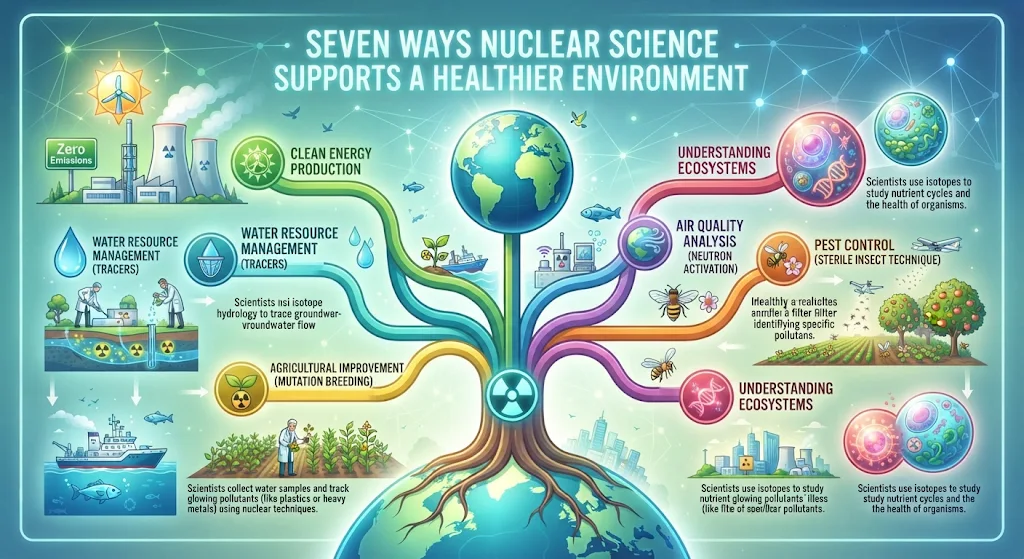
Nuclear techniques can support both environmentally sensitive pest management and more informed decisions about water resources. The Sterile Insect Technique (SIT) reduces pest populations by rearing male insects, sterilizing them with radiation, and releasing them to mate with wild females. Because these matings produce no offspring, repeated releases gradually suppress the population. SIT targets specific species and can limit reliance on insecticides, helping protect crops, beneficial organisms and surrounding ecosystems. Lower pest damage also supports agricultural productivity and can help countries meet the requirements for exporting fruit and other produce.
In Türkiye, scientists with support from the International Atomic Energy Agency (IAEA) and the Food and Agriculture Organization of the United Nations released one million sterile male Mediterranean fruit flies in citrus orchards near İzmir during 2024–2025. Monitoring indicated a 95% reduction in wild female populations. The approach is also used or developed against mosquitoes, tsetse flies, screwworms and moths. By targeting pests without broad chemical treatment, SIT can form part of integrated pest management, alongside surveillance and other control measures. Its effectiveness depends on sustained releases, careful monitoring and adapting operations to local conditions.
Nuclear science also helps address water challenges as glaciers retreat and alter the timing and availability of freshwater, particularly for communities in mountain regions. Cosmic-ray neutron sensors measure soil moisture over broad areas, while isotope hydrology traces water’s origin, movement and age. Together, these methods help researchers assess water availability, understand how glacier loss affects downstream supplies, and improve monitoring where conventional observations are limited. Work supported in countries including Bolivia shows how such measurements can inform land use, irrigation planning and water-resource management. In 2026, the IAEA is launching a research project that combines artificial intelligence with isotope hydrology to address data gaps and improve predictions of water availability. Better evidence can help decision-makers plan for changing supplies, allocate water more effectively and strengthen resilience for agriculture and communities dependent on reliable freshwater.
Fusion research is exploring a potential low-carbon energy source that could eventually provide reliable electricity and broaden the mix of technologies supplying power. However, commercial deployment is not imminent: scientists and engineers are still addressing major scientific and technical challenges, developing components and systems, and preparing the skills and regulatory approaches future projects may require. Continued research is therefore important both for assessing fusion’s prospects and for ensuring that countries can make informed decisions as the technology advances.
The International Atomic Energy Agency (IAEA) supports this work by helping countries build expertise and by encouraging international cooperation. In 2026, it completed a five-year project involving 24 institutions in 18 countries, all working with small- and medium-sized fusion devices. These facilities complement large international projects such as ITER. Their more accessible scale can give researchers opportunities to test ideas, develop innovations and train specialists, while strengthening scientific collaboration across national programmes. A follow-on IAEA project is continuing this cooperation, sustaining links between institutions and supporting further research and training.
Nuclear fission already contributes low-carbon electricity, and the IAEA assists countries considering or operating nuclear power programmes through technical guidance, capacity building and peer reviews. This support is intended to promote safe, secure and sustainable development, tailored to national circumstances. In its September 2026 projections, the Agency raised its global outlook for the sixth consecutive year; under the high-growth scenario, worldwide nuclear generating capacity could more than triple by 2060.
Small modular reactors (SMRs) may offer additional options for remote locations, small electricity grids and energy-intensive industries, as well as data centres and potentially maritime applications. Their proposed designs and deployment models are still developing, and their suitability will depend on factors such as safety, economics, infrastructure and regulation. Microreactors, a smaller category of reactor concepts, may provide power to remote communities and help reduce emissions in industrial sectors that are difficult to decarbonize. The IAEA’s 2026 outlook identified 24 microreactor projects at different stages of development and deployment, reflecting growing interest alongside continuing technical and policy work.
Nuclear reactors are commonly associated with electricity generation, but they also produce substantial heat. In conventional power plants, much of this thermal energy is released rather than put to direct use. Nuclear cogeneration captures some of that heat and supplies it alongside electricity, improving the overall efficiency of the energy system. The approach can make better use of reactor output while providing communities and businesses with services that might otherwise depend on separate fuel-burning equipment.
One established application is district heating, which distributes hot water or steam through insulated pipes to homes, offices and public buildings. Reactor heat can also support cooling systems, including during heatwaves, when demand for air conditioning can place strain on electricity grids. In industry, dependable heat is needed for tasks such as drying, refining and producing materials. Supplying it from a low-carbon source can reduce reliance on fossil fuels, particularly where processes require steady temperatures and continuous operation.
Combined heat and electricity could also contribute to emerging energy and water solutions. Nuclear power can provide the electricity and high-temperature heat used in some methods of producing hydrogen, a fuel and industrial input that may help reduce emissions in sectors that are difficult to electrify. At coastal facilities, reliable power and heat can drive seawater desalination, helping produce drinking water where freshwater supplies are limited. These applications require careful planning, suitable infrastructure and attention to cost, safety and environmental impacts.
Small modular reactors and other developing reactor designs may expand the potential locations and uses of cogeneration. Their scale and configuration could make it easier to match energy supply with local heating networks, industrial sites or water-treatment facilities, subject to regulatory approval and project economics. By coordinating heat and electricity production, communities and industries may meet several needs with one low-carbon energy source. This flexible use of reactor output can improve energy efficiency and support broader efforts to reduce emissions while strengthening essential services.