



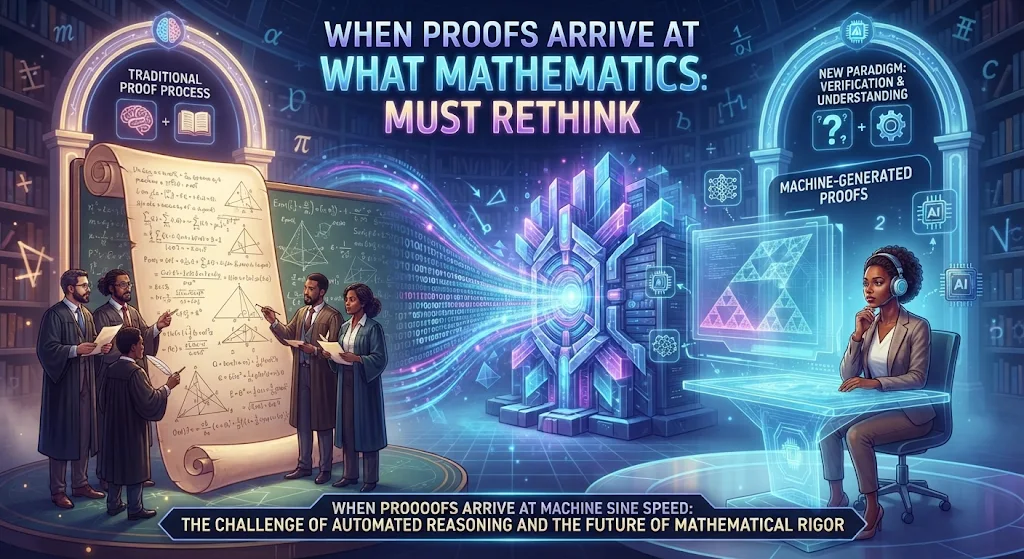
Mathematical research has traditionally advanced through a demanding cycle: a question is posed, possible approaches are explored, and arguments are refined until specialists can evaluate them. Computational systems are beginning to compress the early stages of that cycle. They can generate conjectures, construct long arguments, and produce research-style drafts at a pace that would be difficult for an individual researcher or team to match. The result is a striking change in the volume and speed of mathematical work entering circulation.
One reported release illustrates the scale: more than 700 manuscripts spanning over 370 topics, including work addressing questions connected to longstanding problems such as the Riemann hypothesis. That description should not be mistaken for a claim that these famous problems have been solved. The significance lies instead in the claims and approaches the manuscripts put forward. Each must still be examined by people with relevant expertise, who can assess whether its reasoning is valid, its assumptions appropriate, and its contribution genuinely new. A document that resembles a proof is a proposal for scrutiny, not a verified result.
This creates an imbalance between production and evaluation. A system may generate mathematical material rapidly, but understanding a difficult argument, checking every step, and determining how it relates to decades of prior work remain slower tasks. Specialists must distinguish sound reasoning from plausible-looking gaps, and useful ideas from repetitions or dead ends. The resulting backlog raises practical questions about review, attribution, and how researchers choose what deserves attention. Yet the deeper issue is not simply whether machines can produce proofs. Mathematics has always depended on more than the existence of a formal argument: research is valued for its reliability, insight, explanatory power, and place within a larger body of knowledge. As computational tools expand the supply of possible results, the discipline must reconsider how those qualities are recognized and established.
A mathematical result can be produced without yet being established as reliable knowledge. A proof may be long, machine-generated, or assembled from many computational steps, but its existence alone does not settle whether the conclusion follows from its premises. Establishment requires scrutiny: reviewers must determine whether every argument is correct, how the derivation proceeds, which assumptions and definitions it uses, and whether those assumptions are appropriate to the claim. They must also consider what can be learned from unsuccessful approaches or intermediate steps, which may expose hidden constraints or suggest new questions.
These tasks become difficult when research arrives at a scale that exceeds the available time and expertise. Evaluating hundreds of papers requires more than checking abstracts or accepting reported outputs. Specialists need access to proofs, code, data, and explanations that make independent assessment possible. Yet qualified reviewers are already balancing teaching, research, and service. Mathematical organizations have therefore cautioned that a large volume of submissions may demonstrate computational capacity or production, but does not by itself demonstrate scientific expertise, sound judgment, or mathematical significance. Responsible assessment must distinguish output from validated contribution.
Verification is also inseparable from academic integrity. Research should identify relevant prior work, cite sources accurately, and credit the people whose ideas, methods, or results shaped a contribution. This responsibility applies even when a system produces a proof rapidly: speed does not make intellectual history irrelevant. Reports of disputes about whether earlier mathematicians’ contributions received adequate recognition underscore the need to examine claims of novelty carefully and to document the origins of key ideas. Attribution is not merely a formal requirement; it allows others to understand how knowledge developed and to assess what is genuinely new.
Transparent provenance becomes especially important when systems draw on extensive bodies of existing work. Researchers should make clear what materials informed a result, which parts were generated or checked computationally, and where human judgment entered the process. Such disclosure supports reproducibility, fair credit, and informed review. It also helps readers distinguish a correct formal derivation from a meaningful scholarly contribution—one that is reliable, appropriately situated, and open to independent examination.
Systems that generate mathematical arguments from vast collections of papers, notes, and preprints raise questions beyond technical accuracy. Their source material may include preliminary claims, unpublished drafts, or results later shown to be flawed. If a generated proof depends on such foundations, users need to know which assumptions it inherited and whether they were independently verified. Attribution is equally difficult: a system may combine methods or insights from many contributors without revealing their influence. Copyright and intellectual property rules offer no simple answer when output is novel in form but indebted to human work. Uncertainty about reuse could make researchers cautious about sharing.
Scholarly publishing therefore faces competing responsibilities. Peer-reviewed journals can subject computationally produced claims to expert scrutiny, require sources and methods to be documented, and give readers a stable record to assess. Yet publication behind paywalls or restrictive licenses may limit access to the material needed for replication and collaboration. If researchers cannot inspect training sources or trace an argument’s steps, conventional publication alone may not resolve concerns about reliability. Conversely, refusing to publish machine-assisted work until every provenance question is settled could slow useful research. Supporters argue that no scientific field can remain insulated from technological change; carefully checked computational contributions may accelerate discovery.
The human role may also shift from producing every proof directly toward evaluating, refining, and interpreting machine-generated work. Future systems might propose unexpected conjectures, reveal relationships between distant areas, or produce proofs whose elegance prompts new mathematical ideas. Such possibilities do not remove the need for judgment: mathematicians must test conclusions, identify dependencies, and decide whether a result is meaningful. Clear records of sources, revisions, and verification could help preserve trust while allowing ideas to circulate. If norms balance responsible attribution with practical openness, these tools may become participants in a collaborative process rather than opaque substitutes for it.
Doctoral training has long treated sustained independent work as its defining apprenticeship: students learn a field by mastering techniques, confronting difficult problems, and gradually making original contributions. If computational systems can address some questions in hours that once occupied researchers for years, the purpose of that apprenticeship may need to be stated more clearly. Speed alone cannot define mathematical competence. Training should give greater weight to choosing fruitful questions, recognizing which assumptions matter, and building conceptual understanding that lets students assess whether a result is important, robust, and connected to existing ideas.
This shift would not make calculation or technical skill obsolete. Rather, students may need to learn how to use computational tools critically: checking their reasoning, testing intermediate claims, identifying hidden assumptions, and distinguishing a persuasive output from a valid argument. They must also interpret results and explain why a theorem is true, not merely reproduce a proof. Such abilities prepare mathematicians to evaluate arguments whether they originate with a person, a program, or a collaboration between the two. They also make teaching and assessment more meaningful when routine steps can be automated.
The mathematical dissertation may therefore evolve alongside research tools and expectations. Its value need not depend solely on demonstrating years of effort toward one result; it might also document how questions were selected, how evidence was verified, and what conceptual insight emerged. Whatever form it takes, a correct proof does not automatically provide understanding of a theorem’s significance, the relationships it reveals, or the new questions it makes possible. Computational tools can expand mathematical discovery, but their contribution depends on careful verification, fair attribution, responsible sharing, and human interpretation. Mathematics is not vanishing. Its practices of researching, teaching, assessing, and understanding are changing—and education must help mathematicians navigate that change.