



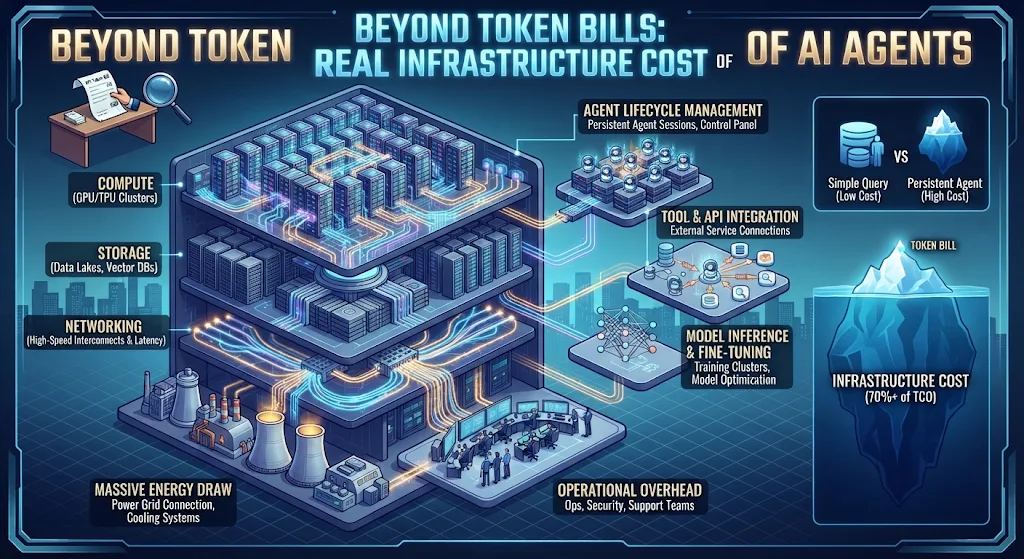
An AI agent is not simply a human user who works faster. A person may open a document, search a system, and make a decision through a handful of deliberate actions. An agent can turn one instruction into a chain of automated steps: retrieving context, querying databases, calling business APIs, searching telemetry, drafting code, running tests, and revising its work. If a tool fails or the result appears incomplete, it may retry, creating still more activity without any additional request from the user.
Token charges reveal only part of this workload. They measure the text processed or generated by a model, but do not necessarily capture the services the agent invokes along the way. API usage, database compute, document retrieval, observability searches, test execution, and supporting infrastructure can each carry separate costs. Some operations may be inexpensive individually, yet a large number of repeated calls across many agents can add up. Background activity also matters: agents can continue gathering information or completing tasks after a person has issued a single instruction.
This creates a finance question that user counts alone cannot answer: why can AI expenses rise faster than the number of employees using the tools? Uber’s reported experience with broad, company-wide adoption of coding assistants offers a useful illustration. As such tools spread, the visible model charges are only one measure of what the organization is paying to support agent-driven work. A coding assistant may use tokens while also searching repositories, interacting with development systems, running tests, and repeating steps when changes do not work as expected. The example is not evidence that every company will incur the same costs; it highlights the difference between a model bill and a broader workload bill. Token-only figures can therefore understate the infrastructure consumed by an agent’s many operations, making a fuller view essential for budgeting and comparison.
Human investigation usually follows a largely sequential rhythm. A person checks an alert, chooses the next source of evidence, reviews what it shows, and pauses to decide where to look next. That pacing limits how many actions occur at once, even when several people are involved. AI agents can behave differently: given a broad objective, they may divide it into subtasks, launch several branches in parallel, and continue iterating or retrying when results are incomplete. A single request can therefore generate far more work than its wording suggests.
Consider an agent asked to investigate rising checkout latency. It might inspect deployment metadata for recent changes, query application logs for errors, compare latency and saturation metrics, follow distributed traces through the request path, and examine downstream services. Each inquiry may expand across regions, time windows, or service instances. The agent could search for a deployment in one branch while tracing slow requests in another, then use findings to create further queries. This parallelism can shorten the time to an answer, but it also increases the number of operations sent to monitoring, logging, and service platforms.
The multiplication is easy to underestimate. If the investigation splits into five parallel paths, each path makes five attempts, and every attempt queries three systems, the request can produce 75 operations: five times five times three. These are illustrative operations, not necessarily 75 unique conclusions, and additional branching or retries can raise the total substantially. Under uncontrolled concurrency, repeated calls may consume shared capacity, increase costs, and trigger rate limits or other throttling. Security systems may also interpret rapid, repetitive requests as suspicious. External services can see the pattern as automated abuse, even when the agent is performing legitimate incident response. Effective agent design therefore needs limits on parallel tasks, retry counts, query scope, and request rates. Monitoring those controls helps teams preserve service capacity while allowing agents to investigate complex problems efficiently.
Treat each AI agent as a distinct production workload rather than an invisible extension of an application. For every run, trace the complete chain from the user’s instruction through model calls, tool use, API requests, database queries, parallel branches, and retries. This end-to-end record shows where work expands, how decisions propagate, and which components contribute to latency and cost. OpenTelemetry offers a vendor-neutral way to collect and correlate telemetry across services and environments, supporting consistent observation even when agents rely on different infrastructure providers. Instrument meaningful boundaries and preserve identifiers that connect user requests to downstream actions.
Monitor six dimensions: request amplification, or how many operations each instruction triggers; concurrency, including simultaneous tasks and branches; retry behavior; investigation depth, such as the number of steps or sources consulted; infrastructure consumption across compute, storage, network, and API capacity; and business value, measured against the outcome the agent was intended to deliver. High activity is not inherently harmful: a complex request may justify many calls. The concern is abnormal activity, including repeated identical queries, rising resource use without improved outcomes, or unusual request volume. Comparing these signals with workload baselines helps teams distinguish necessary effort from waste, errors, or unexpected behavior.
Govern activity with agent-specific budgets and concurrency ceilings, and set investigation-depth limits appropriate to each role. Require stricter authorization for actions with substantial cost or operational impact, and use structured tool interfaces to constrain inputs and make calls auditable. Configure retries with backoff, honor service rate limits, and define stopping rules for futile retries so agents do not continue consuming capacity after repeated failures. Review telemetry alongside task outcomes, then adjust controls when usage patterns or business requirements change. These measures preserve flexibility while making agent workloads predictable, accountable, and easier to manage across production environments.
Permission to inspect systems should not automatically confer permission to modify them. An agent may need read-only access to logs, configurations, and deployment records to diagnose an issue, but changing a setting, restarting a service, or deploying code creates a different class of risk. Treating observation and intervention as one authorization blurs accountability and can turn a routine investigation into an operational incident.
Organizations should authorize actions separately, granting agents only the access needed for each task. Changes that could affect production availability warrant stronger safeguards: restricted tools, explicit limits on the scope of changes, audit trails, and clear rollback procedures. When the potential impact is substantial or uncertain, the agent should pause for human approval rather than proceed autonomously. These controls make it possible to benefit from automated investigation while keeping consequential decisions under appropriate oversight.
Management should also measure what agents accomplish, not just how many tokens they consume or requests they send. A useful evaluation asks whether a task was completed correctly, how long it took, what resources it required, and what business value resulted. For example, a more expensive model may interpret a problem accurately and reach the right answer in a few efficient steps. A cheaper model might appear economical per request yet generate hundreds of unnecessary queries, consume more infrastructure, and delay resolution. The first option can therefore have a lower total cost when downstream usage and the value of a successful outcome are included.
Cost control requires this broader view of the work performed and its consequences. AI agents are autonomous workloads: one instruction can initiate a chain of decisions and turn into a substantial infrastructure event. Organizations need end-to-end visibility into agent activity, resource limits that prevent runaway usage, security guardrails that separate inspection from action, and outcome-based evaluation that connects operating cost to completed tasks and business value. Token and request counts remain useful signals, but they are not a sufficient measure of performance or total expense.