
On 27 January 2026, southern flows through the Druzhba pipeline stopped, turning an interruption in oil transit into a dispute over responsibility. Ukraine attributed the halt to a Russian strike near Brody, a key point in the pipeline network. Hungary and Slovakia instead faulted the pace of Ukrainian repair work, arguing that the delay in restoring transit lay with Kyiv. Neither account received independent verification, leaving the cause and responsibility contested. The competing claims mattered because the pipeline supplies both countries and because the interruption unfolded amid wider disagreements over support for Ukraine and the European Union’s approach to Russia.
Budapest and Bratislava responded with measures that extended beyond oil transit. Hungary suspended diesel exports to Ukraine, while Slovakia stopped emergency electricity support. Both governments also blocked a proposed €90 billion EU loan to Ukraine and the EU’s twentieth sanctions package. Yet the European Commission’s Oil Coordination Group, assessing the situation on 26 February, said there was no immediate threat to supply because the Adria pipeline remained operational. That assessment distinguished a physical shortage from the increased cost and logistical burden of securing oil through an alternative route. Continued supply was possible, but replacing the usual route could be more expensive and politically contentious.
The standoff eased after repairs to Druzhba were completed on 21 April. Oil reached Slovakia and Hungary again on 23 April, restoring flows to the two countries. Hungary then lifted its veto, allowing the EU sanctions package to pass. The sequence linked the restoration of transit with a shift in Budapest’s position, although it does not by itself establish why either event occurred when it did. With no neutral verification of the original cause of the shutdown, the episode exposed how uncertainty around infrastructure damage and repair timelines can shape political disputes. A pipeline interruption may therefore become leverage in wider bargaining, even when alternative routes prevent an immediate supply crisis.
Hungary’s April 2026 election ended Viktor Orbán’s sixteen-year tenure and brought Péter Magyar’s Tisza party to power with a two-thirds parliamentary majority. The result created room for a significant reset in Budapest’s dealings with the European Union and Ukraine. Under the new government, Hungary approved the EU loan for Ukraine and signalled greater willingness to support Kyiv’s European path, reversing key positions associated with Orbán’s administration.
On 3 June, Hungary and Ukraine signed an agreement on minority rights, addressing a longstanding source of tension between the two countries. Budapest also backed advancing Ukraine’s accession process. These moves marked a notable change in political direction: relations with Kyiv, previously strained by disputes and repeated obstruction, began to shift toward structured cooperation. The developments did not, however, translate into an equally rapid transformation of Hungary’s energy arrangements.
Energy Minister István Kapitány said in September that Hungary should be able to end Russian gas imports by October 2027. Oil dependence presents a more difficult challenge: roughly 90% of the country’s crude oil still came from Russia. The government plans to retain access to both the Russian-linked Druzhba pipeline and the Adria route, using alternative infrastructure to diversify supply rather than relying on a single corridor. Hungary has set 2035 as its target for ending dependence on Russian oil.
Household energy prices remain regulated, adding a domestic constraint to decisions about supply and costs. MOL’s refineries may be technically capable of processing non-Russian crude by the end of 2026, an important step toward greater flexibility. Yet technical readiness is not proof that a switch will be commercially viable or implemented at scale. The transition will depend on the cost, availability and reliability of alternative crude, as well as pipeline capacity. Hungary’s political realignment has therefore moved faster on Ukraine policy than on energy: diversification is planned, but the pace of change remains subject to practical and economic limits.
Slovakia’s policy under Prime Minister Robert Fico has combined less confrontational language toward Ukraine with renewed contact with Moscow. Fico softened his rhetoric on the war, and on 4 May 2026 he met Ukrainian President Volodymyr Zelensky in Yerevan. The encounter signalled that Bratislava remained willing to engage Kyiv, even as its approach to energy and relations with Russia continued to reflect distinct economic and political priorities.
A notable step toward Moscow came on 26 October, when Foreign Minister Juraj Blanár attended the first Russian-Slovak intergovernmental commission meeting since 2021 and held talks with Russian Foreign Minister Sergei Lavrov. The sides said they supported stable deliveries of Russian oil through the Druzhba pipeline and agreed to pursue cooperation in the future. They also planned to hold the commission’s next meeting in Slovakia in 2027, restoring a formal channel for bilateral economic dialogue.
Bratislava’s position is shaped in part by the potential cost of exiting long-term energy arrangements. State supplier SPP holds a Gazprom contract running through 2034, with take-or-pay provisions that require payment for specified volumes whether or not they are taken. Estimates of cancellation costs exceed €10 billion and could reach €16 billion. Those obligations help explain Slovakia’s emphasis on continuity of supply, though they do not amount to an announcement of new energy deals.
Indeed, the October meetings produced no new agreements on oil, gas or nuclear cooperation. Slovakia’s renewed engagement with Russia should therefore be understood as an effort to preserve existing supply options and reopen dialogue, rather than as evidence of newly concluded energy commitments. Blanár also offered to host lower-level talks related to Ukraine, indicating that Bratislava was prepared to facilitate discussion on the conflict as well as pursue energy contacts. The combination reflects a mixed course: softer public language toward Kyiv, continued diplomatic engagement with Ukraine, and practical efforts to maintain ties with Moscow amid significant contractual exposure.
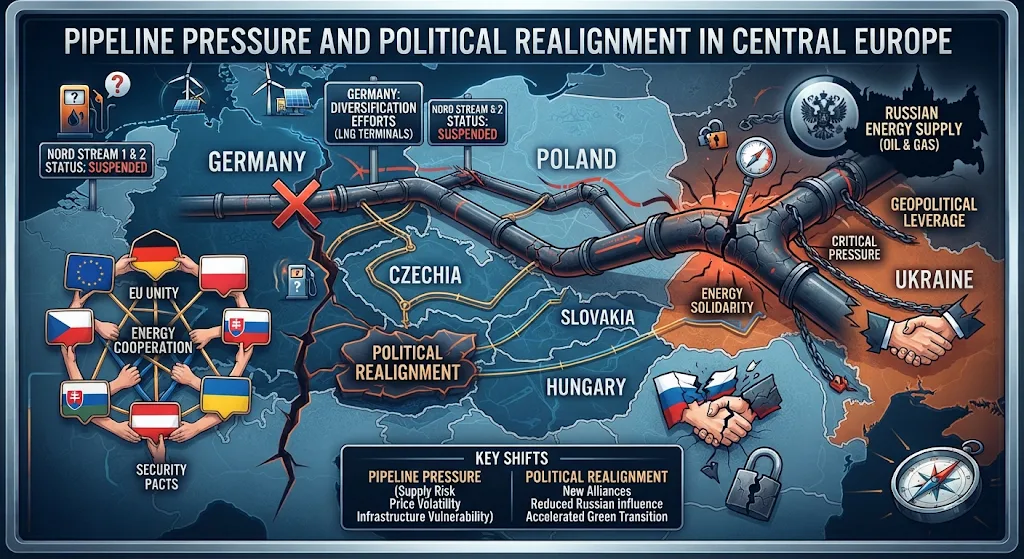
The pipeline crisis did not produce a uniform response in Central Europe; instead, it clarified the distance between Budapest and Bratislava. Hungary’s new leadership moved closer to common European Union positions on Ukraine, reducing the prominence of disputes that had previously set the country apart from other member states. It also signaled that Hungary would seek, over time, to reduce its reliance on Russian gas. These choices marked a political reorientation, but not an immediate break with Moscow-linked energy flows.
Hungary remains substantially dependent on Russian oil, and any transition away from those supplies is expected to be gradual. Existing infrastructure and the practical limits of securing alternative crude mean that political signals cannot immediately change the country’s energy mix. Slovakia, meanwhile, continued to defend its Russian energy ties, citing long-term contractual exposure and the costs of a rapid shift. Its public approach to Kyiv adjusted, but that change did not amount to the same broad alignment with EU policy evident in Budapest. The two governments therefore approached the aftermath of the dispute with different priorities: Hungary sought closer coordination with European partners, while Slovakia emphasized continuity in energy supply.
This divergence changed the political meaning of the Druzhba dispute. As Hungary moved closer to EU positions, it became less likely to serve as a prominent blocker of common policy. Slovakia was increasingly left associated with resistance to shared European measures, even as its stance toward Kyiv became more measured. The shift mattered diplomatically because it altered which government other member states viewed as the principal obstacle to consensus. Yet alignment on votes and public statements should not be confused with rapid energy independence. Diplomatic language can change quickly, while pipelines, refinery economics, and binding contracts shape the pace of diversification. The crisis thus revealed both a political realignment and the limits imposed by material energy dependence.