
The International Atomic Energy Agency (IAEA) helps verify that states meet their commitments to use nuclear material and technology for peaceful purposes. Through safeguards agreements, the Agency applies measures designed to check that declared nuclear material remains in peaceful activities and that relevant facilities and records are consistent with a state’s declarations. These arrangements support confidence among governments and the wider international community, while respecting the specific rights and obligations set out in each agreement.
Independent inspections are a central part of this work. IAEA inspectors may examine facilities, review records, take samples, and use monitoring equipment and other verification tools, subject to the applicable safeguards agreement. The Agency also evaluates information from multiple sources to assess whether its findings align with a state’s declarations. No single measure provides every answer; rather, safeguards combine complementary activities to detect possible diversion and investigate questions or inconsistencies. The resulting assessments offer credible assurance about whether nuclear material is being diverted to weapons programs, while helping identify issues that require clarification. Safeguards are therefore both a technical process and an important foundation for international trust.
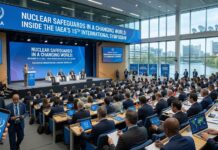
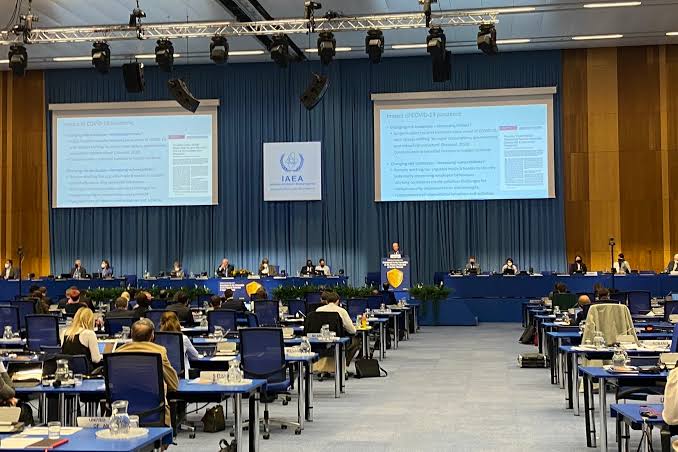
These challenges and methods were at the center of the 15th Symposium on International Safeguards, held in Vienna and online. Organized as a forum for experts and stakeholders to examine the future of nuclear verification, the symposium provided space to discuss evolving technologies, practical experience, and emerging demands on safeguards. About 1,000 people from more than 100 countries and 20 international organizations took part, reflecting the broad international interest in effective verification. The symposium is held every four years, giving the safeguards community a recurring opportunity to share developments, consider lessons learned, and explore how verification can adapt as nuclear science and global conditions change. Its discussions matter because credible safeguards depend not only on established procedures, but also on continued cooperation, technical innovation, and the ability to respond to new risks without weakening confidence in peaceful nuclear activity.
Since the previous Safeguards Symposium in 2022, the environment for nuclear verification has continued to change. Technologies are advancing quickly, while renewed interest in nuclear power and its applications is expanding the range of facilities and activities that safeguards must address. At the same time, geopolitical conditions are shifting, and serious safety and security risks can affect the IAEA’s work in the field. These developments place new demands on verification methods, equipment and the people responsible for applying them.
IAEA Deputy Director General Massimo Aparo framed the response around three shared priorities: innovation, resilience and safeguards as a shared responsibility. Innovation means adapting approaches and tools to evolving technologies and operating contexts. Resilience requires the safeguards system and its workforce to maintain effective operations amid disruption, uncertainty and field risks. Shared responsibility recognizes that verification is not delivered by the IAEA alone. Policymakers, diplomats, national regulators, industry, researchers, technologists and civil society all influence whether safeguards commitments can be implemented effectively.
Progress since 2022 reflects these priorities in practical ways. The IAEA has engaged more closely with industry and regulators to encourage safeguards considerations to be incorporated into nuclear technologies as they are designed and developed. This early engagement can help ensure that verification needs are understood alongside operational and technical requirements. The COMPASS capacity-building initiative has also begun its first regular cycle, supporting participating states in strengthening national safeguards capabilities. Meanwhile, the Agency has continued developing equipment for inspectors, helping them carry out verification work in varied conditions. Together, these efforts show how innovation, institutional preparedness and cooperation can reinforce safeguards. Sustained contributions across the nuclear sector will remain essential as technologies, energy needs and international circumstances continue to evolve.
The symposium’s scientific programme brings together roughly 300 papers, creating a broad forum for examining how safeguards can keep pace with changes in nuclear technology and international verification demands. Participants present research, compare operational experience, and discuss practical methods that can strengthen the effectiveness and efficiency of safeguards. The programme connects technical innovation with the day-to-day realities of inspection, information analysis, and organizational delivery.
Artificial intelligence, machine learning, and advanced analytics feature prominently in discussions of verification. These tools may help specialists process large and varied datasets, identify patterns, and direct attention to issues requiring further assessment. Their value, however, depends on reliable data, appropriate validation, transparency, and expert judgement. Rather than replacing safeguards professionals, analytical systems can support informed decisions when their limitations are understood and their outputs are carefully reviewed.
Other sessions address safeguards approaches for emerging technologies and changing nuclear activities. Small modular reactors raise questions about how verification measures can be designed for different facility layouts, operating models, and deployment settings. Commercial nuclear shipping presents its own practical considerations, including the movement of nuclear material and the need to maintain continuity of knowledge across complex transport arrangements. At the same time, the growing number of nuclear facilities and the increasing volume of material subject to verification require methods that are scalable, adaptable, and sustainable.
These technical challenges make organizational resilience central to the programme. Safeguards organizations must maintain strong performance as workloads, information flows, and expectations increase. That requires capable staff, effective processes, dependable technology, and the ability to adapt while preserving consistency and quality. Resilience is therefore not separate from verification; it is part of the capacity needed to deliver it reliably over time.
The opening plenary frames these themes through keynote contributions on innovation, resilience, and shared responsibility. A subsequent panel considers how the safeguards community can respond to current pressures while making constructive use of emerging opportunities. Together, the sessions emphasize that progress depends not only on new tools, but also on collaboration, sound implementation, and a common commitment to credible verification.
The Vienna symposium is designed not only as a forum for discussing safeguards policy, but also as a practical opportunity to build skills and professional relationships. Its first accompanying Training Days, scheduled from 9 to 13 November, give participants dedicated time to explore the foundations and application of nuclear verification. The programme spans subjects from legal frameworks to verification techniques, helping attendees connect institutional requirements with the work carried out in practice. Participants can also draw on the expertise of the International Atomic Energy Agency (IAEA), gaining insight from professionals engaged in safeguards implementation and development.
This training component recognizes that effective verification depends on a workforce equipped to respond to technical change, evolving security conditions, and the demands of international cooperation. Bringing participants together around shared learning can strengthen understanding across roles and organizations. It also creates space to exchange experience, ask questions, and consider how different forms of expertise contribute to reliable safeguards. Such connections are especially valuable for people entering the field, as well as for established professionals seeking to broaden their knowledge and networks.
People and career pathways will take centre stage in the Wednesday, 11 November plenary, “The People of Safeguards: Perspectives from Across the Community.” The discussion will examine how safeguards work is carried out across international institutions, government, business, and nonprofit settings, and how professionals find their way into these varied roles. A speed-mentoring opportunity with IAEA experts and senior safeguards professionals will complement the session, offering participants a direct way to ask about career development, professional challenges, and the skills needed in the field. By connecting emerging practitioners with experienced colleagues, the event can support a stronger and more diverse safeguards workforce.
Livestreamed plenaries extend the symposium’s reach beyond those attending in Vienna, allowing the wider safeguards community to engage with its discussions. This broader access matters because future verification needs will not be met by any one institution or discipline alone. Continued cooperation across sectors, supported by shared learning and professional exchange, will be central to sustaining expertise, adapting methods, and building the partnerships required for effective safeguards in the years ahead.