

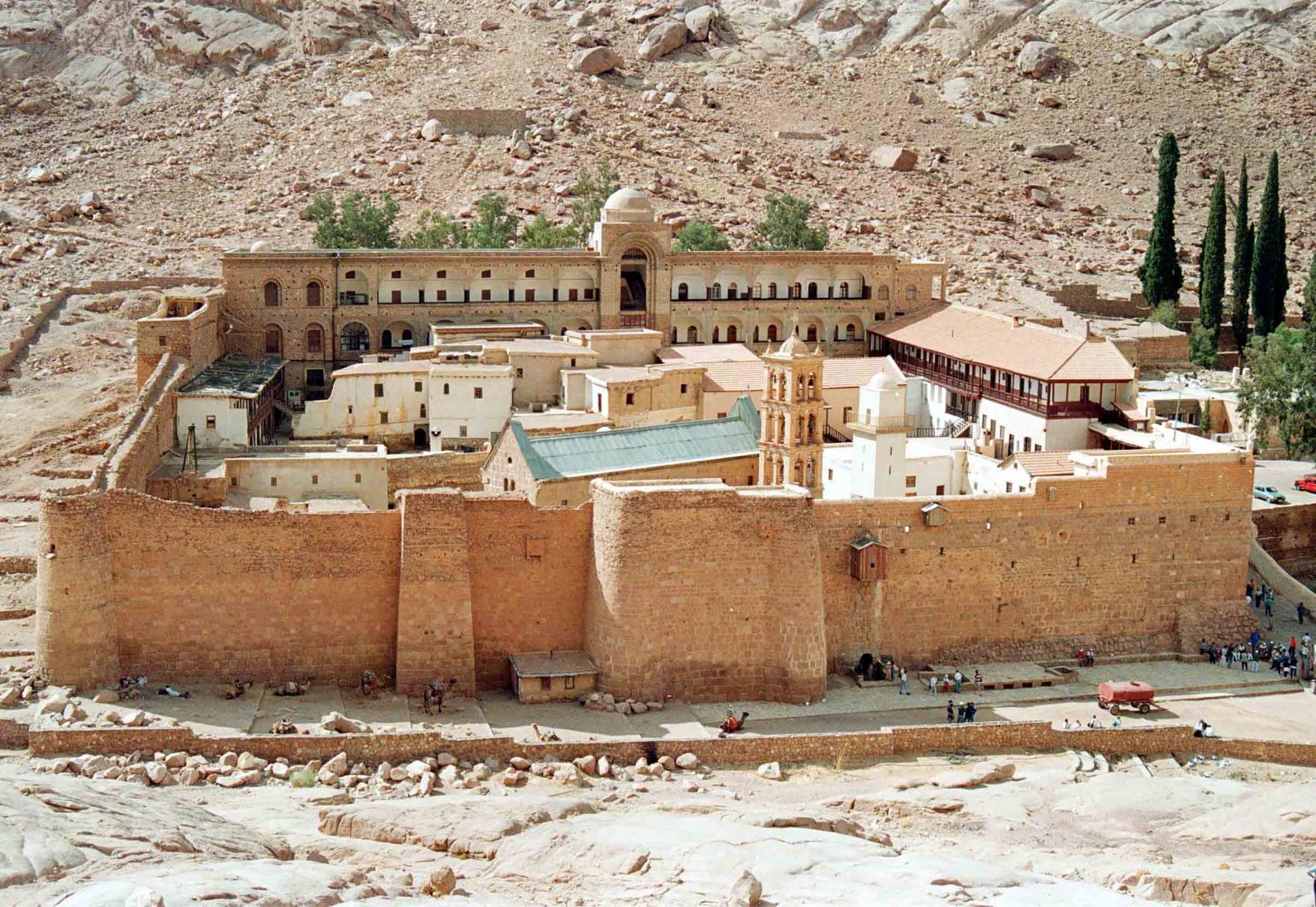
Negotiations over the legal status and properties of Saint Catherine’s Monastery, in Egypt’s Sinai Peninsula, are nearing a consequential point. The discussions concern the historic Greek Orthodox monastery and land and other assets associated with it, amid efforts to settle questions raised by an Egyptian court ruling. The dates now drawing attention are close together, but they refer to different procedural milestones and should not be treated as interchangeable.
Reports have identified October 22 as a target for the parties to reach an agreement. That date appears to mark a negotiating objective, rather than a court-imposed deadline that automatically resolves the dispute. Separately, the stay on implementation of an Egyptian Supreme Court decision is due to expire on October 24. The stay temporarily holds the decision’s effects in abeyance; its scheduled end therefore creates a distinct legal concern if no further arrangement or extension is in place.
The two-day interval has heightened pressure on the monastery, Egyptian authorities, and others involved to clarify whether a settlement can be reached and what steps may follow. An agreement by October 22 could provide time to address outstanding details before the stay expires, but the reported target does not guarantee that negotiations will succeed or that any proposed terms will be finalized. Nor does the approaching expiration alone establish precisely what action will occur afterward; that depends on the ruling, applicable procedures, and any decisions by the parties or relevant authorities.
For the monastery, the immediate uncertainty is not only about a date, but also about the practical and legal consequences of the dispute for its historic presence and property. The approaching milestones have made the negotiations more urgent, while leaving their outcome unresolved. Until the parties announce a firm agreement or the court-related position changes, October 22 remains a reported aim and October 24 the scheduled end of the stay—two separate markers shaping a sensitive moment for the site.
The dispute surrounding Saint Catherine’s Monastery has significance beyond the immediate legal process because the institution holds a prominent place in Greece’s religious and cultural consciousness. As a historic Orthodox monastery, it is closely associated with the continuity of Christian worship and the preservation of a distinctive religious heritage. Questions affecting its future therefore resonate with audiences in Greece well beyond those directly involved in the proceedings.
For the Greek government, the matter also carries a public and political dimension. Officials may be expected to respond to concern about the monastery and to communicate clearly about the issues at stake, while respecting the limits of what is known about the case. The October court deadline gives those concerns a defined point of focus, but it does not, by itself, establish what the court will decide or determine the outcome of any related arrangements.
The timing has made the dispute particularly sensitive. Greece is in a pre-election period, when issues connected to national heritage, religious identity and relations with institutions abroad can attract heightened public attention. Political parties and government representatives may face pressure to demonstrate that they are treating the monastery’s situation seriously. At the same time, campaign dynamics can intensify scrutiny of official statements and actions, making measured communication especially important.
The religious stakes are equally significant. For the monastery’s community and for Orthodox believers who regard it as an important spiritual institution, uncertainty can raise questions about the conditions under which its religious life and heritage will continue. These concerns should be distinguished from conclusions about legal ownership or the practical terms of any property arrangements, which are not established by the deadline alone. The central issue for Greece is how to address a sensitive matter involving a revered religious site without overstating what the court process has yet resolved. That balance will shape public discussion as October approaches.
Efforts to reach a settlement before the court deadline are reportedly complicated by resistance and delays among factions in Egypt. Although negotiations have continued, differing positions appear to have made it difficult to secure agreement on the terms or timing of a resolution. The reported obstacles matter because the October deadline leaves limited room for further discussion: without a shared position, even proposals that have support from some parties may not move forward. The available account does not establish that any single faction has definitively blocked a deal, but it points to a fragmented process in which competing views and procedural delays could prevent an announcement.
Divisions within the monastic brotherhood are also said to be affecting the negotiations. Members may not share the same assessment of what settlement would protect the monastery’s interests, or whether the current discussions offer an acceptable way forward. Such internal disagreement can complicate efforts to present a unified position to Egyptian authorities and other parties involved. It may also create uncertainty about whether any agreement reached by negotiators would have broad support among the monks. These difficulties are reported as part of the wider impasse; they should not be taken to mean that every monk opposes a settlement or that the brotherhood has formally rejected negotiations.
One monk involved in the dispute has expressed particular doubt that an announcement will be made on October 24. In his view, the divisions and delays make such an announcement unlikely. He has also alleged that people are being misled about the prospects for a resolution. That allegation is the opinion of this individual monk, not an established finding, and it should be distinguished from confirmed developments in the negotiations. His remarks nevertheless illustrate the distrust surrounding the process and the uncertainty facing those awaiting clarity. Until the parties disclose an agreed outcome, expectations of an announcement on the date should be treated cautiously, rather than as evidence that a settlement has been finalized.
As the dispute over Saint Catherine’s Monastery approaches a consequential court deadline in October, Athens has sought help beyond its own diplomatic channels. Giorgos Kalantzis, a Greek official, traveled to Jerusalem to ask the Patriarchate of Jerusalem for assistance. The visit reflects the monastery’s religious and institutional ties to the Orthodox Church, as well as the importance of the patriarchate’s standing in the matter. The Patriarchate has jurisdiction over the monastery, giving its leadership a direct role in discussions about the site’s future and the legal steps now facing it. Kalantzis’s approach therefore places the church authority at the center.
The request for intervention comes as the parties continue to navigate a legal process with significant implications for the monastery and its community. By turning to the Patriarchate, Athens is seeking support from an institution that possesses both religious authority and jurisdiction in relation to the site. Its involvement may help sustain dialogue and clarify what steps are possible before the court timetable runs out. Yet a request for assistance is not itself evidence that an agreement has been reached, nor does it settle the underlying legal questions. The immediate diplomatic effort is one part of a still unresolved process.
The urgency is sharpened by the approaching expiry of the court-ordered stay, which has already been extended on four previous occasions. Athens considers another extension unlikely, leaving little confidence that the existing pause can be prolonged again. This does not mean that the case has been resolved; rather, it makes the remaining time for negotiations especially consequential. Talks involving the relevant parties have yet to yield a confirmed resolution, and the Patriarchate’s response to Greece’s appeal has not removed that uncertainty. Until an outcome is formally established, the monastery’s position remains exposed to the approaching deadline and the legal process.