
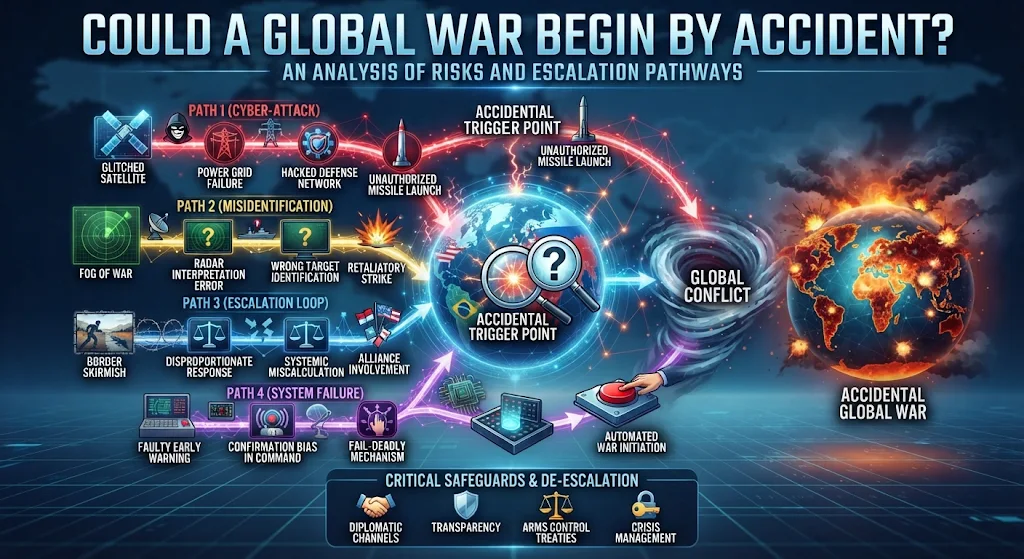
A global war would not necessarily begin with a government deliberately choosing to start one. It could emerge from a chain of events in which each side believes it is responding defensively, while decisions made under pressure steadily narrow the options for backing down. In a tense international environment, a regional crisis can expand when leaders misread an adversary’s intentions or mistake a limited action for preparation for a wider attack.
A direct Russia–NATO confrontation, for example, might begin with a military incident near a border or in contested airspace. A collision, an accidental crossing, or an exchange of fire could cause casualties and prompt demands for an immediate response. Alternatively, an attack on communications networks, power systems, or other critical infrastructure might be difficult to attribute at first. If officials interpret the disruption as a deliberate hostile act, they could authorize retaliation before reliable evidence establishes who was responsible or what the attacker intended.
In such circumstances, leaders may face intense pressure from the public, military advisers, and allies to demonstrate resolve. Waiting for facts can be portrayed as weakness, while a rapid response may be intended to deter further action. Yet the other side could read that response as preparation for a larger offensive and mobilize its own forces. Each move then becomes evidence, in the opposing government’s eyes, that its fears were justified. Communication failures, compressed decision timelines, and incomplete intelligence can make this cycle harder to interrupt.
Nuclear weapons make these misjudgments especially dangerous. Their presence raises the stakes of every confrontation, even when a crisis begins with conventional forces or a limited strike. Leaders may worry that delay will leave them vulnerable, or that an adversary is escalating toward a nuclear attack. That fear can encourage decisions based on worst-case assumptions rather than verified information. Preventing a regional crisis from widening therefore depends on reliable communication, careful assessment, and restraint while facts remain uncertain. The central risk is not simply that war might be chosen, but that escalation could outrun the intentions of those involved.
A rise in military tension or political hostility can make conflict more likely, but it does not make a global war inevitable. Risk describes a possibility, not a fixed outcome. Governments still make choices about how to interpret warnings, respond to incidents, and communicate with rivals. Even when mistrust is deep, leaders may decide that restraint better serves national interests than escalation. They can also face domestic, economic, and humanitarian costs that argue against widening a crisis. Recognizing these choices is not a reason to dismiss serious danger; it is a way to distinguish a warning from a certain prediction.
Diplomacy matters especially during crises, when fast-moving events and incomplete information can encourage worst-case assumptions. Direct negotiations give officials a means to state concerns, test proposals, and seek limited arrangements before positions harden. Talks need not resolve longstanding disputes to be useful; they can create pauses, clarify red lines, or establish steps for de-escalation. Such efforts may be difficult and vulnerable to political pressure, yet maintaining contact can preserve options that would otherwise disappear. Negotiation is not a guarantee of peace, but it can help leaders manage confrontation without treating every challenge as a reason to use force. Continued dialogue keeps that possibility open.
Military communication channels provide another practical safeguard. Hotlines, advance notifications, and meetings between military officials can clarify intentions and distinguish deliberate action from accidents, equipment failures, or misunderstandings. Rules for encounters at sea and in the air can reduce the chance that nearby forces misread one another’s movements. Arms-control agreements serve a related purpose by limiting certain weapons, setting verification expectations, and making capabilities more predictable. These arrangements depend on trust and cooperation, and they can weaken when states withdraw or stop sharing information. For that reason, safeguards require regular attention and political commitment. Their existence leaves room to reduce uncertainty and contain crises before they spread.
Security debates are often framed as contests between competing rights, but no single actor’s account captures the full picture. European governments have a legitimate right to strengthen their defenses, especially when they perceive threats to their territory, institutions, or allies. Investing in readiness, cooperation, and deterrence can be intended to reduce the likelihood of attack. At the same time, Russia describes certain military developments near its borders as challenges to its security and seeks to protect what it considers legitimate interests. Describing that perspective does not establish that its claims are decisive, or excuse conduct that directly threatens other states.
The United States, meanwhile, may debate the scale, cost, and geographic reach of its global commitments. Such reassessment is a sovereign policy choice, yet allies and rivals alike will interpret changes in deployments, guarantees, or diplomatic engagement. A decision intended to focus resources at home might be read abroad as withdrawal, opportunity, or pressure, depending on the circumstances. These interpretations matter because security policy is shaped not only by stated intentions but also by capabilities, timing, and historical experience. Governments cannot assume that measures they call defensive will automatically appear so to others. Nor should concern about perception erase a country’s right to protect its people; it should encourage clearer communication, proportionate choices, and channels for managing disagreement before tensions escalate.
Each actor therefore faces a responsibility to consider how its strategic decisions affect other countries. Military exercises, weapons deployments, alliance statements, and changes in commitments can influence threat assessments well beyond their immediate setting. When leaders overlook that wider impact, a step intended to reassure one population may alarm another, prompting countermeasures that deepen mistrust. This does not mean that every security choice must be abandoned to avoid criticism, or that all parties bear identical responsibility for escalation. It means that choices should be assessed alongside their likely consequences, including the risk of misreading signals or narrowing room for diplomacy. Recognizing competing interests is not a claim that every action is justified. It is a starting point for evaluating decisions carefully and reducing the chance that efforts to feel safer leave others—and ultimately everyone—less secure.
A major international conflict could affect North Macedonia and other Balkan countries even if combat remained far from the region. Disruption to oil and gas supplies, shipping routes, or energy infrastructure could push prices higher across Europe. Balkan economies, many of which depend on imported fuels and have limited capacity to absorb sudden cost increases, would be exposed to those changes. Households could face larger bills for heating, electricity, transport, and food as energy costs ripple through supply chains. Lower-income families would be especially vulnerable, while businesses could confront rising operating expenses and uncertainty about future prices.
At the same time, a conflict that weakened European growth could reduce demand for Balkan exports, investment, tourism, and cross-border services. Slower activity in key trading partners could affect employment and government revenues, leaving public budgets under pressure just as demands for assistance increased. Governments might need to expand energy subsidies or social support while also financing security measures and essential services. If these responses were poorly coordinated or fiscally difficult to sustain, public frustration could grow. Economic stress may also intensify political polarization, encourage disinformation, and sharpen disputes over migration, security, or relations with external powers.
Such pressures could strain cooperation among neighboring states, particularly if governments compete for energy supplies or adopt conflicting responses to economic disruption. Yet regional coordination can help countries manage shortages, protect critical infrastructure, and maintain reliable trade and transport links. For North Macedonia, cooperation with nearby countries and European partners is therefore a practical safeguard as well as a diplomatic priority. Expanding energy sources and routes, improving efficiency, and strengthening interconnections can reduce dependence on any single supplier or corridor. These measures cannot prevent every external shock, but they can limit its reach and support more predictable costs for households and businesses. Energy diversification and stable relations among neighboring countries are vital national interests: together, they reduce exposure to crises beyond the region’s control and improve the Balkans’ capacity to withstand a wider conflict.