

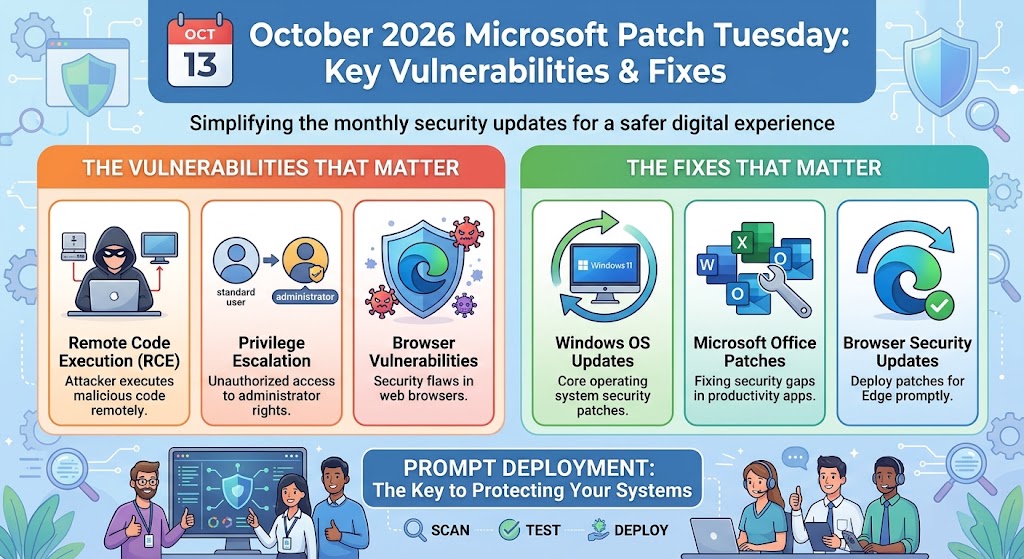
Microsoft’s October 2026 Patch Tuesday release is unusually broad: the company addressed 1,413 vulnerabilities, compared with 999 in September. That increase makes this month’s package a substantial maintenance event for organizations and individual users. Approximately 70 vulnerabilities were rated Critical, while most of the remaining issues were classified Important. These totals cover security fixes across Microsoft products, not a single Windows update, so administrators should check which products and update channels apply to their environments before planning deployment.
The affected estate includes Windows 11 version 24H2 Home and Pro, Windows 10 Enterprise LTSB 2016, and Windows Server 2022, alongside other Windows editions and Microsoft products. Not every listed product receives the same package, and applicability can differ by version, edition, and servicing status. IT teams should verify the relevant release notes and inventory their devices to identify which systems need each update. This is particularly important in mixed environments, where supported client and server versions may follow different servicing schedules.
October also marks a lifecycle transition for two widely deployed platforms. This release is the final update for Windows 11 version 24H2 Home and Pro, making a supported upgrade path important for users who want to continue receiving security fixes. Windows Server 2022 has entered extended support, a phase with different lifecycle terms from mainstream support. Administrators should review Microsoft’s lifecycle guidance and plan accordingly, rather than assuming that all products continue to receive the same types of updates or support benefits.
The scale of the release and the number of Critical issues make prompt assessment essential, but severity labels are only one part of risk. Exposure depends on factors such as whether a vulnerable component is enabled, whether a system is reachable, and what protections are already in place. Organizations should prioritize internet-facing and business-critical systems, assess available mitigations, test updates where operationally necessary, and deploy them without avoidable delay. Home users should install applicable updates through Windows Update and confirm that their devices remain on a supported release.
Among October’s security updates, CVE-2026-96951 in Windows Shell stands out because Microsoft reports that attackers exploited it before a patch was available. Rated 8.8, this command-injection vulnerability can bypass Mark of the Web warnings that normally alert users when downloaded files may be unsafe. The flaw is not described as a silent, zero-click attack: exploitation requires a user to open a malicious file or follow a malicious link. That interaction requirement does not remove the risk, particularly when attackers can persuade users to open content that appears trustworthy. CISA added the vulnerability to its Known Exploited Vulnerabilities catalog on October 13, 2026, and set October 16 as the remediation deadline for U.S. federal agencies.
CVE-2026-108398, also rated 8.8, affects .NET Framework and involves an insecure search-path issue. It can allow an attacker to bypass Windows Defender Application Control, a security feature used to restrict which applications and code may run. The severity rating is the same as that of the Windows Shell flaw, but the available evidence differs: no attacks exploiting CVE-2026-108398 were reported. A high severity score signals potential impact under the rating methodology; it does not, by itself, establish that a vulnerability is being actively exploited. Organizations should still apply the relevant framework updates and assess where WDAC is used to enforce software restrictions.
CVE-2026-92707 affects MessagePack-CSharp and is rated 5.3. Uncontrolled memory allocation can let a remote attacker cause denial of service over a network, without authenticating to the target. The issue was publicly known before fixes were released, but public disclosure is not the same as confirmed exploitation: no active attacks are established by that fact alone. Likewise, its lower score does not mean the flaw is irrelevant to services that process untrusted MessagePack data. Administrators should distinguish three separate signals when prioritizing these fixes: confirmed exploitation, prior public knowledge, and rated severity. The Windows Shell flaw combines active exploitation with a high rating; the .NET issue is severe without reported attacks; and the MessagePack flaw is disclosed and potentially disruptive, but carries a lower rating.
Microsoft’s October 2026 security release reportedly includes about 60 vulnerabilities that can be exploited remotely without authentication or user interaction. That combination raises the stakes for services reachable over a network: attackers may be able to target exposed systems without first obtaining credentials or persuading a user to open a file. Organizations should therefore treat internet-facing and broadly accessible infrastructure as a priority when assessing this month’s fixes.
Several Critical-rated vulnerabilities carry a CVSS score of 9.8. They include CVE-2026-96934 in DHCP Server; CVE-2026-100219 and CVE-2026-105016 in Microsoft QUIC; and CVE-2026-97814 in Windows Text Shaping. These affected components serve different roles, so exposure depends on how each product is deployed and configured. A high severity score signals urgency, but does not by itself establish that a particular organization is vulnerable or that exploitation is occurring.
Other network-related issues also warrant close review. CVE-2026-100222, a heap overflow in Network Policy Server/RADIUS, and CVE-2026-85806, an integer underflow in the same area, are both scored 9.8 while classified as Important. The distinction in Microsoft’s severity label should not obscure the potential consequences for systems that process authentication and network access requests. The release also addresses PostScript printer-driver flaws CVE-2026-70147 and CVE-2026-70153, each rated 9.8. CVE-2026-100202 affects MSMQ Queue Manager through a use-after-free condition that can lead to code execution.
To set a practical patching order, teams should inventory services exposed to the internet and those reachable from large internal network segments, then map those assets to the affected Microsoft products. Apply relevant updates promptly, especially where vulnerable services are enabled or reachable by untrusted parties. Where immediate patching is not possible, evaluate temporary mitigations carefully and confirm that they apply to the organization’s exact product version and configuration. Microsoft’s product-specific security guidance should inform both mitigation choices and post-update validation. Monitoring for unusual activity can complement remediation, but should not substitute for installing applicable fixes.
Microsoft’s October 8 service-side fixes address several severe cloud and business-application vulnerabilities. Partner Center’s certificate-validation flaw, CVE-2026-96207, carries a CVSS score of 10.0, while the Bookings authorization bypass, CVE-2026-94510, is rated 9.9. Microsoft also fixed unauthenticated code-execution vulnerabilities in Dataverse (CVE-2026-88131) and Azure App Service (CVE-2026-77900); both are rated 9.8. These corrections were applied directly to Microsoft-managed services, so customers do not need to install updates or take action for these specific issues.
Enterprise software requires a different response: administrators should review applicable advisories and install the relevant updates. Exchange Server’s stack buffer overflow, CVE-2026-70571, is rated 8.1 and can be exploited through a specially crafted email. Microsoft considers exploitation more likely. Active Directory Domain Services has a code-execution flaw, CVE-2026-70229, also rated 8.1, that applies under certain configurations. SharePoint’s signature-validation issue, CVE-2026-102866, carries the same rating and could permit token manipulation and impersonation. The supplied brief reports no exploitation for these enterprise vulnerabilities.
Office users should also check their update status. Five Critical Outlook vulnerabilities are rated 9.8 and may be triggered when a crafted email is previewed, without requiring the recipient to click a link or attachment. Word’s CVE-2026-70300 involves a WordPerfect document containing a linked graphic. PowerPoint’s CVE-2026-88178 concerns a crafted presentation opened through Office Online. No exploitation was reported for the Word or PowerPoint issues in the brief. Some Office updates are missing for Mac LTSC 2021 and 2024, so organizations using those editions should verify availability and coverage in Microsoft’s release information.
SQL Server should be included in routine patch checks. However, the supplied summary provides no SQL Server vulnerability identifiers or technical details; consult the relevant Microsoft advisory for affected versions and remediation guidance rather than assuming particular flaws or fixes. For all customer-managed products, confirm applicability against deployed versions and configurations, then prioritize installation according to Microsoft’s guidance and internal change-control requirements.