

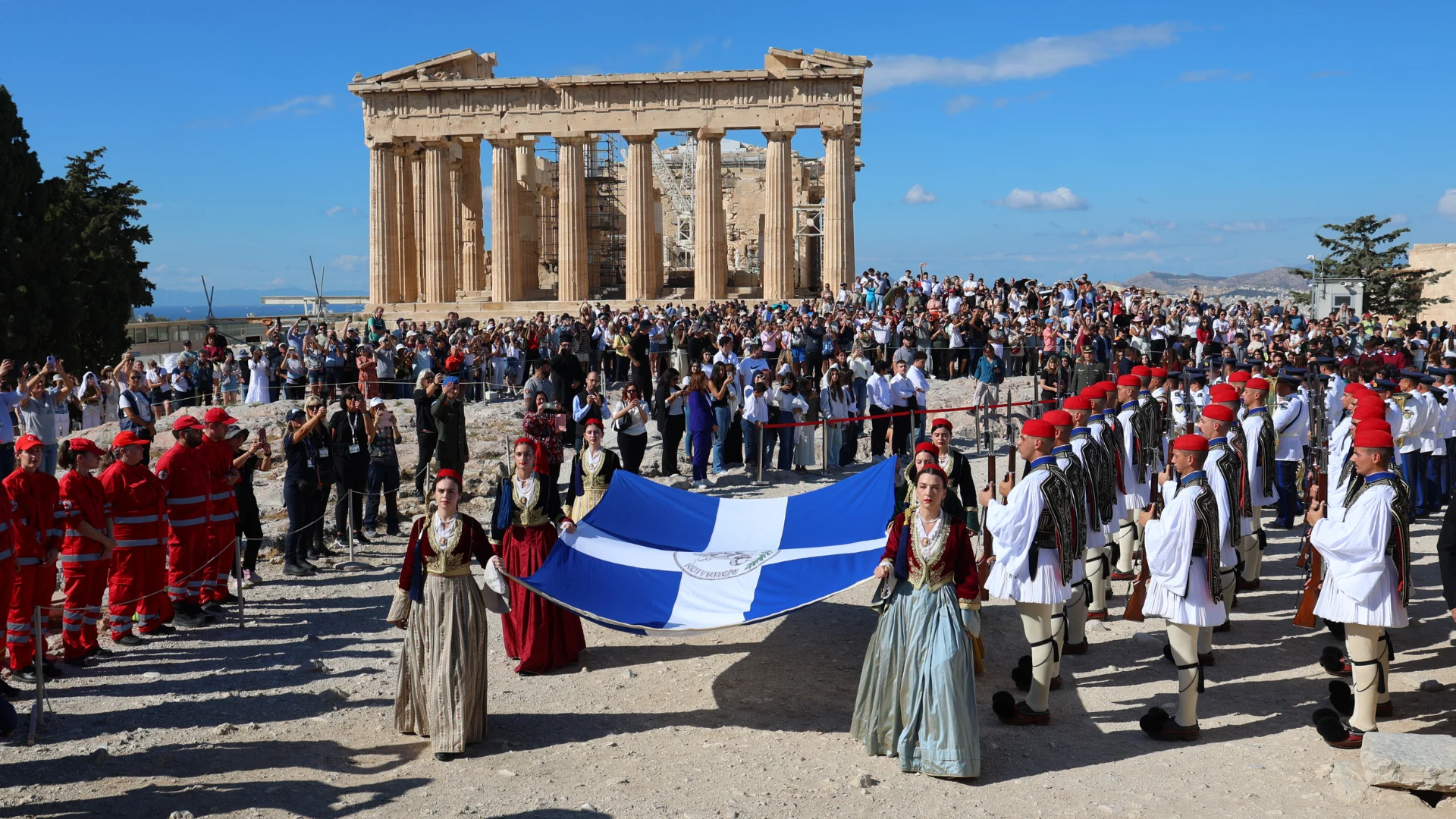
Athens Marks 82 Years of Freedom with Acropolis Flag Ceremony
At 11:00 on Monday, Athens will mark the 82nd anniversary of its liberation with a commemorative flag-raising ceremony on the Acropolis. The event places the observance at one of the city’s most recognizable historic sites, where Greece’s blue-and-white national flag will be raised above the capital. Its setting gives the occasion a public focus: remembering Athens’s liberation through a formal civic act at a landmark closely associated with the country’s past. The stated program centers on this act, scheduled for the late morning, and does not require assumptions about additional activities or speeches. It is a formal moment of remembrance.
Raising the flag at the Acropolis carries significance beyond the mechanics of a ceremonial gesture. The blue-and-white colors identify Greece’s national flag, and their appearance over this ancient site links a contemporary civic observance with a place that has long stood at the center of Athens’s historical identity. The ceremony therefore marks liberation in a setting that is both distinctly local and nationally meaningful. The account of the occasion remains focused on that connection: a flag raised above the city, on an anniversary that recalls Athens’s return to freedom. No further interpretation is needed to describe the importance of the site and symbol together.
Expected to attend are President of the Republic Constantine Tassoulas and Athens Mayor Haris Doukas. Their anticipated presence gives the observance official representation from the national and municipal levels. The event’s stated details identify the time, location, anniversary, flag-raising, and these expected attendees; they do not establish any further program items or remarks. Accordingly, the ceremony can be described plainly as a commemorative gathering centered on raising the Greek flag on the Acropolis. At 11:00, that act will provide the visible marker of Athens’s 82nd anniversary of liberation, bringing a historic landmark into the city’s annual remembrance without embellishing the announced facts.
German troops withdrew from Athens in October 1944, bringing to a close roughly three and a half years of occupation. For residents of the Greek capital, the departure marked a decisive change in daily life and in the political condition of the city. The period had placed Athens under foreign control and imposed severe hardships on its population. Although the withdrawal did not erase the difficulties experienced during those years, it ended the occupation of the capital and opened a new chapter in its public life. The moment is remembered as a turning point in Greece’s modern history.
With the departure of German forces, Athens returned to Greek control, allowing the capital to resume its place as the country’s national center. The change carried practical significance, but it also had a powerful public meaning: the city was no longer occupied. For people who had lived through years of restriction and uncertainty, the end of the foreign military presence signaled the possibility of recovery and self-government. The transition did not resolve every challenge facing Greece. Instead, it marked the restoration of freedom in the capital and the beginning of a difficult period of rebuilding after occupation.
The return of the Greek national flag to public view gave visible expression to this change. Its appearance in Athens represented the restoration of national sovereignty and the end of a period in which the city had been governed under occupation. The flag’s renewed presence connected the experience of liberation with the identity of the Greek state, offering a shared symbol at a moment of transition. Remembering the withdrawal therefore involves more than recalling a military departure: it recognizes the return of the capital to freedom and the renewed ability of its people to see their national flag flying in their city.
When Athens was liberated in October 1944, the city’s streets filled with people who had endured years of occupation, deprivation and uncertainty. Thousands poured into public spaces, emerging from homes and gathering along roads and squares to share the news and welcome the end of German rule. The crowds were more than spectators: their presence made the moment a public expression of relief after a prolonged period in which daily life had been shaped by shortages, fear and loss.
Celebrations brought strangers together in a common response. People greeted one another, cheered and raised their voices, turning the city into a scene of collective emotion. For many Athenians, the joy of liberation was inseparable from what had come before. The occupation had left deep hardship and grief, so the festivities did not erase those experiences; they offered a chance to acknowledge that a difficult chapter had ended and that the city could begin to recover. In the streets, relief and hope were visible alongside the memory of those who had suffered.
The return of the Greek flag to the Acropolis gave this shared celebration a powerful focus. Above the city, the national emblem signalled that Athens was again under Greek control, while the gatherings below showed how strongly residents welcomed that change. The flag ceremony linked a historic landmark with the everyday lives of people filling the streets, connecting national restoration to the restoration of the capital itself. As Athenians celebrated, their presence affirmed a renewed civic life and a sense of belonging that occupation had sought to suppress. The crowds’ response therefore captured both the immediate happiness of freedom and the larger hope of rebuilding Athens after years of foreign rule.
After the Greek flag is raised above the Acropolis, the anniversary observances will continue with a wreath-laying ceremony at the Tomb of the Unknown Soldier. The sequence moves from a landmark visible across Athens to a memorial at the center of the city, joining a public symbol of national freedom with a quiet act of remembrance. At the tomb, the wreath will honor those whose names and individual stories may be unknown, but whose sacrifice remains part of the country’s history.
The ceremony is a tribute to all who lost their lives in war. Its formal gestures offer a moment to recognize the human cost borne by soldiers and others caught in conflict, and to reflect on the lives given in the struggle for freedom. In the setting of an anniversary marking liberation, the observance also gives remembrance a central place alongside celebration. It asks those present to consider not only the achievement of independence, but also the loss and hardship that accompanied the path to it.
The flag-raising and the wreath-laying convey distinct but connected meanings. High above the city, the flag represents a nation’s return to freedom and the continuity of its public life. At the Tomb of the Unknown Soldier, the wreath expresses gratitude and mourning for those who did not live to see that freedom secured. Together, the ceremonies frame Athens’s commemoration as both an affirmation of liberation and an acknowledgment of its cost. They connect the city’s visible symbols with a lasting duty to remember those who served and fell, ensuring that the anniversary honors not only the moment of release, but also the people whose sacrifice helped make it possible.