


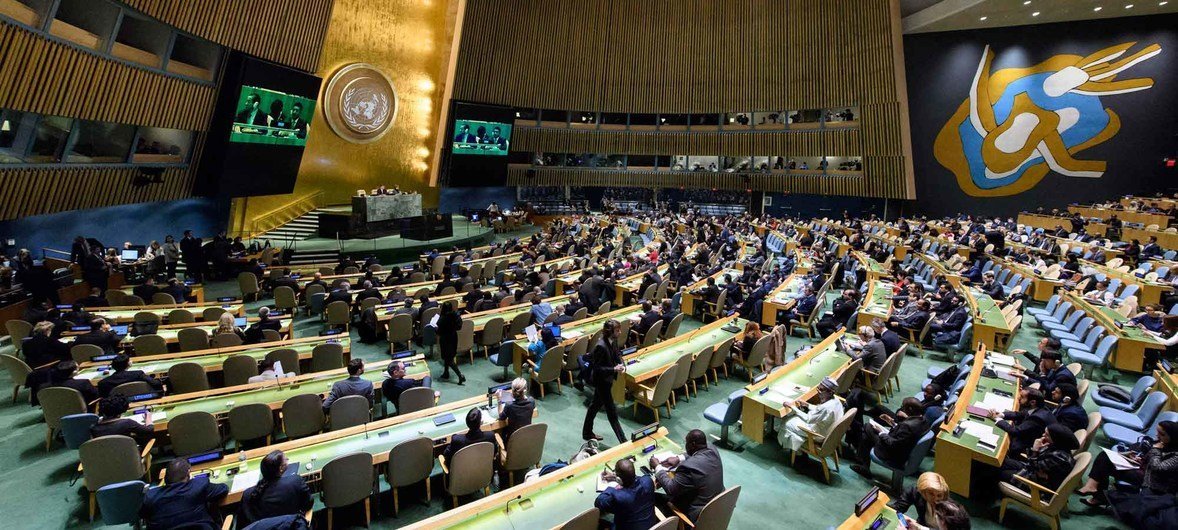
Overview of the General Assembly Debate
The backdrop of the recent UN General Assembly debate centered around the significant and often contentious role of the United States in matters of international peace and security. Specifically, the discussion was framed within the context of the ‘veto initiative,’ which serves as a mechanism for member states to critique particular veto actions taken by permanent members of the Security Council. This debate gained traction following the US’s substantive decision to veto a ceasefire resolution aimed at alleviating the humanitarian crisis in Gaza, a move that drew widespread condemnation from various nations.
At the core of the assembly’s proceedings was the objective to establish a forum where global criticisms of the US’s veto could be aired and where alternative solutions to the ongoing conflict in Gaza could be explored. This meeting was not merely a rhetorical exercise; it was an essential gathering for international stakeholders as it illuminated the broader implications of unilateral actions by powerful nations, particularly in the context of armed conflicts and humanitarian crises.
United States’ Justification and Proposed Peace Plan
The recent actions by the United States in the context of the UN General Assembly debate have raised significant discussion regarding its justification for vetoing a resolution related to the ongoing conflict involving Israel and Hamas. Central to the U.S. rationale is the perception of Hamas as a terrorist organization, which, according to U.S. officials, undermines peace efforts in the region. The U.S. firmly asserts Israel’s right to defend itself, stating that any peace plan must acknowledge this right in light of the continued threats posed by Hamas. This defense is rooted in the belief that without a secure environment, sustainable peace cannot be achieved.
In this regard, President Donald J. Trump’s proposed peace plan, unveiled in early 2020, has been a focal point of discussion. The plan outlines several critical components aimed at resolving the long-standing Israeli-Palestinian conflict. Notably, it includes provisions for a ceasefire, coupled with a call for the release of hostages held by Hamas. The disarmament of Hamas is also highlighted as a non-negotiable element, aimed at ensuring that militant activities do not continue to threaten Israel and destabilize the region.
Furthermore, the peace plan enhances economic redevelopment prospects for the Palestinian territories, addressing the dire humanitarian situation and fostering a climate conducive to lasting peace. U.S. officials have criticized the UN resolution as lacking sufficient measures for holding Hamas accountable and promoting Israel’s security, arguing that only through direct negotiations can a viable solution be reached. The perspective of both the United States and Israel underscores a commitment to achieving safety and prosperity in the region through what they believe to be a balanced approach, albeit one that requires challenging existing perceptions within the international community.
Responses from Palestine and Arab States
The recent veto by the United States regarding resolutions aimed at addressing the humanitarian crisis in Gaza has elicited strong responses from Palestinian representatives and various Arab states. The ongoing conflict has raised serious concerns about the implications for peace in the region, with many viewing the US action as detrimental to the stability necessary for a two-state solution. Palestinian officials have reaffirmed their commitment to a peaceful resolution based on international law, perceiving the US peace plan with caution. They argue that genuine reconciliation requires a halt to hostilities and a commitment to addressing humanitarian needs.
In statements following the veto, leaders from Egypt, Jordan, and Saudi Arabia have emphasized the urgent necessity for a ceasefire to alleviate the suffering in Gaza. Egypt has called for immediate international action to prevent further civilian casualties, advocating for renewed negotiations that respect the rights of both Israelis and Palestinians. Meanwhile, Jordan has reiterated its stance, stressing the importance of the two-state solution as the only viable path to lasting peace. King Abdullah II urged the international community to adopt a more balanced approach that holds all parties accountable, including Israel, for its military actions.
Saudi Arabia, reflecting the sentiment of many Arab leaders, condemned the tactics employed by Israel during the ongoing conflict and highlighted the need for humanitarian aid to reach those affected. The kingdom’s officials have also urged the United States to reconsider its position, arguing that a fair peace plan must prioritize the rights and dignity of the Palestinian people. Collectively, these voices underscore a shared commitment among Arab states to support Palestinian aspirations while advocating for a stable and secure region, capable of achieving lasting peace through mutual respect and dialogue.
International Criticism and Calls for Reform
The United States’ veto power within the United Nations Security Council has drawn considerable criticism from various nations, particularly in relation to issues surrounding the Middle East, such as the ongoing conflict in Gaza. Countries like Iran, South Africa, and Russia have vocally opposed the US stance, characterizing its vetoes as detrimental not only to immediate peace efforts but also to the overall functioning of the UN Security Council. This criticism highlights a growing concern among international actors regarding the implications of the US’s unilateral decision-making process.
Iran, for instance, has condemned the US for its perceived partiality, arguing that the continued application of the veto power undermines the principles of justice and equity that the UN was founded upon. They have asserted that such actions exacerbate the humanitarian crises faced by Palestinian civilians, portraying the US as an obstacle to achieving peace in the region. South Africa has echoed this dissent, emphasizing that the veto power held by the US serves as a barrier to meaningful negotiations and dialogue necessary for resolving longstanding conflicts.
Russia’s position further builds upon this sentiment, calling for a reevaluation of the veto power system itself. Russian officials have articulated that reliance on the veto as a tool can stall progress and encourage polarization among member states, ultimately impacting the council’s ability to address pressing global issues effectively. In light of these discussions, several nations have initiated calls for reform within the UN Security Council framework. Many propose a reexamination of the veto’s role and its implications for international law and multilateral diplomacy, perceiving it as a significant barrier to achieving lasting peace and justice on a global scale. The ongoing debate reflects the urgent need for a renewed consensus on how the UN can effectively champion peace initiatives worldwide.
Frequently Asked Questions
I conceive this site contains very good written subject matter blog posts.


I have read some good stuff here. Certainly worth bookmarking for revisiting. I wonder how much effort you put to create such a wonderful informative site.
Have you ever thought about writing an e-book or guest authoring on other blogs? I have a blog based on the same topics you discuss and would love to have you share some stories/information. I know my audience would value your work. If you’re even remotely interested, feel free to shoot me an email.
I love your blog.. very nice colors & theme. Did you create this website yourself? Plz reply back as I’m looking to create my own blog and would like to know wheere u got this from. thanks
Really instructive and good anatomical structure of subject matter, now that’s user genial (:.
Dead composed subject material, regards for selective information.
hello there and thank you on your info – I’ve certainly picked up anything new from right here. I did alternatively expertise a few technical points the usage of this web site, as I experienced to reload the site lots of instances prior to I may just get it to load correctly. I had been wondering if your web hosting is OK? Now not that I am complaining, but slow loading circumstances times will often impact your placement in google and can damage your high-quality rating if ads and ***********|advertising|advertising|advertising and *********** with Adwords. Anyway I’m including this RSS to my email and could glance out for a lot extra of your respective fascinating content. Make sure you replace this once more soon..
Hello my loved one! I want to say that this article is awesome, great written and come with approximately all vital infos. I would like to look more posts like this .
I have not checked in here for a while since I thought it was getting boring, but the last several posts are good quality so I guess I will add you back to my everyday bloglist. You deserve it my friend 🙂
Hello there, I found your site via Google while searching for a related topic, your website came up, it looks great. I’ve bookmarked it in my google bookmarks.
you may have an ideal weblog right here! would you prefer to make some invite posts on my weblog?
I like what you guys are up too. Such clever work and reporting! Carry on the superb works guys I’ve incorporated you guys to my blogroll. I think it will improve the value of my web site :).
Magnificent web site. Plenty of useful info here. I am sending it to several friends ans also sharing in delicious. And obviously, thanks for your sweat!
Thanks for one’s marvelous posting! I quite enjoyed reading it, you can be a great author.I will ensure that I bookmark your blog and definitely will come back down the road. I want to encourage one to continue your great posts, have a nice afternoon!
Howdy! This is kind of off topic but I need some advice from an established blog. Is it difficult to set up your own blog? I’m not very techincal but I can figure things out pretty fast. I’m thinking about making my own but I’m not sure where to begin. Do you have any ideas or suggestions? Thank you
Keep working ,remarkable job!
I conceive this site contains very good written subject matter blog posts.